Alibaba's HK$80 Billion Share Sale Is the AI Bill Landing on Shareholders
Priced at a 3.6% discount and confirmed complete this week, the first placing since Alibaba's Hong Kong listing sends HK$80 billion into full-stack AI. The June quarter shows why equity was the only lever left: RMB 44.7 billion of cash burned in three months while profit fell 75%.
 Vincent Jiang · 3 min read
The cash clock turned in September
On 29 September the consensus on Alibaba's cash generation flipped: TIKR's estimate for next-twelve-month levered free cash flow moved to about minus RMB 16 billion, from plus RMB 48 billion on 30 June, with nothing positive expected before fiscal 2028 1. The same day, as Eddie Wu unveiled the Zhenwu V900 chip and the Hong Kong shares jumped 5.1%, CFO Toby Xu filed a US$1.41 million stock sale, no reason given, and the ADRs closed at $107.74, down 26.5% for 2026 21.
The first Hong Kong placing is done
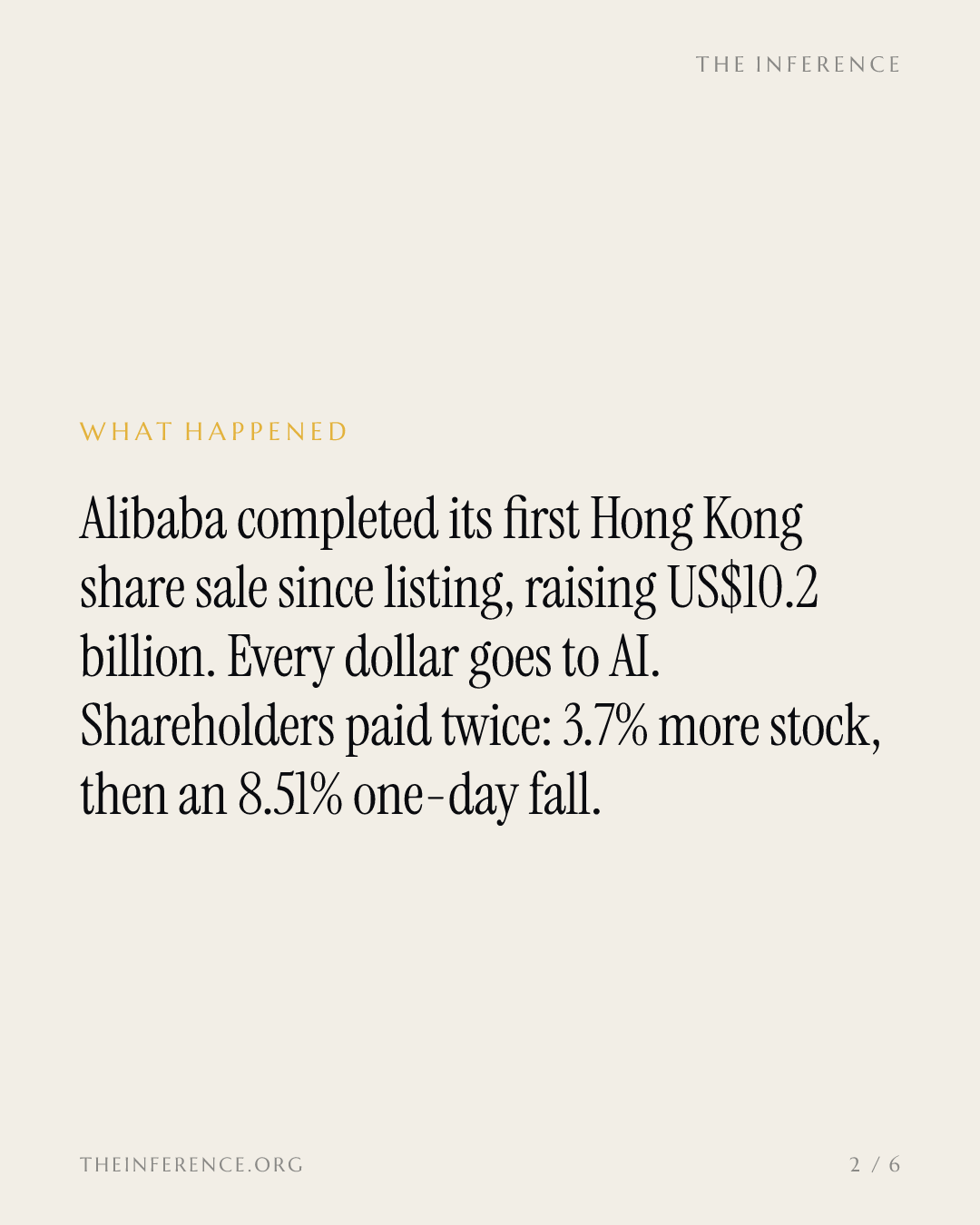
Days later came the mechanism: Alibaba has completed the HK$80 billion placing, its first since the Hong Kong listing, with every dollar of net proceeds committed to full-stack AI 34. The 710 million shares went out at HK$112.70 on 23 August, a 3.6% discount, raising US$10.2 billion: the largest primary follow-on a Hong Kong-listed company has sold 56.
They spread future earnings across roughly 3.7% more stock 1. Demand overshot, sovereign wealth funds in the book, yet the stock fell 8.51% the next day, to HK$112.5 64.
The shops stopped paying
The June quarter is why equity was the only lever left. Revenue rose 9% to RMB 268.95 billion while net income fell 75% to RMB 10.44 billion 7. Adjusted EPS of RMB 8.52 missed the RMB 10.53 consensus, the fifth straight miss 81. Free cash flow ran at minus RMB 44.67 billion, against minus RMB 18.82 billion a year earlier, on capex up 75% to RMB 67.68 billion; cash and liquid investments fell RMB 46.3 billion, to RMB 474.5 billion 7.
Quarterly net income has fallen from $6.7B to $1.6B since late 2024
Data
| Net income | |
|---|---|
| Q3 '23 | $3.82B |
| Q4 '23 | $2.05B |
| Q1 '24 | $0.47B |
| Q2 '24 | $3.36B |
| Q3 '24 | $6.27B |
| Q4 '24 | $6.73B |
| Q1 '25 | $1.73B |
| Q2 '25 | $5.67B |
| Q3 '25 | $2.95B |
| Q4 '25 | $2.34B |
| Q1 '26 | $3.71B |
| Q2 '26 | $1.56B |
E-commerce still pays for the lab's burn
The funder is stalling. Customer management revenue fell 7%, up 1% like-for-like, and e-commerce adjusted EBITA slipped 1% to RMB 39.75 billion even as quick-commerce revenue grew 45% 7.
Cloud is the one segment that pays for itself: revenue up 45% to RMB 48.44 billion, adjusted EBITA up 133% to RMB 5.63 billion 7. AI Labs and Applications lost RMB 13.86 billion, a loss 330% wider 7. The shop still earns RMB 39.7 billion a quarter; the lab now spends more than a third of it.
E-commerce still pays for the AI lab's burn
Data
| Value | |
|---|---|
| E-commerce | RMB 39.75B |
| AI Cloud & Compute | RMB 5.63B |
| AI Labs & Apps | -RMB 13.86B |
The chip is the cost lever
Wu says AI capex breaks even within three years, payback shortening to 2.5 years as T-Head's own silicon replaces bought-in chips; half the RMB 380 billion three-year plan is spent 8. Goldman Sachs sizes the 20-gigawatt-by-2032 target at RMB 200–300 billion a year 4. The V900, three times faster than its predecessor and in mass production in early 2027, is meant to bend that curve toward Wu's goal of more than US$100 billion a year in external cloud and AI revenue 2.
Two camps, one quarter to decide
Twenty-one analysts sit at Moderate Buy, average target USD 187.05, on a stock below its 50- and 200-day moving averages 3. The bull case is a mechanism, not a mood: cloud EBITA compounding at 133% inside a fixed RMB 380 billion envelope 78. Tsai and Wu bought US$15.3 million of shares in August; Toby Xu sold US$1.41 million on 29 September 1. The September-quarter report, which landed on 25 November last year, carries consensus near RMB 11 per ADS 1. A sixth miss would say the bill is still growing.
Deepdive
AI-generated from this story and its cited sources. Not investment advice.