DeepSeek Doubles Revenue to $1B, Then Passes the Bill to Investors With No Votes
The lab that sold the world a $6 million training run crosses $1 billion in annualized revenue only after raising prices up to 4.5 times, and is closing a second $7.45 billion round at about $75 billion with a Shanghai listing in preparation. Minority investors get a five-year lockup and no votes; Liang Wenfeng keeps about 84% of the economics.
 Vincent Jiang · 3 min read
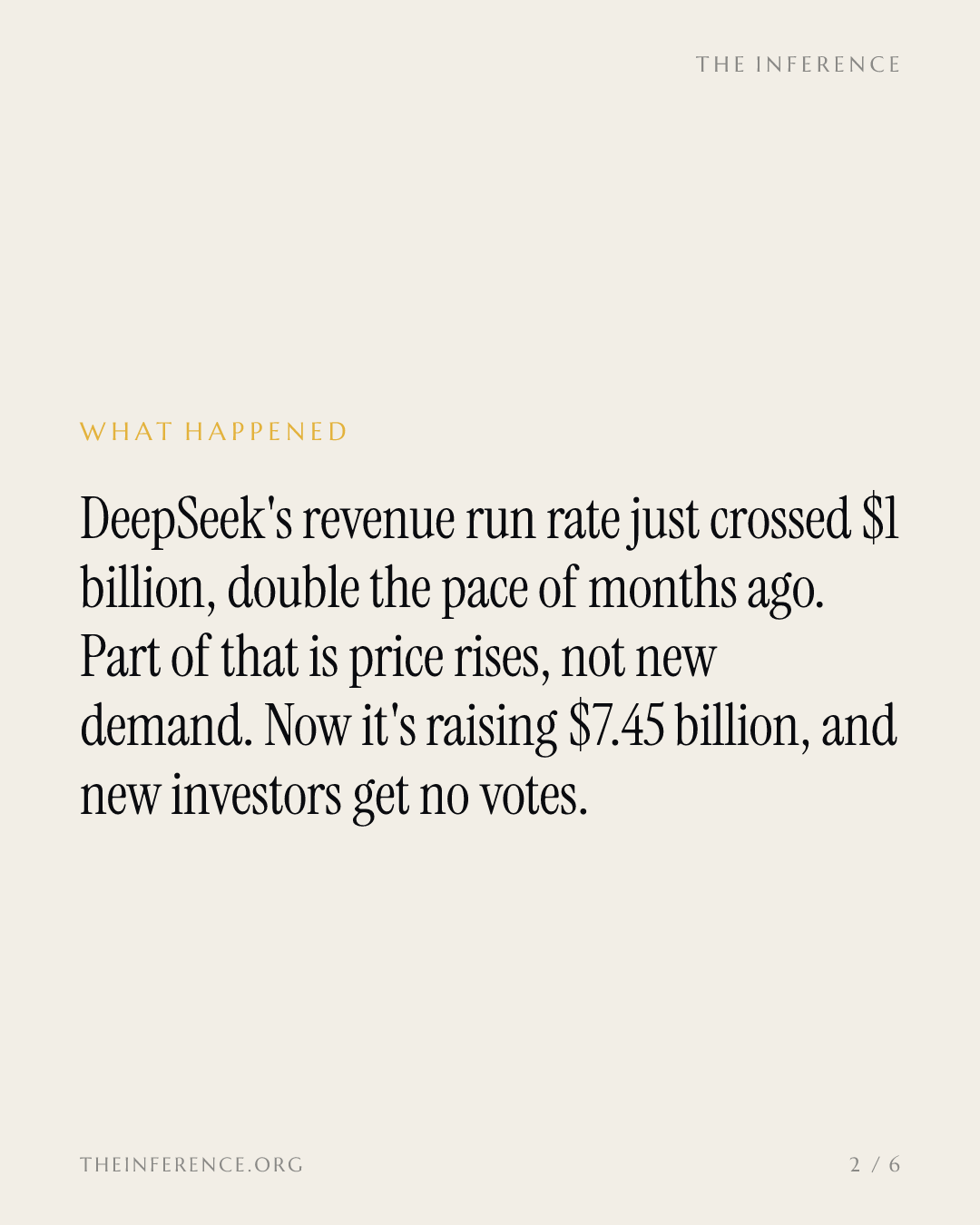
Liang Wenfeng took a fresh number to his investors: DeepSeek's annualized revenue run rate has crossed $1 billion, more than double the pace of a few months ago 123. A run rate projects what twelve months of the current pace would bring in; it is not booked revenue 3. Part of the doubling is price, not demand: the lab lifted model prices by 2.3 to 4.5 times 3.
The round buys the next training run
The same meetings carried a more telling figure: more than 70% of DeepSeek's compute still goes to training new models, under 30% to serving the customers who generate the revenue 3. The second round now closing targets 50 billion yuan ($7.45 billion) at a 500 billion yuan valuation, about $75 billion, by the end of October 345. It was suspended once in July, then revived in August at nearly $8 billion, with the stated uses being compute, model development and talent 45. At that price, investors would pay roughly 75 times the run rate the founder just disclosed 34.
No votes, five years locked, 84% for Liang
June's first outside round took in about $7.4 billion at more than $50 billion post-money; Liang put in 20 billion yuan of it himself, Tencent 10 billion, CATL 5 billion 5. Outside backers bought units in a limited partnership Liang controls, carrying a five-year lockup and zero votes; the state AI fund invested directly and is the only holder with votes and no lockup 6. Liang reportedly keeps about 84% of the economics and near-total control 1. CITIC Securities is hired for a STAR Market listing meant to begin this year, size and timing undecided 5.
DeepSeek's second round prices it at $75B, up half again from June
- Amount raised
- Post-money valuation
- Estimate
Data
| Amount raised | Post-money valuation | |
|---|---|---|
| June 2026 round | $7.4B | $50B |
| October 2026 round (estimate) | $7.45B | $75B |
MiniMax already walked this path
MiniMax doubled on its January Hong Kong debut and later sank to roughly a quarter of that level, a slide that followed its May announcement of STAR Market exploration 17. Its first half did not help: $116.6 million of revenue, an adjusted net loss that doubled to $293 million, and an $800 million ARR figure annualized from a single week of August 89.
DeepSeek's $1B run rate lands second among China's AI labs
- Estimate
Data
| Value | |
|---|---|
| Z.ai (Zhipu) (estimate) | $1.6B |
| DeepSeek (estimate) | $1B |
| MiniMax (estimate) | $0.8B |
The bull case has a ceiling
Demand held through the price hike 3, and Hong Kong does pay for delivered revenue: Z.ai has climbed from a $7.1 billion IPO valuation toward a $54 billion market value, roughly 34 times its claimed $1.6 billion ARR 158. What the bulls cannot yet price is a run rate that doubles on a price rise, a round that stopped once 4, and a listing path that has already broken one peer's stock 17.
The close comes first, then the filing
The end-October close is the first marker; a STAR filing is the second. The legend was a $6 million training run 1. The business is two rounds worth nearly $15 billion in five months, and the next model has to carry both 35.
How this brief was made
01Gathered & sourced181 channels · 1,721 articles▾
Agents swept 181 channels and ingested 1,721 articles, then de-duplicated and ranked them for signal.
02Verified & cross-validated9 claims · 24 data feeds▾
Every one of 9 load-bearing claims was checked against primary sources, with 24 live data feeds reconciling the figures and charts.
- 1WowTale, DeepSeek's Revenue Tops $1B as It Pursues $7.5B Round and Shanghai IPO, 27 September 2026
- 2The Information (Juro Osawa, Qianer Liu), DeepSeek's Annualized Revenue Hits $1 Billion as Startup Finalizes $7.5 Billion Fundraising, 23 September 2026
- 3Reuters, China's DeepSeek annualised revenue run rate hits $1 billion, the Information reports, 24 September 2026
- 4Reuters, DeepSeek resumes funding round seeking nearly $8 billion, 6 August 2026
- 5Reuters, Exclusive: China's DeepSeek taps CITIC Securities for domestic IPO, sources say, 9 September 2026
- 6Forbes (Anisha Sircar), DeepSeek Just Raised $7.4 Billion. Here's The Catch., 17 June 2026
- 7Reuters, China's AI startup MiniMax explores Shanghai STAR Market listing, 31 May 2026
- 8South China Morning Post (Minxiao Chang, Xinmei Shen), Are Z.ai and MiniMax heading down opposite financial paths months after Hong Kong IPOs?, 3 September 2026
- 9MiniMax Group (HKEX: 00100) interim results via PR Newswire, MiniMax Announces First Half 2026 Financial Results, 26 August 2026
03Reviewed & edited1 human editor▾
One editor read the draft against the evidence, tuned the framing, and signed off before it shipped.
Become a contributor
Reporting on the business of AI and want it read? We take pitches from outside contributors who bring primary sources and a number worth arguing about.
Deepdive
AI-generated from this story and its cited sources. Not investment advice.