Everspin's CXL MRAM demo is a sales call, and the rig on the crate shows it
Everspin's world-first CXL-MRAM demo rests on 4GB of memory carried over PCIe Gen3, and a company with $80.3M raised in 23 years cannot fund the volume manufacturing the pitch implies. Who pays, who benefits, and what Infineon's $1.12B memory exit says about the odds.
 Vincent Jiang · 3 min read
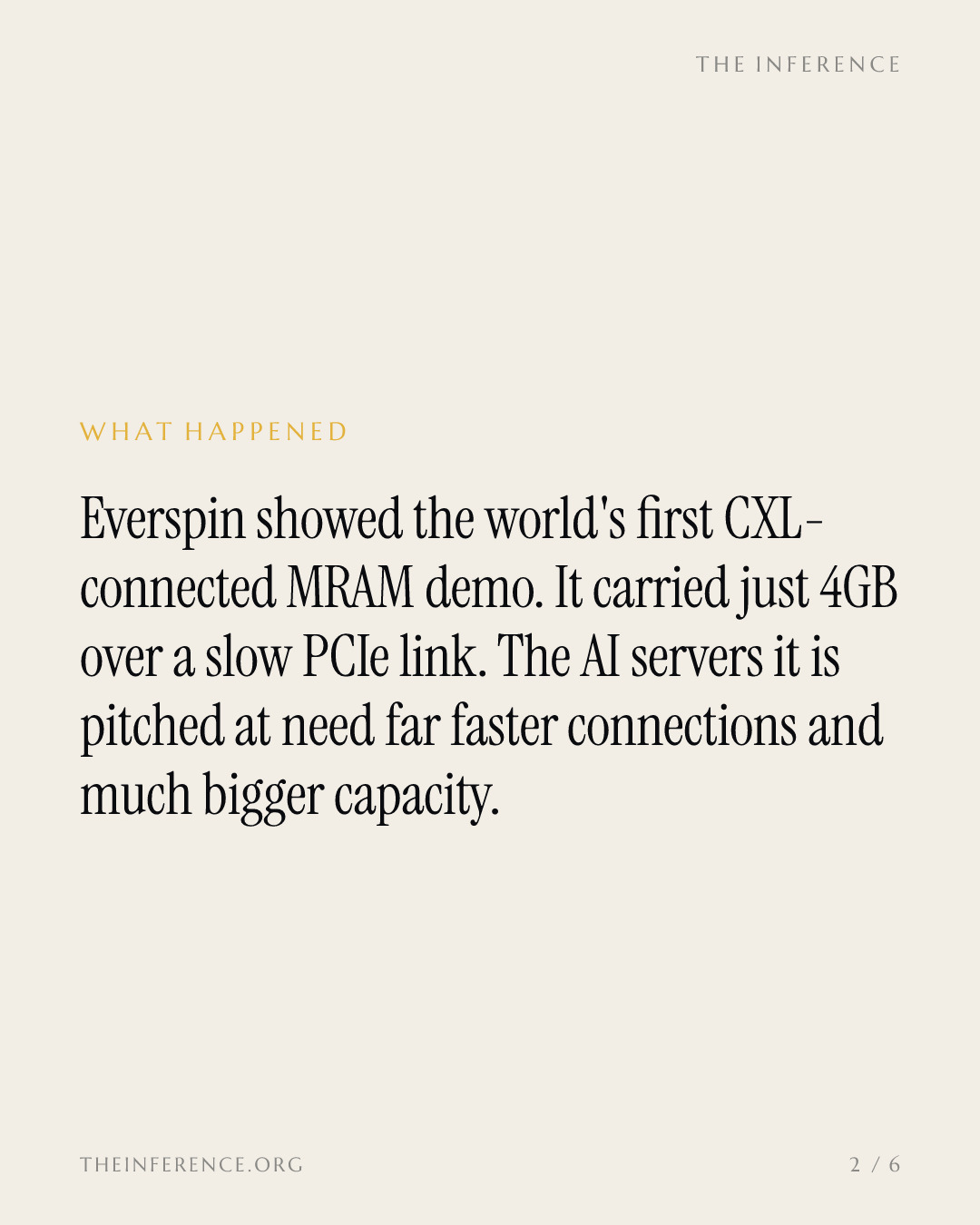
Everspin announced on 29 September the "world's first CXL-connected MRAM platform": four 1GB MRAM memory modules on an FPGA card, connected to a Supermicro server over a CXL link, with writes up to 100 times faster than NAND solid-state storage. 1 2 Most trade coverage reprinted the release verbatim; one write-up framed it as a fix for the "memory wall" that forces GPU clusters to idle at training checkpoints. 3 What the rig actually was, and what it can plausibly be worth, tells a different story.
The rig is smaller than the pitch
The only outlet that asked got answers. The demo used 4GB of Everspin PERSYST DDR4 MRAM (four 1GB UDIMMs, which Blocks & Files identifies as a 1-gigabit-per-module family) mounted on an AMD Alveo U250 FPGA card. 1
The CXL link itself ran on 8-lane PCIe Gen3, confirmed by Everspin on the record, though the release pitches checkpointing and persistent KV cache for AI servers. 1 Those use cases need Gen5 or Gen6 links, as Blocks & Files noted before asking. 1 A demo is a sales call, not a product.
A record quarter is not a business model
The commercial gap is the wider one. Everspin has raised $80.3 million since 2003 and IPO'd in 2017 with a see-sawing revenue line; 1 MRAM yields run an estimated 70 to 85 percent against 90-plus for mature NAND, and scaling 1GB modules to the multi-terabyte densities data centers buy is a manufacturing problem money has to solve. 3
Revenue rose in seven of eight quarters to a record $18.7M
Data
| Revenue | |
|---|---|
| Q3 '24 | $12.09M |
| Q4 '24 | $13.24M |
| Q1 '25 | $13.14M |
| Q2 '25 | $13.2M |
| Q3 '25 | $14.06M |
| Q4 '25 | $14.8M |
| Q1 '26 | $14.87M |
| Q2 '26 | $18.74M |
The company just posted record Q2 revenue of $18.7 million, up 42 percent year over year, on a $40 million defense contract, yet booked a GAAP loss of $3.6 million after litigation charges. 5 The stock sits at $16.37 against a 52-week range of $6.12 to $51.50, so shareholders have already priced the story once, in both directions. 5
A discarded specialty line fetches nearly triple Everspin
The repricing next door is the tell. On 30 September Infineon agreed to sell its NOR Flash and F-RAM business, at far larger scale than Everspin's, to Winbond for $1.12 billion in cash. 4 That is roughly 2.8 times Everspin's entire $396 million market capitalization, 4 5 a discarded specialty line fetching nearly triple the whole company, which is the honest measure of where Everspin's balance sheet stands. Any path out of the niche runs through a partner's balance sheet: a Winbond, a Microchip, a defense contractor. The signal to watch is a signed manufacturing or licensing partner with volume capital behind it before the next earnings report; silence there would confirm the demo as technology scouting, and leave the AI memory toll with Micron, SK Hynix and Samsung. 3
Deepdive
AI-generated from this story and its cited sources. Not investment advice.