Goldman's biggest prime-broker client of 2026 was a two-year-old AI fund running four-times leverage
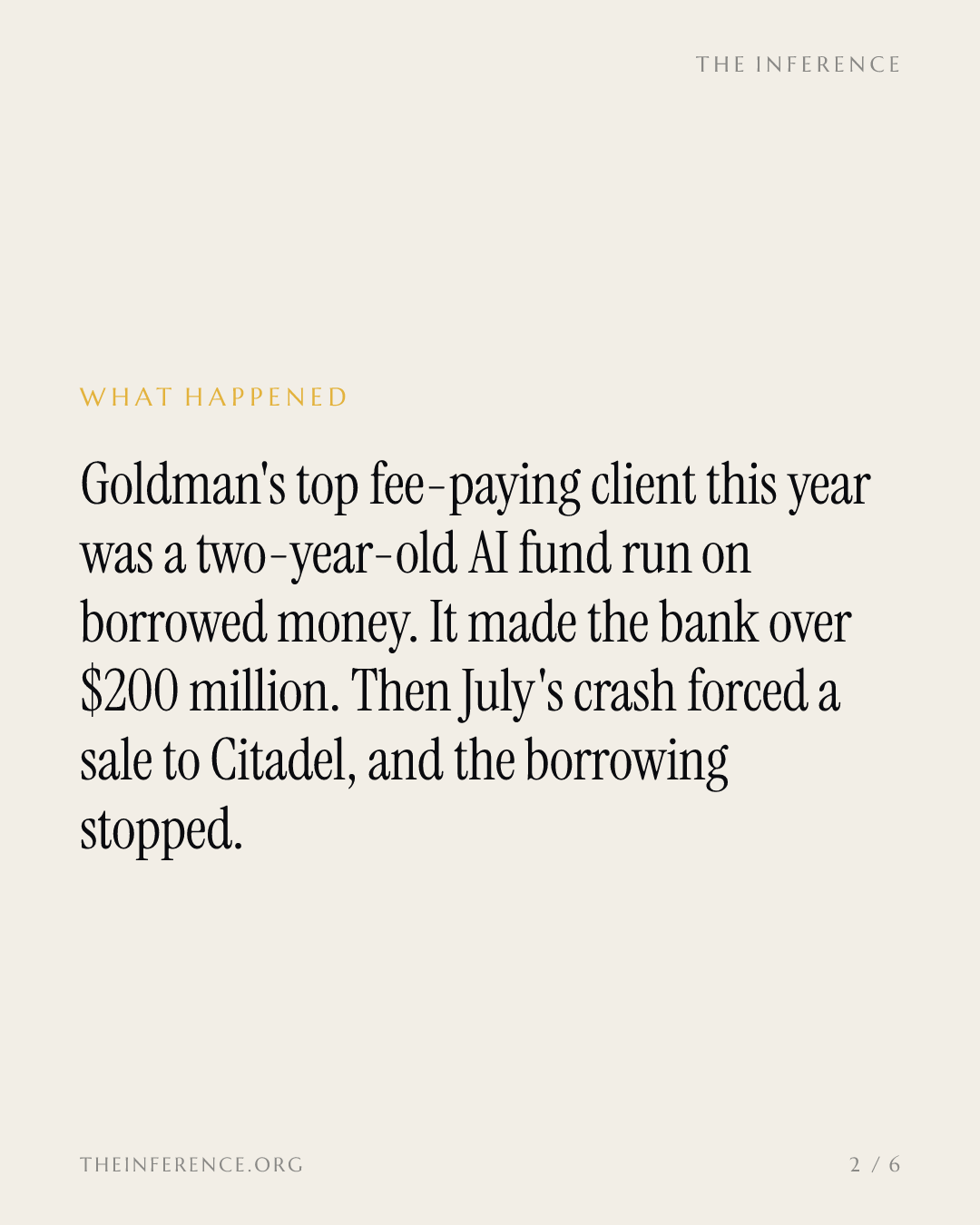
Goldman collected more than $200 million in fees from Leopold Aschenbrenner's two-year-old fund this year, more than from any other prime-brokerage client, per the FT. That client no longer borrows, and the fee machine it ran on has stopped.
 Vincent Jiang · 3 min read
He called the crash a buying chance, then lost the book
Six days before Ken Griffin's Citadel absorbed his fund's entire public-equity book, Leopold Aschenbrenner wrote to investors that July's AI rout offered "some of the most attractive opportunities since early 2025" and invited fresh capital by 1 August 2026 1. The capital never came. Margin calls from Goldman Sachs, JPMorgan and Bank of America did, and on 30 July the whole public book went to Citadel 1.
The invoice for the leverage era just landed
Goldman earned more than $200 million in fees from Situational Awareness this year, people familiar with the matter told the Financial Times, more than from any other prime-brokerage client 23. The fund also ranked among the bank's biggest trading-division clients overall this year, the FT report noted 2. A fund founded in 2024 sharing league-table space with Citadel and Millennium is, in Oninvest's summary, virtually unprecedented on Wall Street 4. Goldman was one of its main lenders, and the fund remains a client 2.
Fees on the way up, a margin call on the way down
The client was built on borrowed money. Situational Awareness launched in 2024 with $225 million in seed capital, ran its public book at roughly four-times leverage and returned 439 percent in the first half of 2026 alone 15. Assets touched about $45 billion at the start of July, then fell to roughly $10 billion after the forced sale 16.
Citadel took the roughly $16 billion book at a discount understood to be near 10 percent 56. Goldman got paid on the way up, Citadel bought on the way down, and the limited partners met the margin call: the portfolio dropped 67 percent in July, coming "closer to permanent capital impairment than is acceptable to us" 7.
A $225 million launch became $45 billion, then $10 billion, in two years
Data
| Assets under management | |
|---|---|
| Launch, 2024 | $0.23 |
| Jul 2026 peak | $45 |
| After Citadel sale | $10 |
JPMorgan walked, Goldman kept the account
JPMorgan ended its lending relationship with the fund after the losses 7. Goldman, Citigroup and Bank of America still execute for it, and the fund has added Clear Street as a broker 7. The SEC has subpoenaed all four banks over the fund's trades, leverage and communications with lenders; no wrongdoing has been alleged, and the fund says it will cooperate with any request 6. Goldman and the fund declined to comment on the fee figure 4.
The fee machine is switched off
The fund told investors in July it would no longer borrow to size positions, Oninvest reports 4. In September it came back to public markets through options on AMD, Bloom Energy, CoreWeave and SK Hynix, instruments that spend premium instead of owing margin 8. Citadel has unwound more than 80 percent of the risk it bought, in over 100 block trades worth more than $4 billion 8. An Anthropic stake up 620 percent this year keeps the fund up roughly 80 percent 9. Aschenbrenner's own words close the ledger: "not blowing up is task number one and two" 9. Watch whether any client ever pays Goldman like this again without borrowed money.
How this brief was made
01Gathered & sourced328 channels · 1,087 articles▾
Agents swept 328 channels and ingested 1,087 articles, then de-duplicated and ranked them for signal.
02Verified & cross-validated9 claims · 38 data feeds▾
Every one of 9 load-bearing claims was checked against primary sources, with 38 live data feeds reconciling the figures and charts.
- 1Tech Times, "Citadel Buys Situational Awareness Portfolio as 4x Leverage Ends AI Fund's 1,000% Run", 30 July 2026
- 2Seeking Alpha (via MSN), "Goldman Sachs said to have earned over $200M in fees this year from Situational Awareness", 24 September 2026
- 3MT Newswires (via Yahoo Finance), "Market Chatter: Goldman Sachs Earns Over $200 Million in Fees From Situational Awareness", 24 September 2026
- 4Oninvest, "Goldman Sachs Earned More Than $200 Million in Fees from the 'AI Nostradamus' Hedge Fund", 27 September 2026
- 5Seeking Alpha, "Citadel buys bulk of Situational Awareness's public investments following AI-related losses", 30 July 2026
- 6CNBC (via MSN), "SEC reportedly subpoenas Wall Street banks over AI hedge fund Situational Awareness's near collapse", 25 August 2026
- 7Reuters (via AOL), "JPMorgan curbed lending to Situational Awareness after AI losses, source says", 11 September 2026
- 8Quartz (via Yahoo Finance), "Leopold Aschenbrenner's Situational Awareness buying options after collapse", 11 September 2026
- 924/7 Wall St (via MSN), "Leopold Aschenbrenner's $20 billion AI hedge fund imploded. Here's how it's still up 80% this year", 3 August 2026
03Reviewed & edited1 human editor▾
One editor read the draft against the evidence, tuned the framing, and signed off before it shipped.
Become a contributor
Reporting on the business of AI and want it read? We take pitches from outside contributors who bring primary sources and a number worth arguing about.
Deepdive
AI-generated from this story and its cited sources. Not investment advice.