Google Opens a 9-Billion-Variant DNA Atlas. Proof Still Costs.
Google DeepMind put a petabyte of DNA predictions behind a search box. The 22% gain only shows up when you pair it with the old methods, and someone still has to pick up the pipette.
 Vincent JiangSeptember 9, 2026 · 2 min read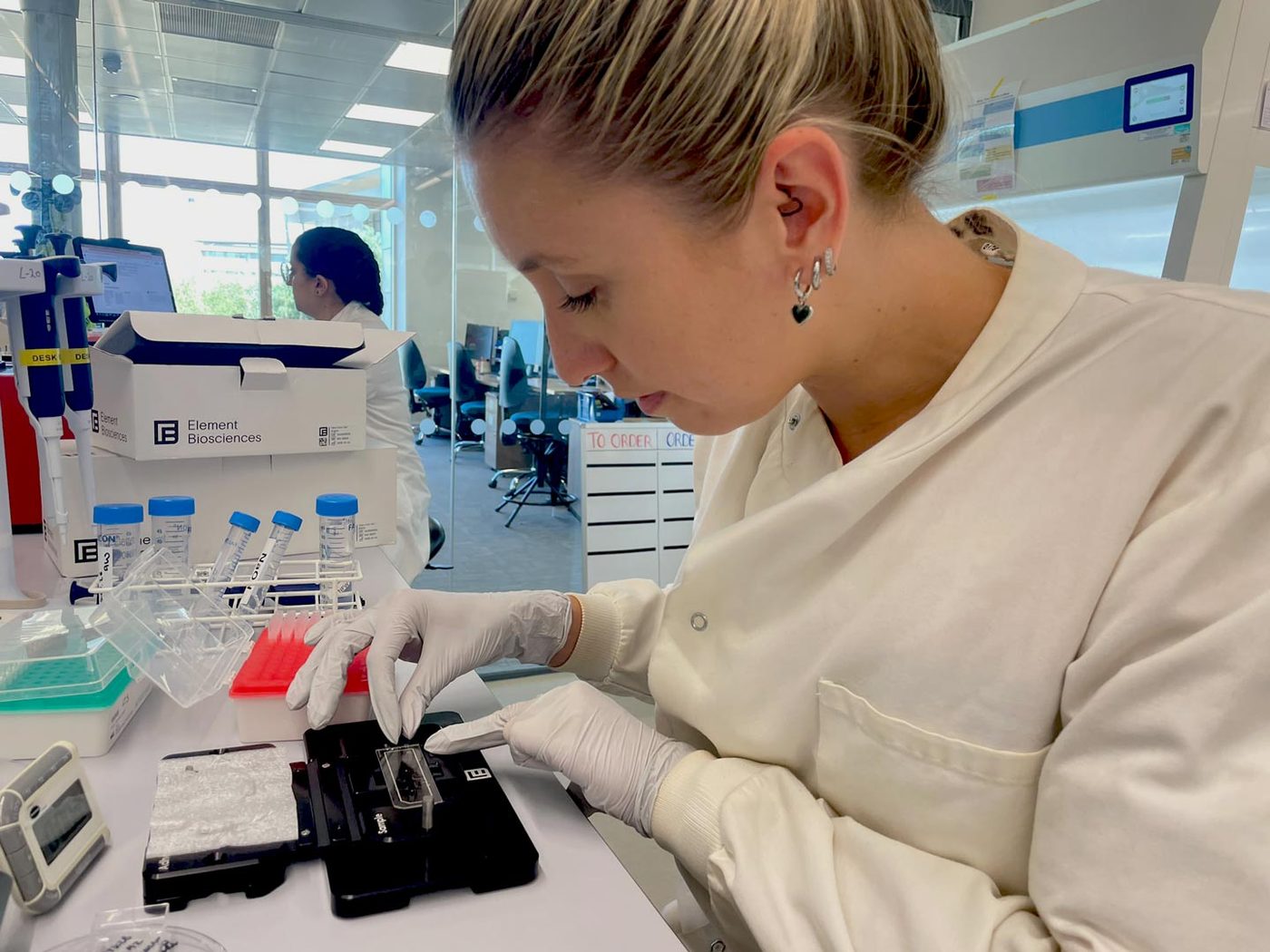
Nine billion possible DNA changes now fit behind a browser search box. On September 8, Google DeepMind released AlphaGenome Atlas, a petabyte of predictions that researchers previously had to compute themselves.1,8
Where the opportunity actually sits
The opportunity lies partly in the roughly 98% of human DNA that does not encode proteins.2 Some regulates genes; some still has no known function.
On X, Sundar Pichai emphasized browser access3. Pushmeet Kohli highlighted a score for ranking variants4. Both point toward choosing experiments more efficiently.
One result worth a closer look
One result deserves a closer look. In 54,189 UK Biobank participants5, combining Atlas features with baseline methods found 728 significant associations between rare non-coding variants and circulating protein levels, versus 595 for baselines alone. That is roughly 22% more. Atlas alone found 460.6 The gain came from combining methods.
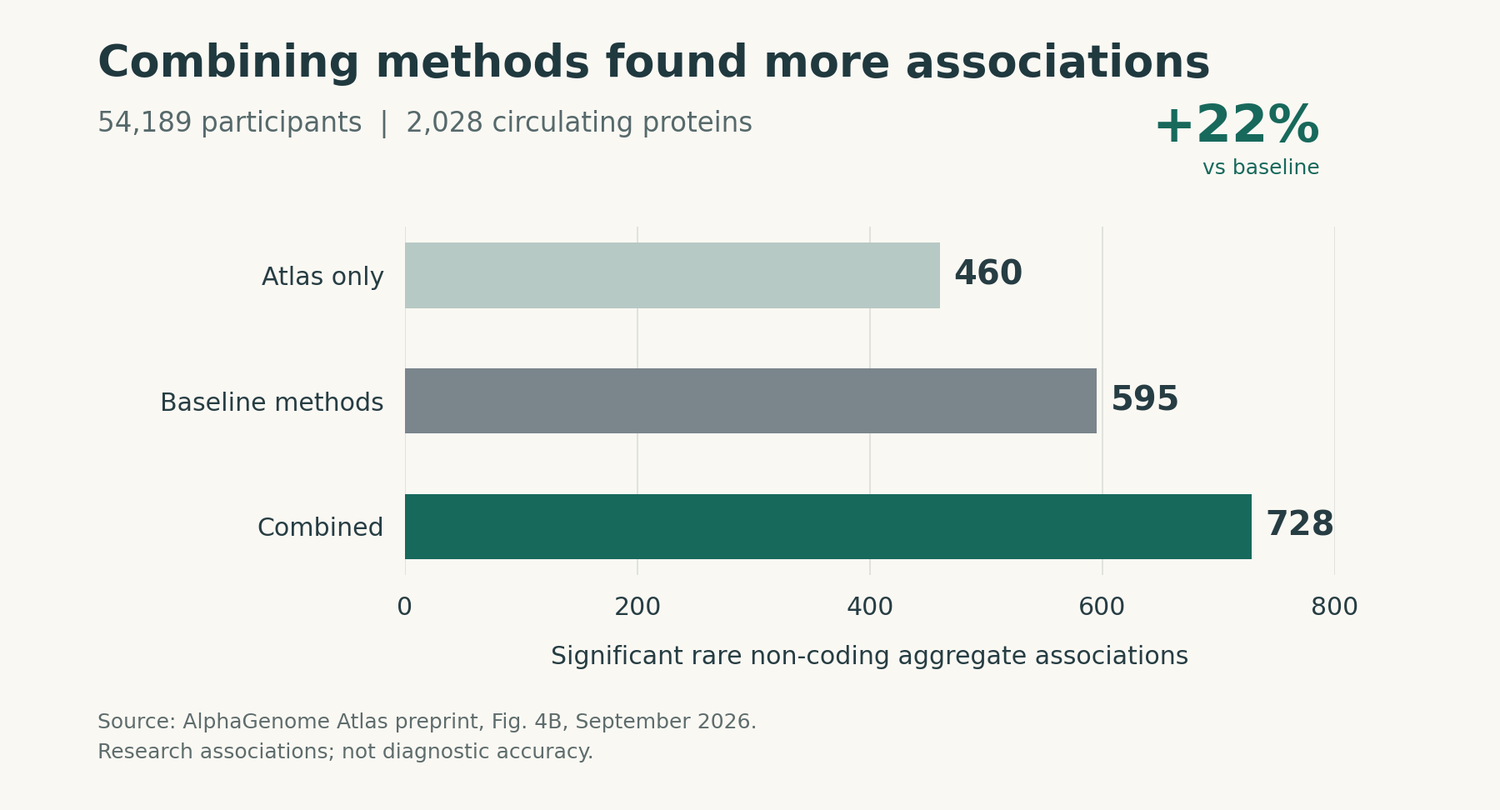
Research associations, not diagnoses
Those are research associations, not diagnoses. In GREGoR rare-disease research, Broad scientists used Atlas to flag a DNM1 variant, then added experimental evidence.7
The underlying model matched or beat leading rivals in 25 of 26 variant-prediction evaluations.9 Yet tissue-specific predictions remain difficult, and clinical decision-making is excluded.10
The commercial distinction
The commercial distinction matters. The Atlas portal is free for non-commercial research11, with commercial Cloud access announced as forthcoming8. The underlying AlphaGenome model already requires a paid Cloud subscription plus infrastructure costs.12
For biotech, the opportunity is a better shortlist for the lab. Whether that produces cheaper medicines remains unproven. Someone still has to pick up the pipette.
How this brief was made
01Gathered & sourced324 channels · 1,075 articles▾
Agents swept 324 channels and ingested 1,075 articles, then de-duplicated and ranked them for signal.
02Verified & cross-validated12 claims · 14 data feeds▾
Every one of 12 load-bearing claims was checked against primary sources, with 14 live data feeds reconciling the figures and charts.
- 1IEEE Spectrum (Atlas release).
- 2NHGRI (non-coding DNA).
- 3Sundar Pichai on X.
- 4Pushmeet Kohli on X.
- 5UK Biobank (genetic data).
- 6AlphaGenome Atlas preprint, Fig. 4B.
- 7Broad Institute (GREGoR).
- 8Google DeepMind (launch).
- 9Nature (AlphaGenome paper).
- 10Science Media Centre (expert reaction).
- 11GitHub (use restrictions).
- 12Google Cloud (AlphaGenome docs).
03Reviewed & edited1 human editor▾
One editor read the draft against the evidence, tuned the framing, and signed off before it shipped.
Confidential tips
Know something about this story? We protect our sources. Reach the editor directly, or read our guide to sharing securely.
Deepdive
AI-generated from this story and its cited sources. Not investment advice.