Molina recovered $34 million of Michigan Medicaid fraud. The state's rates never subtracted it.
CMS has given Michigan until late October to explain zero fraud recoveries in Medicaid managed care, a clock that runs eight days past Molina's 21 October earnings. Molina is now 79% a Medicaid story, and the rate base in question never netted the money its plans clawed back.
 Vincent Jiang · 3 min read
Thirty days to explain a zero
On 29 September 2026, CMS administrator Mehmet Oz gave Michigan and seven other states 30 days to explain why they reported zero Medicaid fraud referrals and no overpayments recovered in managed care 41. The deadline lands around 29 October, eight days after Molina Healthcare reports third-quarter results on 21 October 2026 3. For one insurer on Michigan's Medicaid books the question is not abstract: the state sets its rates from the very spending that never got corrected.
Molina is now almost purely a Medicaid story
Molina's second quarter put Medicaid premium revenue at $8.0 billion of $10.2 billion total, 79% of the book 7. The rest is shrinking on purpose: the company exits traditional Medicare Advantage for 2027, keeping only special-needs plans 72, and drops its Ohio marketplace plans, shrinking its ACA footprint from 14 states to six 8.
The filings do not break Michigan out of that Medicaid segment, so the state exposure cannot be sized from them 7. What they do show is a margin slide, from 4.5% in late 2024 to 1.3% in the second quarter, with management calling 2026 the trough year for Medicaid pretax margins on the promise of future rate increases 710. A rate marked down in Lansing lands directly on that thesis.
Molina's operating margin has slid from 4.5% to 1.3% in two years
Data
| Operating margin | |
|---|---|
| Q3 '23 | 4.2% |
| Q4 '23 | 3.5% |
| Q1 '24 | 4.3% |
| Q2 '24 | 4.4% |
| Q3 '24 | 4.5% |
| Q4 '24 | 3.6% |
| Q1 '25 | 3.9% |
| Q2 '25 | 3.3% |
| Q3 '25 | 1.2% |
| Q4 '25 | -1.4% |
| Q1 '26 | 0.8% |
| Q2 '26 | 1.3% |
The insurer looked harder than the state
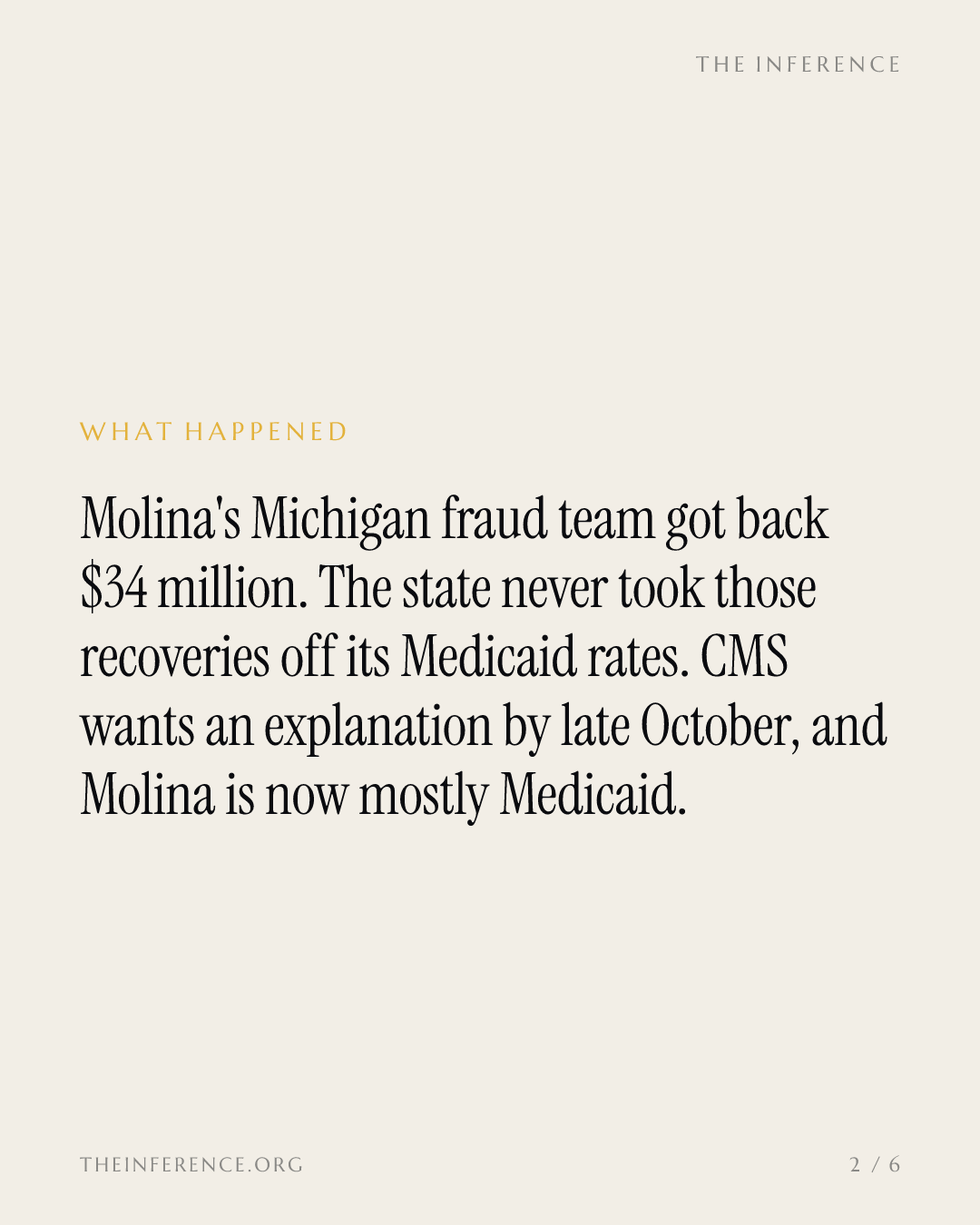
The Michigan figures are single-source, from a write-up citing HHS-OIG and CMS audits whose documents did not surface in retrieval. Molina's Michigan fraud unit carried 33 staff, more than the attorney general's entire prosecution unit, and in fiscal 2019 it identified $37 million in overpayments and recovered $34.4 million 1.
The state's own Medicaid agency referred four suspected provider-fraud cases to prosecutors across fiscal 2018 to 2020, in a program approaching $21 billion a year 1. The insurer investigating the program was bigger than the state prosecuting it.
Molina fields more fraud staff in Michigan than the state's prosecutors
Data
| Value | |
|---|---|
| Molina's Michigan fraud unit | 33 |
| Michigan prosecution unit (2021) | 31 |
| Ohio fraud unit (FY2023) | 102 |
The rate base never subtracted the money
Michigan pays each plan a per-member rate built from the prior year's spending 1. Federal rules require recovered overpayments to come off next year's base, and CMS warned Michigan in 2022 that without that accounting, plans "could be receiving inflated rates per member per month" 1. A rate built on fraudulent spending pays out as if the spending were real medical care.
One year of Molina's recoveries is a rounding error, roughly 0.16% of a $21 billion program. Meridian, another Michigan plan, recovered $15.5 million; the exposure is the pattern compounding across plans and years, not any single clawback 1.
Billions already deferred elsewhere
And CMS has shown the lever it holds. It deferred more than $1 billion of Medicaid funding to California and Minnesota in July, more than $2.5 billion from the two states this year, and has moved to withhold funding from the fraud units of Hawaii and New York 56. "If it smells like fraud, we are not paying for it anymore," Oz said 5.
The states push back
Utah, also flagged, says the zero "did not accurately reflect the managed care data" it submitted, data that included 133 fraud referrals from its managed care plans 4. Michigan's attorney general does prosecute when cases arrive: in July she sued a nursing home operator over more than $111 million in alleged Medicaid fraud 9. Molina's arrangement is contractual, not illicit; under Michigan's contracts, recoveries are generally the plan's to keep 1. None of which answers why the recovered money never came off the rates.
Two outcomes, two prices
Michigan owes Washington an answer by roughly 29 October 2026, after Molina's 21 October print and 22 October call 34. Two outcomes price differently: forced netting marks down a rate base, a clean data fix leaves it standing. The plans found the fraud; the state priced it in anyway.
Deepdive
AI-generated from this story and its cited sources. Not investment advice.