Parsons Keeps Winning Contracts. Keeping the Profit Is Harder.
A $1.9 billion quarter of contract awards arrived with a $15 million net loss. The backlog is real; whether the cash behind it is has to be proven quarter by quarter.
 Vincent JiangSeptember 14, 2026 · 6 min read
The losses reveal what Parsons actually sells
Carey Smith told investors in July that Parsons was preparing to leave two contracts in a remote location where staffing and supplies had become too expensive.1 The company she leads had just recorded $1.9 billion of contract awards in a quarter. It also reported a $15 million loss attributable to its shareholders.2
That is the complication inside PSN. Parsons can secure work on some of the government's most important problems and still struggle to keep the money earned solving them.
Parsons combines defense technology with infrastructure engineering. Investors are buying both technical capability and management's ability to price, staff and finish complicated work.
The second quarter exposed the second skill. Its unaudited results included approximately $78 million of losses on federal programs intended for sale and $41 million from an infrastructure joint venture. Reported adjusted EBITDA was $42 million. Management's additional normalization, removing those charges, produced $161 million. Both figures include earnings belonging to outside owners of consolidated ventures.2
Those exclusions explain the difference between a bad quarter and a potentially healthy continuing business. They do not make the losses economically irrelevant.
The filing shows that the federal charge included about $61 million of expected future losses. The joint-venture charge reflected a higher estimate of completion costs. These were delivery obligations becoming more expensive, rather than merely a falling valuation on an acquired asset.3
For an operator, this changes the question. How much of today's attractive backlog was priced before tomorrow's staffing, equipment and scheduling problems became visible?
Read the contract before celebrating the number
The latest announcements show why procurement vocabulary matters. On September 14, Parsons announced nine solutions designated as eligible for awards on defense marketplaces. That improves access to buyers. It does not establish an order amount.4
August's COMET announcement is more dramatic: a place on an intelligence contract vehicle with a combined ceiling exceeding $14 billion. Parsons must compete for individual orders. PeopleTec announced its own place on the same vehicle in September. The opportunity is shared.5,6
Even a concrete extension requires attention to timing. The $514 million missile-defense option announced August 24 had already contributed $195 million to second-quarter bookings. Adding the whole headline to the quarter's wins would double-count part of the opportunity.7,2
Winning access, receiving orders, recognizing revenue and collecting cash are separate achievements. The investment case gets stronger as work moves through each stage.
The cyber kit has a better argument
SealingTech, a Parsons subsidiary, offers a more tangible reason for optimism. The Defense Innovation Unit described the customer's problem in March 2025: military cyber teams used fragmented equipment that created interoperability difficulties. Teams needed a portable security-operations capability that could work where internet access and permission to move sensitive data were restricted. DIU selected three prototype suppliers from 92 submissions, including SealingTech.8
In August 2026, Parsons announced that SealingTech had received a five-year, sole-source production agreement for the Joint Cyber Hunt Kit, with a ceiling of $750 million. That ceiling remains a maximum, not guaranteed sales. But selection for production is a more substantial commercial milestone than admission to a marketplace.9
My inference is that standardization could improve Parsons' economics. Reusing a product across teams can spread engineering expense across deliveries, while integration and support can deepen the customer relationship. The benefit depends on repeat orders, actual delivery costs and support obligations. Neither the award ceiling nor the procurement decision establishes a product margin.
Expertise matters, including the kind rivals own
Parsons' infrastructure business illustrates the value of accumulated experience. The Windsor-Detroit Bridge Authority appointed Parsons as owner's engineer for the Gordie Howe International Bridge in 2018. Its responsibilities included design reviews, inspections and compliance oversight. The authority reported that the bridge opened on July 27, 2026. Parsons helped the owner oversee delivery; it was not the project's design-build prime.10,11
That distinction matters. Technical oversight and assuming construction risk can produce very different economics, even on the same physical asset. The bridge is evidence of Parsons' operating role, not an identified source of its second-quarter charge.
Customer familiarity also benefits competitors. In February, GAO denied an Amentum-Parsons venture's challenge to an Army extension of KBR's European logistics work. Continuity and transition considerations helped justify keeping the incumbent. Relationships can defend existing revenue while making someone else's contract harder to displace.12
The cash hurdle behind a $5 billion valuation
At the September 14 closing price of $46.94, Parsons had an estimated equity value of roughly $5 billion, using its July 21 share count. This is an approximation, not a fully diluted valuation.13,3
Management's annual operating-cash-flow midpoint is $460 million, with approximately $90 million of capital spending. Subtracting the two produces $370 million, making the equity value roughly 13.5 times that amount. But the calculation comes before joint-venture funding and distributions to outside owners. It is not cash wholly available to PSN shareholders.14,3
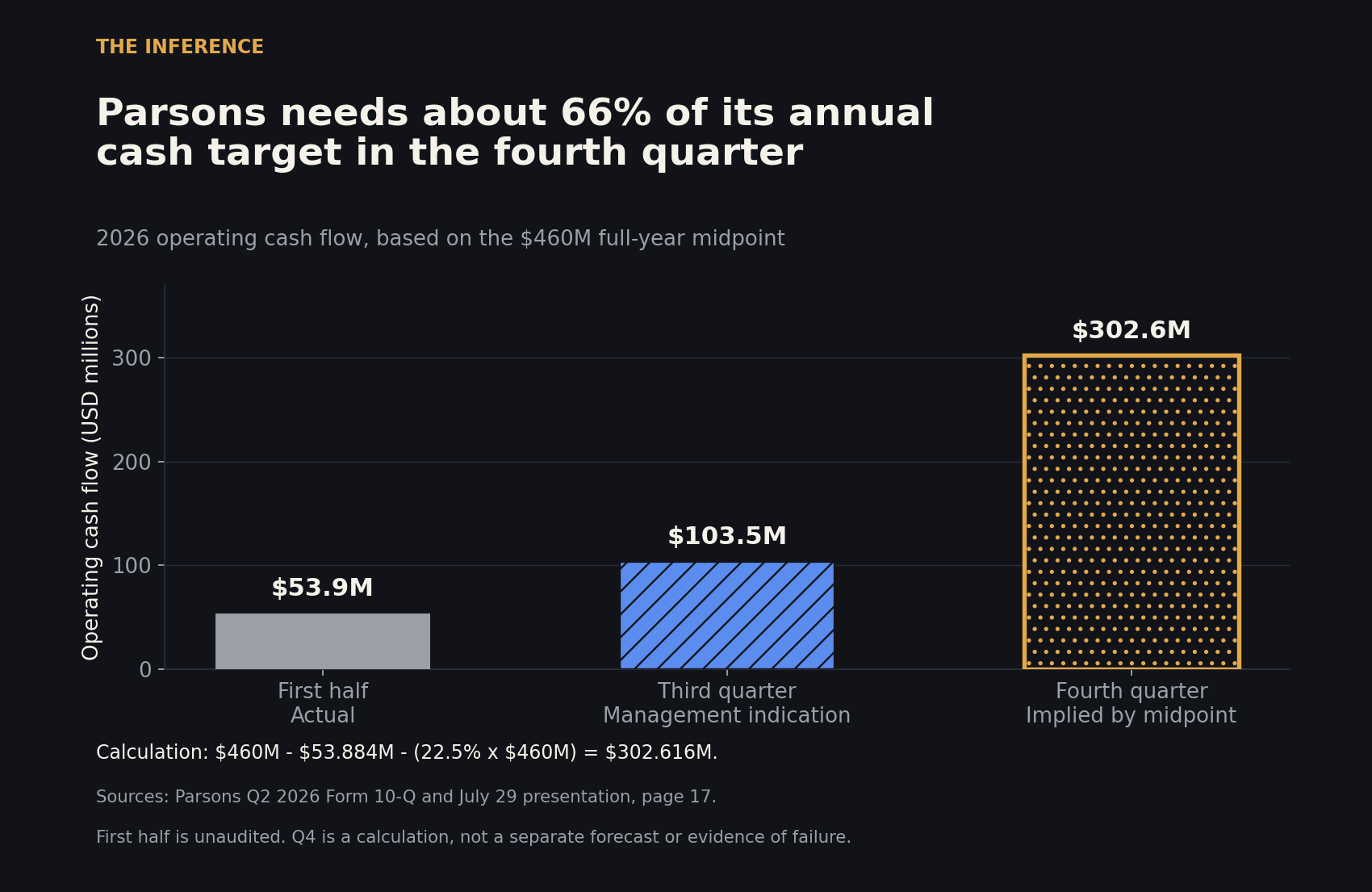
Getting there also requires a strong finish. Parsons generated approximately $54 million of operating cash in the first half. Management indicated that the third quarter should produce about 22.5% of the annual midpoint, or $104 million. My calculation leaves approximately $303 million for the fourth quarter: nearly 66% of the year's target.3,14
The quality of a backlog is measured in the cash left after delivery.
This timing is a test of management's explanation, not proof the outlook will fail. On the July call, CFO Matt Ofilos attributed cash pressure partly to purchases of memory and storage inventory and the timing of customer payments. Products can improve margins while requiring cash before the customer pays. Growth and cash consumption can arrive together.1
A cleanup can produce a better business
The strongest bull case is that the federal exits remove poorly suited work while the legacy infrastructure project moves toward completion. Management attributed the infrastructure charge to exceptional rainfall and schedule delays, and said Parsons had stopped pursuing similar consortium work in 2019.1
At June 30, roughly $6.6 billion of Parsons' $9.3 billion backlog was funded. Infrastructure's adjusted EBITDA excluding its joint-venture charge rose 18%, and its normalized margin reached 11.9%. Federal's normalized margin was lower, at 8.2%. The continuing business therefore contains real strength, although improvement is uneven.14
Smith does not need every new product to become a giant platform. Better contract selection, repeatable cyber deliveries and fewer construction obligations could together improve earnings quality. A smaller revenue base could be worth more if it requires less capital and produces fewer unpleasant surprises.
The unresolved issue is whether the cleanup ends with these contracts. Investors need evidence that the next generation of work carries better economics through completion.
Watch collections and completed exits
The next results should establish whether third-quarter operating cash approaches management's roughly $104 million indication. A shortfall would raise the fourth-quarter requirement unless annual guidance changes.
Then watch whether the planned contract sales transfer the remaining obligations by year-end, as the filing anticipates, and whether new charges emerge while existing projects finish.3
For Smith, the next convincing result is cash collected after the work is done.
How this brief was made
01Gathered & sourced320 channels · 2,173 articles▾
Agents swept 320 channels and ingested 2,173 articles, then de-duplicated and ranked them for signal.
02Verified & cross-validated14 claims · 15 data feeds▾
Every one of 14 load-bearing claims was checked against primary sources, with 15 live data feeds reconciling the figures and charts.
- 1The Motley Fool, Parsons (PSN) Q2 2026 earnings call transcript, Aug 7 2026, reproducing the Jul 29 call (primary-speaker evidence: Smith on the remote contracts and rainfall; CFO Matt Ofilos on inventory purchases and payment timing). Weather causation is attributed, not independently proved; this host is not counted as independent company verification.
- 2Parsons, Q2 2026 results, Jul 29 2026 (unaudited reported results, non-GAAP reconciliations, funded backlog, bookings, and the $195M of the MDA extension already booked in Q2).
- 3Parsons, Form 10-Q for the quarter ended Jun 30 2026, filed Jul 29 2026 (primary unaudited filing: cash flows, programs held for sale, JV completion estimates, backlog, and the Jul 21 share count). Company-hosted filing used because direct SEC HTML retrieval was intermittent.
- 4Parsons, announcement of nine solutions designated eligible for defense marketplace awards, Sep 14 2026 (primary record; no order value established).
- 5Parsons, COMET contract-vehicle position announcement, Aug 26 2026 (primary record: a shared multiple-award vehicle with a combined ceiling exceeding $14B, not a $14B Parsons order).
- 6PeopleTec, COMET contract-vehicle position announcement, Sep 8 2026 (another awardee's primary announcement, confirming COMET access is shared; does not identify Parsons' future task-order share).
- 7Parsons, Missile Defense Agency contract-option announcement, Aug 24 2026 (primary record: $514M two-year extension; $195M of it already disclosed as booked in Q2 results).
- 8Defense Innovation Unit, prototype-selection announcement, Mar 20 2025 (primary customer account: fragmented equipment and interoperability problems, three prototype suppliers selected from 92 submissions, including SealingTech). Evidence of the customer need and prototype procurement, not of the subsequent production award's funding or SealingTech's unit economics.
- 9Parsons, SealingTech Joint Cyber Hunt Kit production-award announcement, Aug 25 2026 (primary record: five-year sole-source production OTA with a $750M ceiling, a maximum rather than guaranteed sales).
- 10Windsor-Detroit Bridge Authority, owner's-engineer appointment record, Mar 5 2018 (primary record of Parsons' oversight role and scope, distinct from the design-build prime).
- 11Windsor-Detroit Bridge Authority, bridge-opening record, Sep 1 2026 (primary confirmation of the Jul 27 opening; does not identify this bridge as the source of the Q2 JV loss).
- 12US Government Accountability Office, Amentum Parsons Logistics Services decision, Feb 4 2026 (primary adjudication: denied the JV's challenge to an Army extension of KBR's European logistics work on continuity and transition grounds).
- 13Stock Analysis, PSN historical prices, identifying S&P Global Market Intelligence as its data provider, Sep 14 2026 close of $46.94 (primary market-data series reproduced through a distribution site).
- 14Parsons, Q2 2026 investor presentation, Jul 29 2026 (pages 8-9 explain normalization; pages 16-18 present guidance and assumptions, including Q3 operating cash at approximately 22.5% of the full-year midpoint). Normalized measures are management's supplemental presentation, not independently certified recurring earnings.
03Reviewed & edited2 human editors▾
2 editors read the draft against the evidence, tuned the framing, and signed off before it shipped.
Confidential tips
Know something about this story? We protect our sources. Reach the editor directly, or read our guide to sharing securely.
Deepdive
AI-generated from this story and its cited sources. Not investment advice.