Sony and Universal price Suno's licensed restart at a $9 billion ceiling
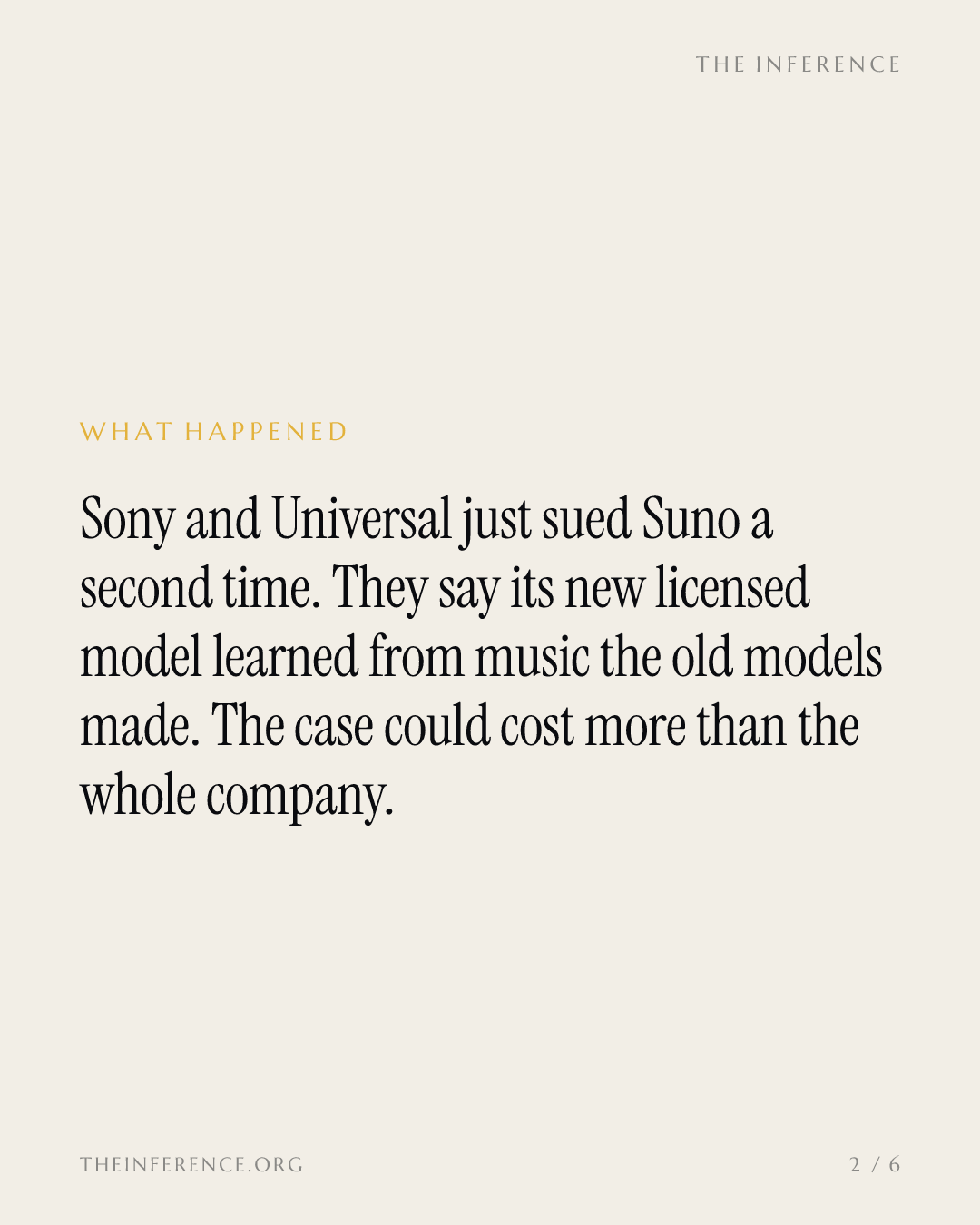
A second major-label suit filed 18 September 2026 says Suno's v6 launders 60,202 copied recordings through its own users' creations. The labels' statutory ceiling now tops the $5.4 billion valuation investors paid in June.
 Vincent Jiang · 3 min read
A judge just lowered the bar for suing Suno
Monday in Boston, Judge F. Dennis Saylor IV let a class action by independent artists proceed against Suno without a single named infringing output. One hundred examples of imitative tracks were enough at the pleading stage, and a YouTube anti-circumvention claim survived alongside them 1. Ten days earlier, Universal and Sony opened a second front before the same judge 2.
$9 billion against a $5.4 billion company
The new complaint, filed 18 September, asserts 60,202 sound recordings. Willful infringement runs to $150,000 per work, a ceiling just over $9 billion, plus roughly $150 million if each recording also counts as a $2,500 act of circumventing YouTube's protections 2. The 2024 case covers 560 recordings; Saylor on 18 August declined to fold 61,026 more into it 2.
Bond Capital led a $400 million Series D in June at a $5.4 billion valuation, with Lightspeed and Menlo Ventures among the returning investors 3. Shulman discloses about two million paying subscribers and $300 million in annual recurring revenue 4. The ceiling now tops the whole company.
One September complaint carries more than 100 times the 2024 case's exposure
Data
| Value | |
|---|---|
| Second suit, Sept 2026 | $9.03B |
| YouTube stream-ripping claim | $0.15B |
| First suit, June 2024 | $0.08B |
The licensed reset that inherits its past
Suno launched v6 on 9 September as its clean start, built with Warner, which settled and licensed in November 2025, plus BMG and Believe, retiring every earlier model 25. The company says v6 trained on licensed partner content and "interactions including creations and preference signals" from its community, and calls the claims "fundamentally flawed on both the facts and the law" 2.
The complaint replies that those creations are outputs of the old models: "Training a 'new' model on the outputs of an infringing model does not eliminate the infringement; it launders it." V6, the labels write, is "the fruit of the same poisoned tree" 2. Suno's own 1 September filing admits audio data was "obtained from YouTube for use as training data using YT-DLP" 26.
The partnerships became exhibits
Three deals with three rightsholders in under a year "confirm that a functioning market exists" for training licences, the complaint argues, the market a fair-use defense must deny 2. Brody's answer: the revenue share is "not in exchange for training" and "not really about the data" 5. Munich has already ruled once, on 31 July, where Suno conceded unlicensed training, and ordered it to open its books on the works 4.
Half a dozen suits are pending against Suno in Massachusetts alone 7. Warner took the settlement and the launch partnership; the two majors that stayed in court are the two that sued again 2.
What Suno can and cannot argue
Suno's formal answer calls its training "quintessential fair use" while admitting tens of millions of public recordings 2. Shulman says v6 holds no Universal, Sony or Kobalt songs 5. Both can be true and still not answer the lineage claim, which rests on user creations spun from the old models, not partner catalogs. No court has ruled on laundering, and $9 billion is a ceiling, not a finding.
The dates that decide it
Fact discovery in the first case closes 30 September, the parties want the stream-ripping track extended to 20 November, and the labels want a jury 2. The same question is coming for every lab training generation N+1 on generation N's outputs: if lineage carries, provenance becomes a balance-sheet item and rebuilding on synthetic data is no reset 8. A licence clears the songs, not the model that grew up on them.
How this brief was made
01Gathered & sourced290 channels · 2,333 articles▾
Agents swept 290 channels and ingested 2,333 articles, then de-duplicated and ranked them for signal.
02Verified & cross-validated8 claims · 22 data feeds▾
Every one of 8 load-bearing claims was checked against primary sources, with 22 live data feeds reconciling the figures and charts.
- 1Virginia Lawyers Weekly, Operator of AI music generator can't escape copyright suit, 28 September 2026
- 2Music Business Worldwide, Suno confirms V6 model was trained on 'creations' from users, as it blasts latest Sony and Universal lawsuit, 22 September 2026
- 3TechCrunch, Still facing copyright lawsuits, AI music generator Suno raises another $400M, 3 June 2026
- 4Forbes, Suno Loses Copyright Lawsuit To GEMA: Why The Ruling Should Worry AI Music Companies, 5 August 2026
- 5Billboard, Suno Launches First AI Models 'in Partnership With the Music Industry', 9 September 2026
- 6The Verge, Suno admits it scraped audio from YouTube in a court filing, 11 September 2026
- 7Boston.com, Major record labels sue Cambridge-based AI platform, again, 27 September 2026
- 8RouteNote, Sony and UMG Sue Suno Again Over AI Music Training: What 'Model Laundering' Means, 28 September 2026
03Reviewed & edited1 human editor▾
One editor read the draft against the evidence, tuned the framing, and signed off before it shipped.
Become a contributor
Reporting on the business of AI and want it read? We take pitches from outside contributors who bring primary sources and a number worth arguing about.
Deepdive
AI-generated from this story and its cited sources. Not investment advice.