ADP's hiring gauge fell to 18,500 weekly job adds from 26,000, yet the stock sits near its 52-week high
The Oct 20 NER Pulse fell to 18,500 weekly job adds from a revised 26,000, erasing the summer climb, yet ADP closed at $289.30, near its 52-week high. Its earnings run on interest on client cash, and October 28 shows whether that line holds while the hiring tape breaks.
 Richard Tang · 2 min read
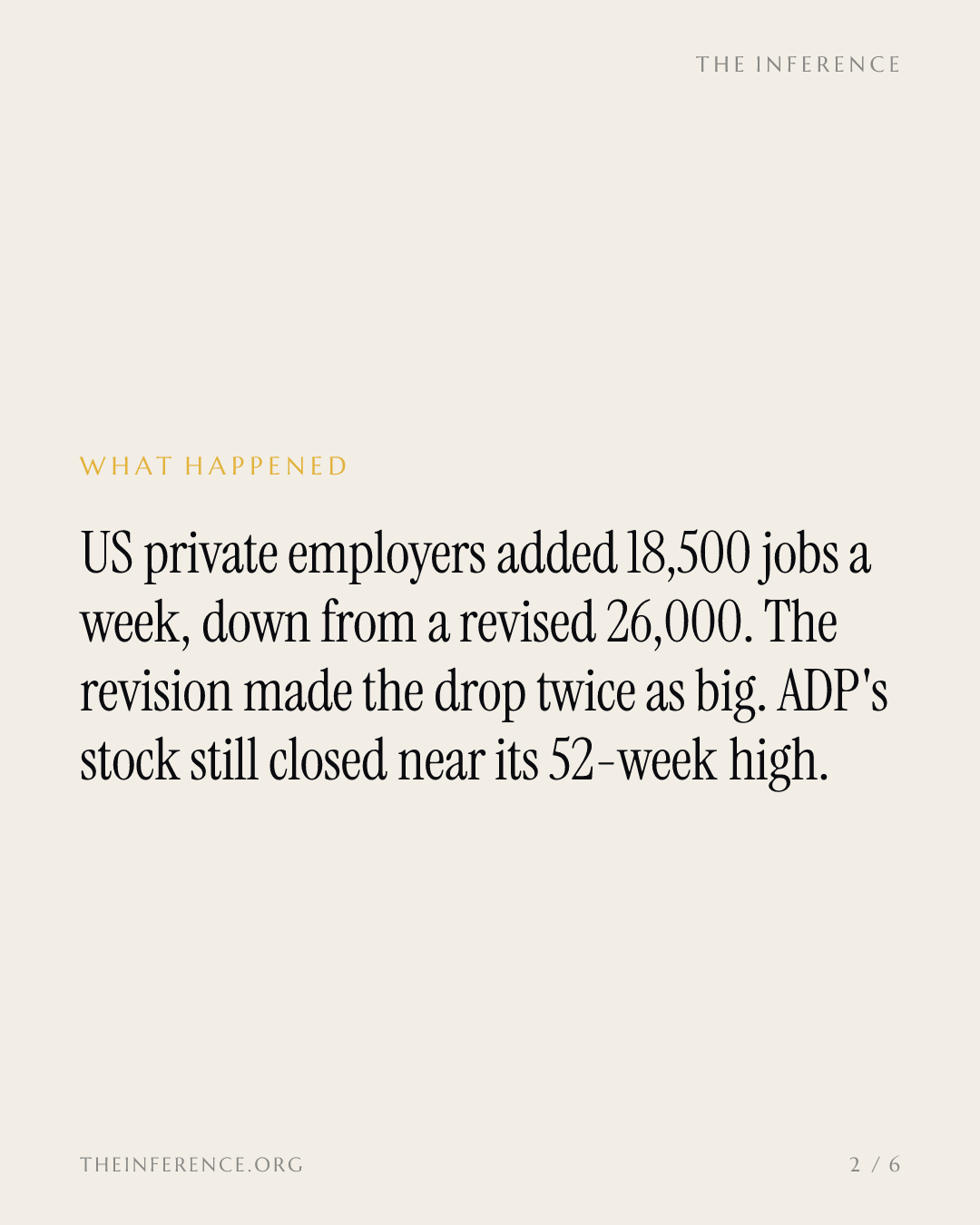
ADP's+0.56% — ADP, up 0.56 percent today own weekly payroll tape just broke, and the stock is near its high anyway. The NER Pulse, the weekly hiring gauge ADP Research publishes with Stanford's Digital Economy Lab, shows US private employers added an average of 18,500 jobs a week for the four weeks ending October 3, down from a revised 26,000 the week before 1. The market closed October 20 with ADP at $289.30, 1.68% below its 52-week high, a week before the fiscal first-quarter report on October 28 5.
The revision is the story. The prior week printed 24,750 on October 13 2; it is now booked at 26,000 1, so the real drop is 7,500 jobs a week, not 1,250. The new print sits back below early September's 20,000 1, erasing the climb from July's 8,250 low 3. The eight-day winning streak that carried ADP to $279.27 by October 14 was priced on a recovery its own gauge no longer confirms 3.
Two ways to read the same company
One camp reads ADP as a labor-market proxy, and that reading is now visibly broken. The other reads what pays the bills: the float, the client payroll cash ADP holds between collecting and paying out. Interest on that roughly $40 billion of client cash reached $1.35 billion in fiscal 2026, up 14%, against revenue of $21.95 billion that grew 6.7% on only about 1% more client employees on payroll 3. Fiscal 2027 guidance puts client-funds interest at $1.545 billion to $1.565 billion and pays-per-control growth at just 0% to 1% 4.
The hiring recovery ADP's own tape built is gone in one print
Data
| Weekly job adds, four-week average | |
|---|---|
| Jul 18 | 11,000 |
| Jul 25 | 8,250 |
| Aug 1 | 9,500 |
| Aug 8 | 11,750 |
| Aug 15 | 10,000 |
| Aug 22 | 12,250 |
| Aug 29 | 16,750 |
| Sep 5 | 20,000 |
| Sep 12 | 22,500 |
| Sep 19 | 25,250 |
| Sep 26 | 26,000 |
| Oct 3 | 18,500 |
The same AI story cuts both ways
Stanford's lab, which co-produces the Pulse, finds workers aged 22 to 25 in AI-exposed occupations sitting 19% below less-exposed peers, a gap built on slower hiring rather than firing 3, which is what this tape printed. My read: slower hiring shrinks the payroll volume the float scales with, while the Fed's fight with AI-driven inflation, September CPI at 3.7% with October hike odds briefly near 50% 6, keeps the rate on that cash high 7.
October 28 is the tell
The report must show revenue growth again outrunning client-employee growth and the interest line holding 3, while the gauge the rally was priced on rolls over. If the float holds, the tape break was noise. If it does not, the stock is still priced for the labor recovery it just lost, with both published targets, $273.50 on twelve votes and a $286.40 street average, sitting below the price 5 3.
The daily newsletter