Alphabet and Meta buy a year's head start on Biohub's $1.8 billion biology data; the protein model ships free
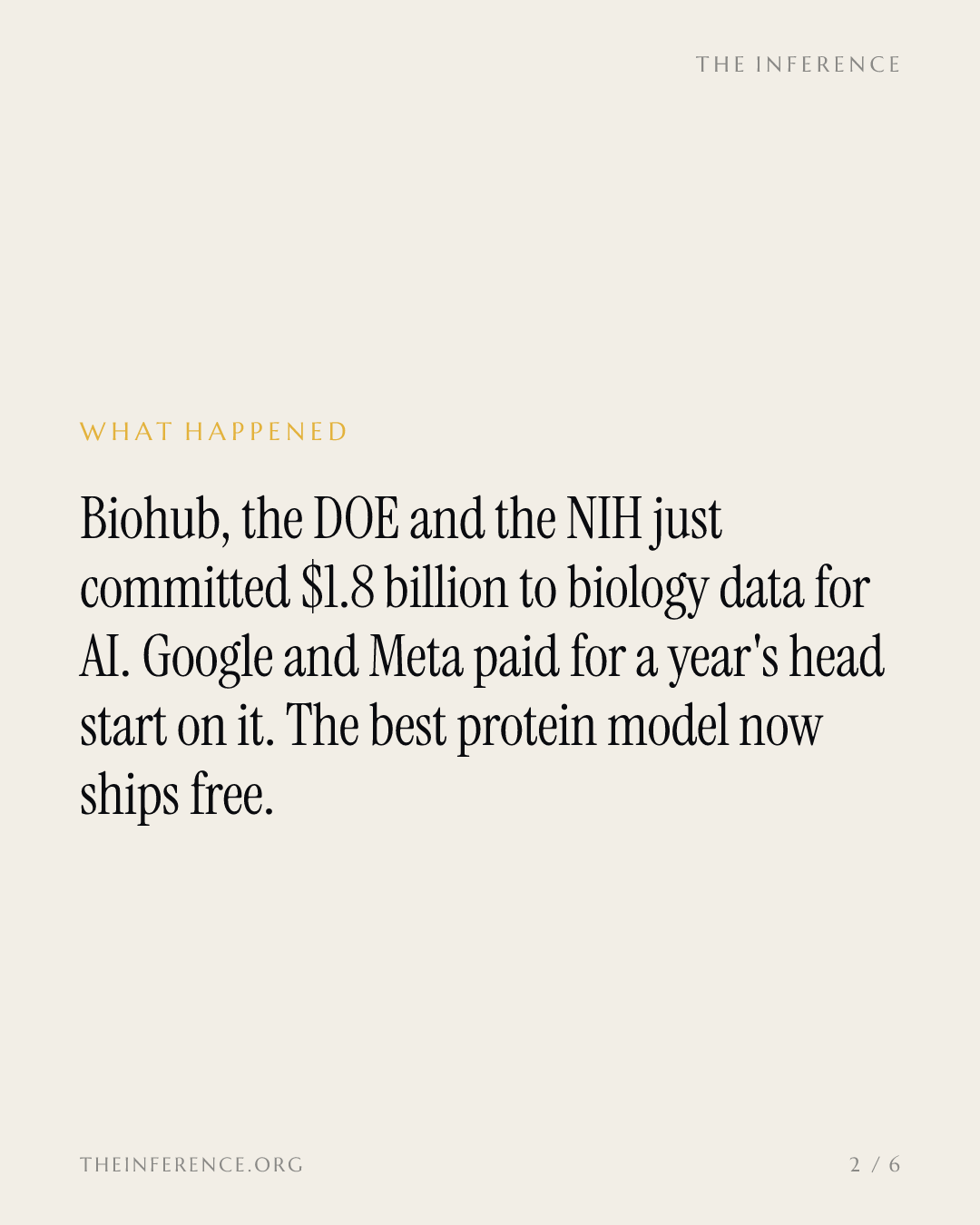
Biohub, the DOE and NIH committed $1.8 billion on October 7 to AI-ready biological data. Corporate funders get a one-year head start; the ESM protein models, once a $142 million venture bet, now ship free under an MIT license.
 Vincent Jiang · 3 min read
A $1.8 billion pot with one nonprofit at the center
On October 7, Biohub, the Department of Energy, the National Institutes of Health and new tech funders committed $1.8 billion in funding, data, computation and measurement technology to generate AI-ready biological data, which organizers call the largest coordinated commitment of its kind to date 12. The commitment reprices two camps at once: vendors selling AI protein design, and the $142 million seed bet on EvolutionaryScale$142M — EvolutionaryScale, private, latest valuation $142M, whose frontier models became free infrastructure when the lab folded into Biohub 3.
The head of science at the center of it, Alex Rives, was a year earlier chief scientist of EvolutionaryScale, a venture-backed frontier lab that no longer exists as an independent company 13.
The rival model is the free one
EvolutionaryScale raised a $142 million seed in 2024, led by Nat Friedman, Daniel Gross and Lux Capital, with AWS+3.31% — AWS, up 3.31 percent today and Nvidia's−0.47% — Nvidia, down 0.47 percent today NVentures aboard 3. In November 2025 the Chan Zuckerberg Initiative folded its biomedical research into Biohub, a step Reuters describes as including the acquisition of the startup; Rives took the top science job, and Biohub pledged a tenfold compute expansion to 10,000 GPUs by 2028 45.
The lab's own site now states EvolutionaryScale is part of Biohub, with ESM models, APIs and services moved to biohub.ai under Biohub's terms 6. What the seed holders received is undisclosed.
In May the team released ESMFold2: designed binders against five cancer and immunology targets, lab hit rates of 36% to 88% for mini-binders, nanomolar affinity, benchmarked against Google DeepMind's AlphaFold 3 and Chai Discovery's$225M — Chai Discovery, private, latest valuation $225M Chai-1 3. Everything shipped under an MIT license, commercial use included 3.
Lab hit rates for ESMFold2-designed mini-binders ranged from 36% to 88% across five targets
Data
| Value | |
|---|---|
| KRAS G12D | 36% |
| IL-2R | 70% |
| TrkA | 72% |
| IL-7R | 80% |
| PD-L1 | 88% |
The $300 million buys a year, not the models
Corporate money is a sixth of the $1.8 billion pot
Data
| Value | |
|---|---|
| DOE Office of Science | >$500M |
| NIH (prior-investment data) | >$500M |
| Biohub (anchor) | $500M |
| DeepMind, Isomorphic, Meta | $300M |
Corporate money buys time, not ownership. Funders get a one-year exclusive window on the data before it goes public 89, and the government-funded share carries no embargo 7. "We have to have some incentive for commercial players to be a part of this, and the embargo period creates that," Rives said 89. The rest of the pot is DOE's more than $500 million over five years through its Genesis Mission, NIH-coordinated datasets from more than $500 million in prior federal investment, and Biohub's founding $500 million 17.
Who this reprices
Design-tool vendors such as Chai Discovery now sell against a lab-validated frontier model that anyone can download, and Biohub hands it out through partners including AWS Bio Discovery and SandboxAQ 3.
The listed touchpoints run in every direction: Alphabet+0.98% — Alphabet, up 0.98 percent today and Meta−0.41% — Meta, down 0.41 percent today as funders, Amazon as a seed backer whose cloud distributes the models, Nvidia as a seed backer whose chips will carry the initiative's compute 13. The nonprofit at the center is financed by Mark Zuckerberg and Priscilla Chan's pledge of 99% of their Meta shares 5.
Rives plans to approach drugmakers and philanthropies next, with a first dataset due in about a year and predictive models targeted within five 7. Whether cellular biology exhibits the same scaling laws seen elsewhere in AI is the open question the whole pot rests on 9.
Deepdive
AI-generated from this story and its cited sources. Not investment advice.