Amazon on tape: AI stays free-cash-flow negative for years; $3 billion of Nvidia racks monthly
A recorded AWS all-hands puts Amazon's AI cash drain in its executives' own words, and internal emails show roughly $3 billion of Nvidia racks arriving every month before the power exists to run them. Gartner now prices the revenue AI data center owners need through 2030 at $8.5 trillion, against the $3.6 trillion it expects them to earn.
 Vincent Jiang · 4 min read
A congratulation for going cash negative
At an internal staff meeting in September, John Felton, chief financial officer of Amazon's+3.91% — Amazon, up 3.91 percent today cloud division, had a joke for Prasad Kalyanaraman, the 21-year company veteran promoted this year to the S-team, the leadership group that reports directly to CEO Andy Jassy. "You've taken us free cash flow negative as a company, so congratulations," Felton said, according to a recording of the meeting 1.
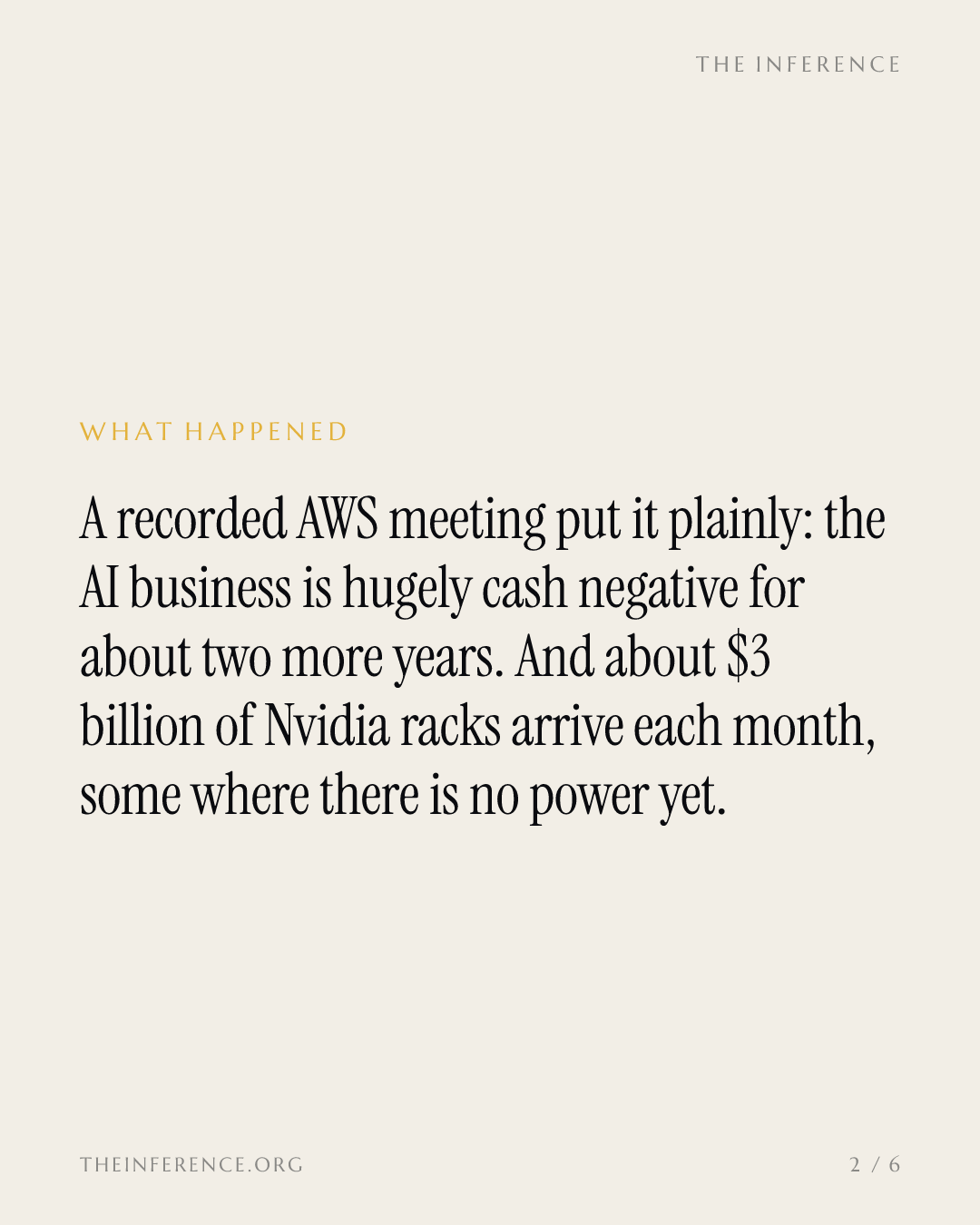
Kalyanaraman, who runs much of the AI infrastructure build, did not dispute it. The machine-learning and AI business is "hugely free cash flow negative," he said, and should stay that way for "the next couple of years or so" 1.
The bleed is already in the accounts. Trailing free cash flow ran at minus $7.6 billion over the twelve months to June, against a positive $18.2 billion a year earlier 2.
The cash now leaves the company earlier
Amazon lifted its 2026 capital spending plan to $220 billion in July, from $200 billion, with Jassy blaming the higher cost of memory chips 2. The cash also leaves the company earlier than it used to.
Under a new "Early Rack Receipt" process, Amazon takes ownership of server racks built around Nvidia's+1.79% — Nvidia, up 1.79 percent today GB300 chip before they reach a data center, giving up the old arrangement in which suppliers carried the cost of the gear in transit 1. One internal email projected about $5 billion of racks arriving in August, then roughly $3 billion a month "for the foreseeable future," at sites that in some cases had room for the machines but no power to switch them on 1.
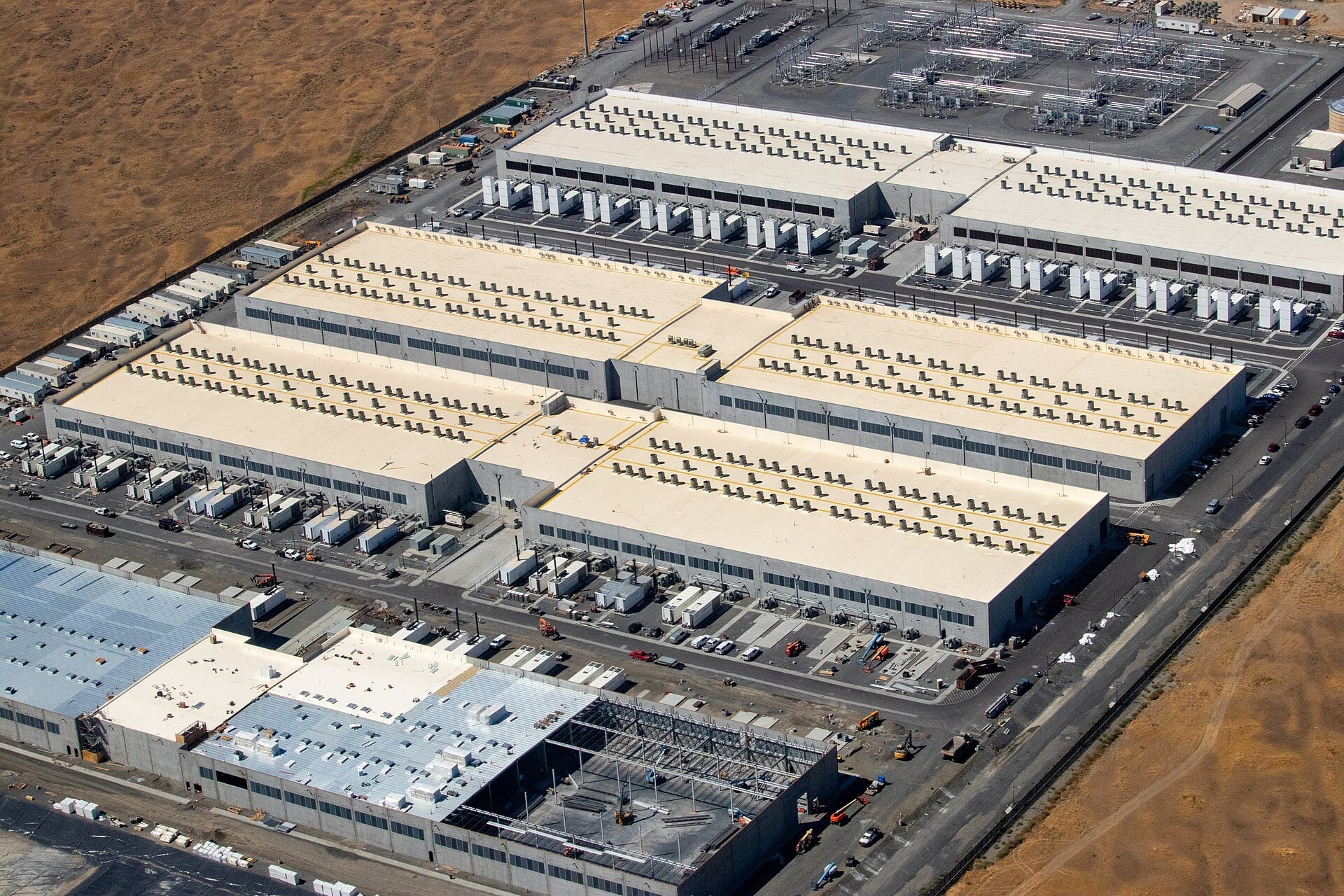
Amazon disputes the email's finding that a supply chain team lacked "a clear forecasted path," calling hardware staging near deployment sites "best business practice" 1. Behind the build sits 44 gigawatts of capacity under development across 16 states, more than double Google, Meta−1.71% — Meta, down 1.71 percent today and Microsoft+0.92% — Microsoft, up 0.92 percent today on Cleanview Research estimates 1.
The 'surely by 2027' promise has slipped
In 2023, Kalyanaraman told Jassy AWS would "surely" be out of its capacity crunch by 2027. This September he said demand would still exceed capacity in 2027 1.
Amazon's capex overtook its operating cash flow in 2026
- Capex
- Operating cash flow
Data
| Capex | Operating cash flow | |
|---|---|---|
| Q1 '24 | $13.94 | $18.99 |
| Q2 '24 | $16.39 | $25.28 |
| Q3 '24 | $21.28 | $25.97 |
| Q4 '24 | $26.05 | $45.64 |
| Q1 '25 | $24.26 | $17.02 |
| Q2 '25 | $31.37 | $32.52 |
| Q3 '25 | $34.23 | $35.53 |
| Q4 '25 | $38.47 | $54.46 |
| Q1 '26 | $43.23 | $26.03 |
| Q2 '26 | $53.08 | $45.39 |
A clear line of sight meets Gartner's gap
Jassy's latest shareholder letter claims a "clear line of sight" to strong returns and calls AI a "once in a lifetime opportunity" 1. The demand is documented: AWS revenue grew 37% in the second quarter, its fastest pace in 18 quarters, on a $496 billion backlog of contracted work not yet delivered 12.
Gartner's October 14 release sizes the other side 3. AI data center owners would need $8.5 trillion of cumulative revenue through 2030 to cover announced spending, financing costs and a 12% return on invested capital, and Gartner−1.91% — Gartner, down 1.91 percent today forecasts no more than $3.6 trillion will arrive 34.
What Gartner measured, and what it assumed
The 12% is a return Gartner assumes investors demand, not a measured figure 4. The full model sits in research sold only to Gartner clients, and the impairment warning is conditional: spending that could be exposed, not a loss that has happened 4. Gartner says more than $3.5 trillion of spending could be exposed to impairment by 2030, and does not expect the 12% return to be reached before the end of 2032 3.
Bain, working different assumptions, reaches a similar place. It sees annual AI infrastructure spending hitting $1.5 trillion by 2031, and reckons the AI services market would need to top $6 trillion a year to pay for it 5.
The bond market is now the counterparty
The squeeze lands hardest on neoclouds, the specialists that lease out GPU capacity. Gartner expects more than 80% of them to cease independent operations by 2030, and CoreWeave+2.35% — CoreWeave, up 2.35 percent today, the largest, fell as much as 17% on the day of the release 36.
Its unsecured bonds traded at levels the market read as distress, and chief executive Mike Intrator called the selloff "irrational," saying the company's backlog covers its debt 6. Hyperscalers, Gartner says, have diversified revenue that could sustain the spend for years 3.
Amazon has issued debt this year, and capital spending took 94% of its operating cash flow in 2025, up from 62% in 2023 7. The next reading is the third-quarter report, due within weeks 7.
Amazon's debt jumped $88 billion in nine months as the AI build grew
- Debt
- Cash
Data
| Debt | Cash | |
|---|---|---|
| Q3 '23 | $137B | $49.6B |
| Q4 '23 | $135.6B | $73.4B |
| Q1 '24 | $134.7B | $72.9B |
| Q2 '24 | $133B | $71.2B |
| Q3 '24 | $134.7B | $75.1B |
| Q4 '24 | $130.9B | $78.8B |
| Q1 '25 | $133.2B | $66.2B |
| Q2 '25 | $133.9B | $57.7B |
| Q3 '25 | $135.4B | $66.9B |
| Q4 '25 | $153B | $86.8B |
| Q1 '26 | $209.9B | $101.8B |
| Q2 '26 | $223.2B | $78.2B |
Amazon pays for racks months before a utility delivers the power that lets them earn anything. On the company's own projection, another $3 billion of them arrives next month 1.
Deepdive
AI-generated from this story and its cited sources. Not investment advice.