AMD pays $8.2 billion for Fei-Fei Li's World Labs as robot training data orders jump as much as a hundredfold
Robot makers now order a hundred times the annotated footage they did a year ago, and AMD is paying $8.2 billion to make that dependence disappear. The collection layer is a race to the bottom, so the value sits with whoever removes the data bill.
 Richard Tang · 3 min read
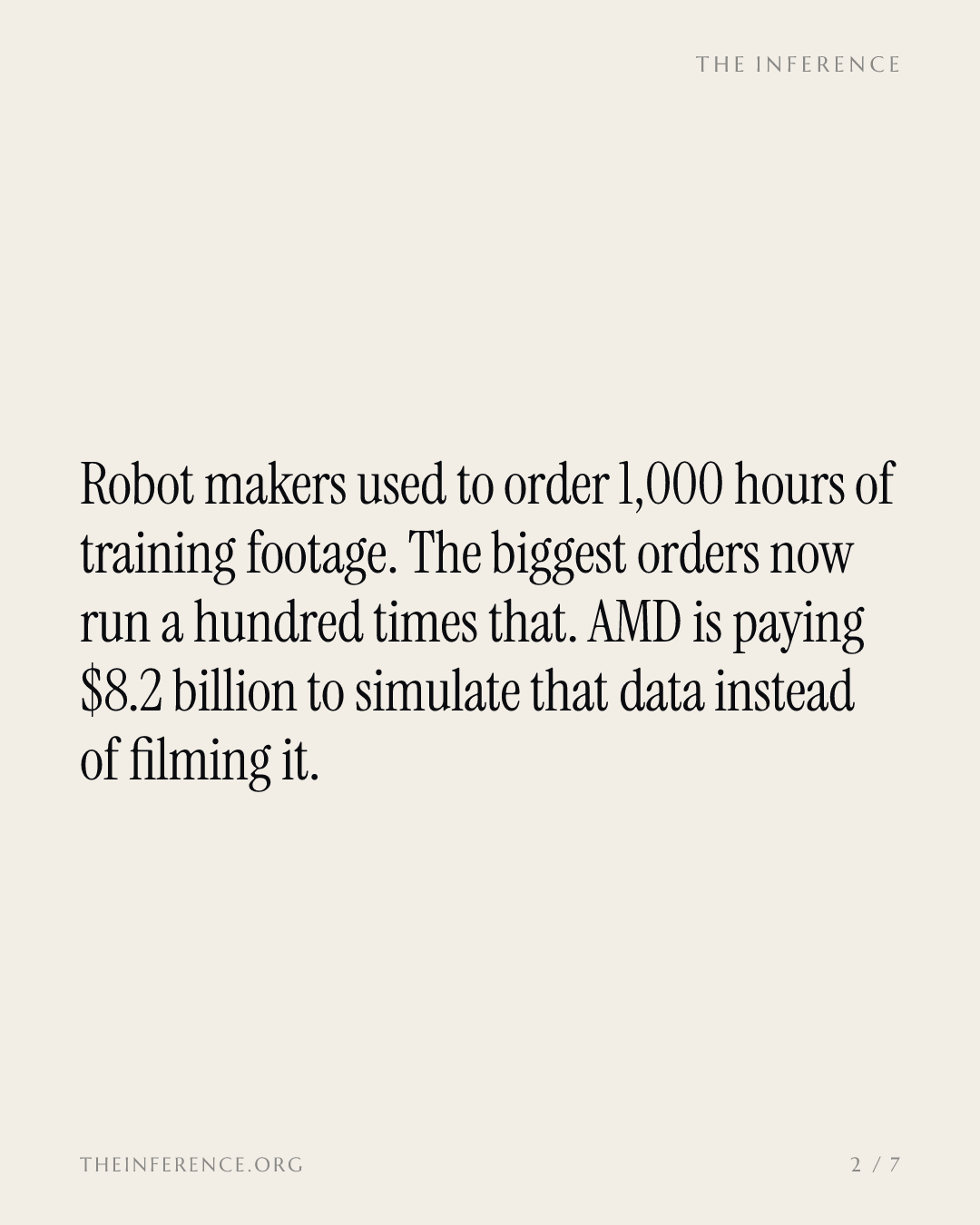
Robot makers now order a hundred times the annotated footage they ordered a year ago, and the money question is not whether that demand is real. It is who keeps it. Business Insider's feature today put the first order sizes on this market: Encord, the private company selling the data layer for physical AI, says demand for robot training data is roughly ten times what it was a year ago 1. Its named customers, robot makers Dyna Robotics and Agility Robotics, have gone from ordering 1,000 hours of annotated footage per order to as much as a hundredfold that size 1.
Robot data orders have grown up to a hundredfold in a year
Data
| Hours per order | |
|---|---|
| A year ago | 1,000 hrs |
| Now | 10,000 hrs |
| Top orders | 100,000 hrs |
The demand is real, and capital is already paying for it
The mechanism behind the orders is simple: humanoid robots can demo, but a demo is not an eight-hour factory shift, and the gap between the two is data. "It is widely agreed in the robotics world that data is the key bottleneck," as Kyle Chan of the Brookings Institution put it 1. So companies pay humans to wear cameras. Microagi's Shift alone pays more than 35,000 people to record themselves on household chores and odd jobs 1, at up to $30 an hour. The Financial Times wrote up the "robot gyms" where machines are trained for the real world just before this feature landed 2. Robotics companies raised $33.4 billion in the first half of 2026, more than they raised in all of 2025 1. Demand and capital are pointing the same way.
The collection layer has already failed the margin test
Sam Padilla shut his robotics data startup, Eidon AI, this year after thin margins and upfront costs killed it. He compared the business to dropshipping: "There is a clear arbitrage opportunity to make money if you're willing to race and race to the bottom," he said, and "a technical bottleneck does not necessarily imply a good business" 1. The wage side of the same trade shows the squeeze: Human Archive pays workers in cheaper labor markets between $1 and $10 an hour 1. Scale AI$29B — Scale AI, private, latest valuation $29B, Instawork and Uber+2.26% — Uber, up 2.26 percent today are all rushing to sell the same footage 1, which is what a commodity looks like before prices settle.
AMD just paid to shrink the data bill
That is the backdrop for AMD's−3.39% — AMD, down 3.39 percent today $8.2 billion, all-stock acquisition of World Labs$1B — World Labs, private, latest valuation $1B, Fei-Fei Li's world-model startup, expected to close by year-end pending approval 3. World Labs' Marble tool generates interactive 3D environments, and it is already pitched for simulated robot training 4. Li, who becomes AMD's chief scientist, joins a chipmaker whose rival Nvidia−1.91% — Nvidia, down 1.91 percent today already sells world models into this market 4. No benchmark, customer deployment or delivery date exists yet, so the deal signals research direction more than proven capability 5.
AMD's data hedge costs less than the sector raised last year
- USD, billions
- Estimate
Data
| USD, billions | |
|---|---|
| Robotics funding, H1 2026 | $33.4B |
| Robotics funding, all of 2025 | $28.7B |
| AMD's World Labs price (estimate) | $8.2B |
But the logic is legible. If simulation can turn a few recordings into many training environments, the orders Encord is booking get cheaper to fill, and the collection layer's leverage was thin to begin with. Whether simulation can fully replace physical footage at scale is the open bet, and no source settles it.
The value sits with whoever needs the least data
The chain to watch runs: paid humans record the physical world today, that footage trains today's robots, and the simulation layer exists to compress the footage bill tomorrow. UC Berkeley's Ken Goldberg adds the deeper warning: "even if we had unlimited data now, I don't know if this approach will work," and it might take five years or fifty 1. A bottleneck everyone is racing to engineer around is not a moat. The robots are coming either way, and that is good news, because the data cost curve is exactly what has been holding them back. The reward, though, belongs to the builders who make robot learning cheap, not to the camera fleet competing on wages. That is where the money in this market will sit.
Deepdive
AI-generated from this story and its cited sources. Not investment advice.