Applied Materials' 2030 targets promise two points of share. That only recovers ground it already lost.
Applied Materials opened its $5 billion EPIC Center, signed Intel to a named collaboration and set 2030 margin targets while the stock fell 17.6 percent. The November print decides whether the withheld outlook hid demand or supply.
 Vincent Jiang · 5 min read
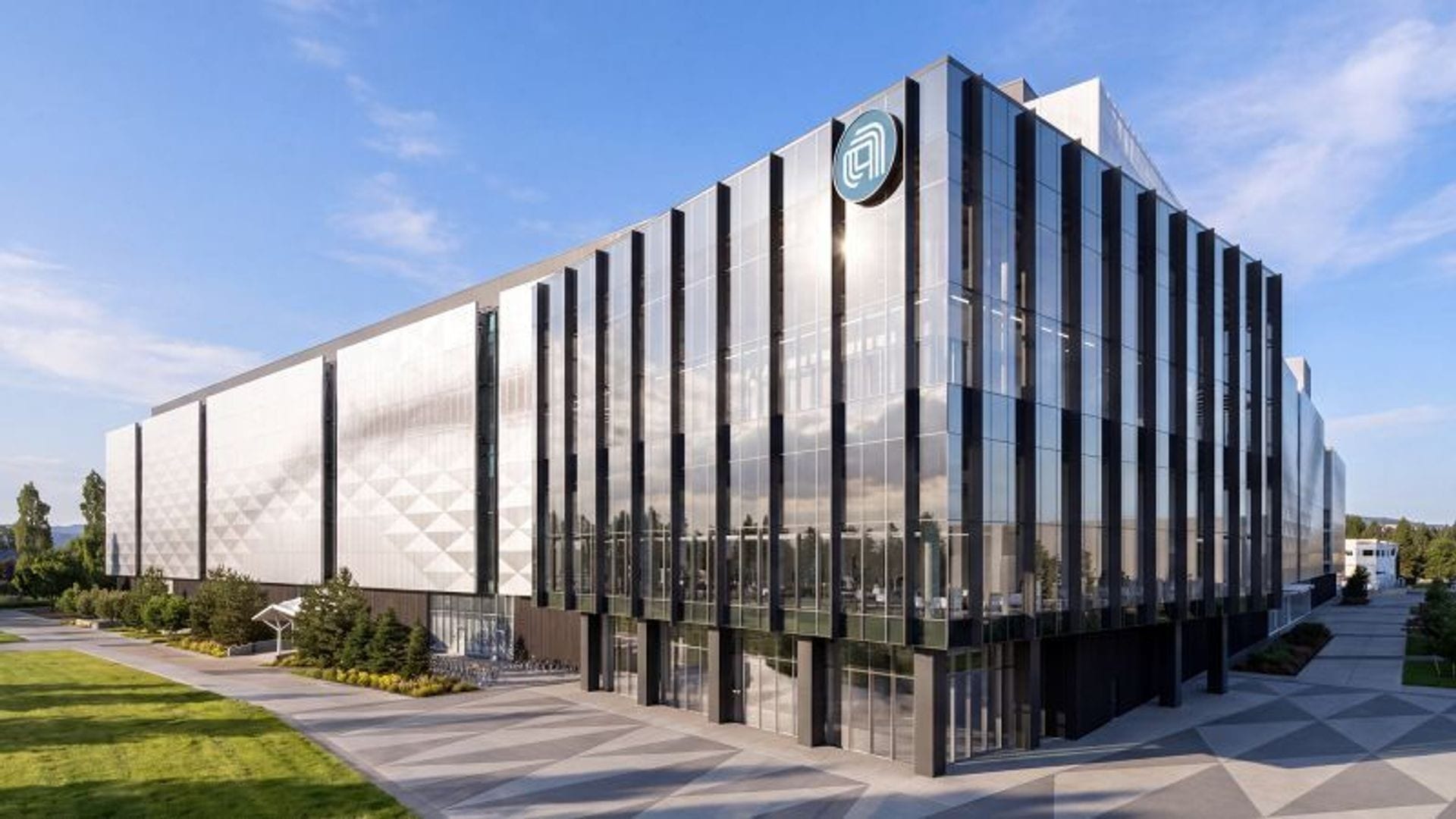
On October 12, 2026, Gary Dickerson, chief executive of Applied Materials−4.61% — Applied Materials, down 4.61 percent today, the largest maker of the tools that deposit, etch and measure the layers of a chip, opened the EPIC Center in Sunnyvale, California: a $5 billion research building where TSMC−2.00% — TSMC, down 2.00 percent today, Intel−5.63% — Intel, down 5.63 percent today, Samsung Electronics+2.62% — Samsung Electronics, up 2.62 percent today, Micron−5.51% — Micron, down 5.51 percent today and SK hynix−6.17% — SK hynix, down 6.17 percent today will develop next-generation chip processes alongside Applied's own engineers, joined by innovation partners including Broadcom−4.11% — Broadcom, down 4.11 percent today, Advantest and Besi−4.80% — Besi, down 4.80 percent today 1. Three days later Intel signed a named collaboration there on transistors, interconnects and Foveros 3D stacking, Intel's technique for stacking chips vertically, pairing EPIC with its Hillsboro, Oregon campus 2. The same week the stock fell 17.6 percent from its October 5 close 3. The commitments run deep: TSMC has told investors its capital spending through 2028 will be significantly higher than the prior three years, ASML−0.28% — ASML, down 0.28 percent today has an order book reaching 2030, and five of the industry's biggest chipmakers have signed into the same building 4. The market cut the shares anyway, pricing the equipment cycle nearer its top than its start.
The 2030 targets are large, dated and margin-led
At its investor day at SEMICON West, the chip industry's annual equipment trade show, Applied set a 54 percent gross margin target for calendar 2030 against 50.4 percent in the August quarter on a non-GAAP basis, the adjusted measure that excludes one-time items 5. Service revenue is expected to exceed $12 billion by 2030, and the eBeam business, electron-beam metrology tools that measure chip patterns for defects, is expected to generate $2 billion in calendar 2026 5. Roughly 75 percent of expected wafer fab equipment growth to 2030, WFE being the industry's term for chipmaking tools, comes from leading-edge foundry-logic, DRAM and advanced packaging, three segments where the company claims the number-one equipment position 5. Chief financial officer Brice Hill described the margin path as about 100 basis points a year on average, a basis point being a hundredth of a percentage point 5. The filings back the direction: gross margin has climbed from 47.3 percent in the quarter ended October 2024 to 50.3 percent in the quarter ended July 2026, while operating margin reached 33.7 percent 56.
Gross margin reached 50.3 percent in the July 2026 quarter against a 54 percent target for 2030
Data
| Gross margin | |
|---|---|
| Oct '24 | 47.3% |
| Jan '25 | 48.8% |
| Apr '25 | 49.1% |
| Jul '25 | 48.8% |
| Oct '25 | 48% |
| Jan '26 | 49% |
| Apr '26 | 49.9% |
| Jul '26 | 50.3% |
The two-point share gain only claws back lost ground
The complication sits in one number. Market data from The Information Network, a research firm that tracks equipment spending, puts Applied's reported WFE share at 20.0 percent in 2024 and 17.9 percent in 2025 7. The promised gain of more than two points lands near 19.9 percent, below where the company stood two years earlier and level with 2023 57. The share target is a recovery, and the base year is the company's own choice. The same data show the ground still shifting: Applied's equipment revenue grew 1.0 percent in the first half of 2026 while Lam Research−4.77% — Lam Research, down 4.77 percent today, KLA−4.37% — KLA, down 4.37 percent today and ASML grew 23.3, 12.6 and 13.3 percent 7. Management also declined to give a WFE outlook, named cleanroom capacity as the biggest near-term limit ahead of lead times, hiring, energy and fab financing, and said access to China has fallen to about 70 percent of the market from full access in the early 2020s, with no leading-edge, DRAM or NAND business there at all 5.
Applied grew equipment revenue 1 percent in the first half of 2026 while peers grew 13 to 23
Data
| H1 2026 revenue growth | |
|---|---|
| Applied | 1% |
| KLA | 12.6% |
| ASML | 13.3% |
| Lam Research | 23.3% |
Two more points of share lands near 19.9 percent, below 2024's 20.0
- Estimate
Data
| Value | |
|---|---|
| 2023 reported | 19.9% |
| 2024 reported | 20% |
| 2025 reported | 17.9% |
| 2030 target (estimate) | 19.9% |
The cycle forecasts point the other way
The Diligence Stack, a forecasting service, lifted its 2026 WFE forecast to about $153 billion, up roughly 28 percent from 2025, and its 2030 figure to about $278 billion, calling its own January bull case the new base 4. A separate tracker sees 2026 at $143.9 billion after a record $116.9 billion in 2025 7. ASML reported a record quarter, raised its 2026 outlook to roughly €44.5 billion and negotiated price increases on its most critical tools for the first time in its history; TSMC raised its 2026 growth outlook to about 44 percent and said AI demand is still far above what it can supply 4. Applied's own account has leading-edge logic and DRAM fabs near full utilization with cleanroom space setting the pace of tool installs 45. The constraint, as Applied describes it, is not orders but cleanroom space: fabs are running full and the tools wait for buildings.
38 times earnings already prices the 2030 targets
At the October 14 close the stock traded at 38.3 times trailing earnings against 22.7 for the S&P 500, while free cash flow slipped to $5.62 billion from $5.82 billion even as net income rose to $9.27 billion 3. History cuts both ways: after 11 falls of more than a fifth since 2010, the shares gained a median 46.5 percent a year later, but only after a median further drop of 20.5 percent 3. Paying 38 times for a share target that recovers 2024 is the trade the market is refusing.
The door opens on November 12
Fiscal fourth-quarter revenue is guided at $9.75 billion to $10.8 billion against $9.12 billion in fiscal Q3, the quarter ended July, with the report due on or around November 12 36. Two outcomes decide the argument, both stated by the company's own framing 5. A print below $9.75 billion, or a fiscal 2027 guide below the $10.25 billion fourth-quarter midpoint, means the withheld outlook was hiding demand, not supply. A print at or above $10.25 billion with gross margin holding the August quarter's 50.4 percent, and a fiscal 2027 guide above it, confirms a supply-constrained cycle. Unresolved either way: the share figures are one research firm's estimates, Applied's own footnote says the $5 billion EPIC capital spending scales up over time as customer projects begin, and the company has said how little it will say about how much of its remaining China revenue sits at nodes a new export rule could reach 157.
Deepdive
AI-generated from this story and its cited sources. Not investment advice.