Attackers faked checkout through a 49,000-store Shopify app as Amazon and eBay block AI shopping agents
Amazon, eBay and the big banks are shutting AI shopping agents out; Shopify let them in and RBC lifted its target into the November 3 print. Days earlier, attackers used Shopify's trusted app settings to fake checkout, and the cost landed on merchants, not the platform.
 Richard Tang · 2 min read
Shopify+0.99% — Shopify, up 0.99 percent today is winning the split over AI shopping agents, and last week its openness was turned against it. Amazon+4.93% — Amazon, up 4.93 percent today is blocking Meta's−0.68% — Meta, down 0.68 percent today Muse agent and has sued Perplexity$20B — Perplexity, private, latest valuation $20B over its shopping assistant, while eBay+0.43% — eBay, up 0.43 percent today, JPMorgan Chase−1.55% — JPMorgan Chase, down 1.55 percent today and Charles Schwab lock agents out of marketplaces and accounts 12. Shopify opened its catalog to more agents and wired Muse to its Shop Pay checkout instead, and on October 16 RBC raised its price target to $200 ahead of results due November 3 13.
Breadth is the upgrade case. RBC analyst Paul Treiber, citing Store Leads data, counts Shopify's merchant base growing at its fastest pace since late 2021 while rival platforms shed active merchants 4.
Shopify's merchants grew while rival platforms shrank
Data
| Value | |
|---|---|
| Shopify, all merchants | 15% |
| Shopify Plus | 24% |
| Rival platforms, avg | -14% |
The growth and the attack came through the same door
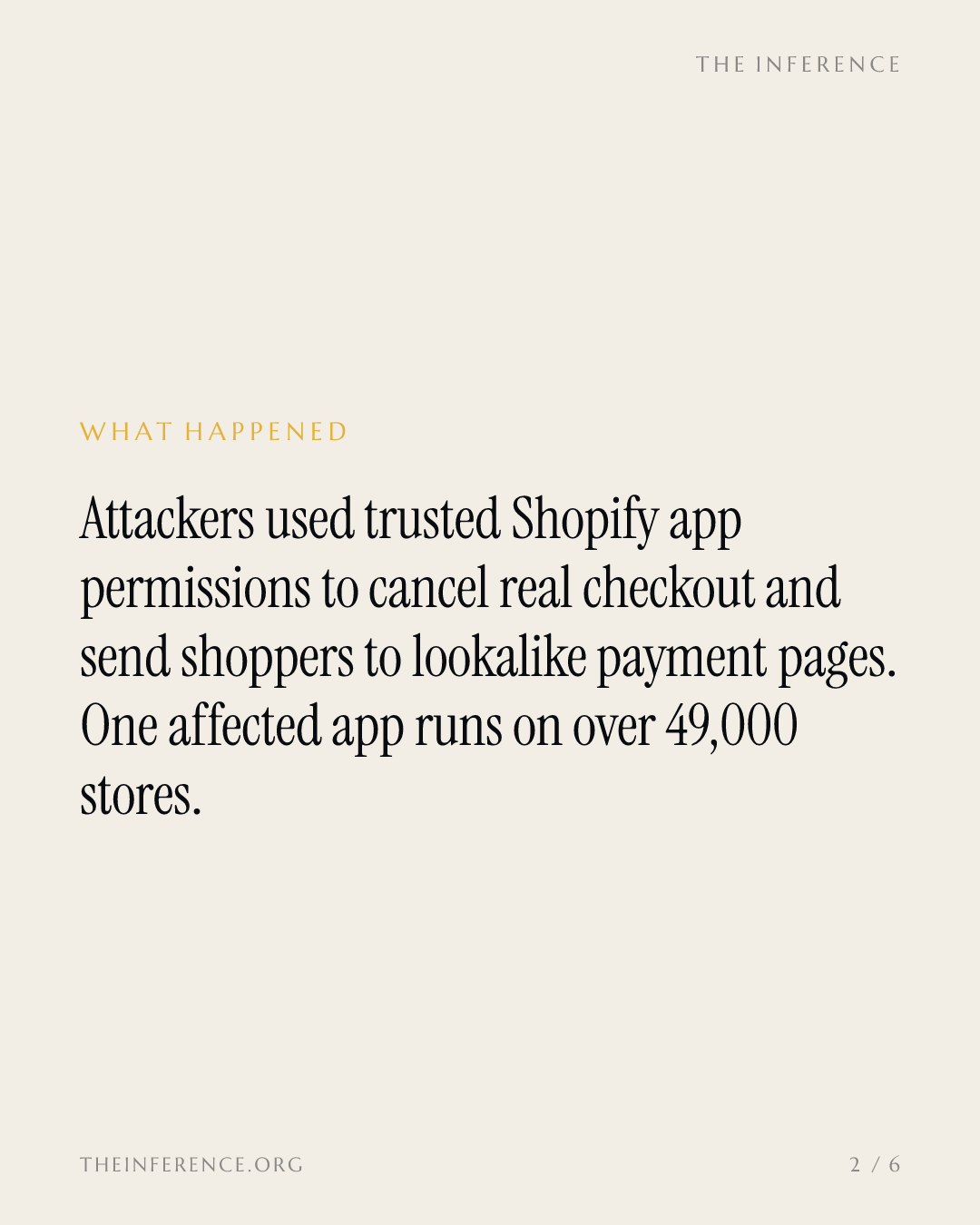
On October 13, intruders entered the internal tools of two app developers, Logbase and HulkApps, and pushed JavaScript through settings that merchants had already granted permission 56. A function named "hijack" canceled the real checkout and moved shoppers to lookalike payment domains, firing once per browser session so a merchant's own retest would eventually reach the genuine page and look clean 56. Selleasy, the upsell app at the center of it, runs on more than 49,000 stores 6. No storefront password was broken; the trusted channel was the weakness 6.
The bill landed one level below the platform. Carly Clarke shut WAGD, her dog-harness store, the night a customer was diverted, and Shopify kept it closed on its own advice until clearing her to reopen only today; her losses are still uncounted 5.
The beat case and the breach are not on the same page
RBC's upgrade, as publicly summarized, rests on merchant growth, pricing power and AI commerce 34; the attack sits outside that case while traveling the same permissions. Consumers already lean wary: 45% of US adults refuse to trust AI with a purchase at all 1. Whether any of this reaches Shopify's numbers on November 3, no published source can say yet.
The mechanism to watch is identity. Amazon insists agents identify themselves before they transact 7; the fake checkout worked because nothing distinguished a trusted rewrite of the payment page from a hostile one. Verified identity for every party that touches the payment moment, app, agent or storefront, is what lets an open platform stay open. Whoever builds that layer is closing the gap between capability and trust, and should be paid for it.
Deepdive
AI-generated from this story and its cited sources. Not investment advice.