Bezos promises three-day workweeks; so far the gains are landing in profits, not pay
Amazon's founder says AI productivity could let Americans support a family on three days of work a week. The second-quarter record shows the gains arriving somewhere else first: unit profits up 17.8%, real hourly pay down 0.1%, labor's share of output at its lowest since 1947.
 Vincent Jiang · 3 min read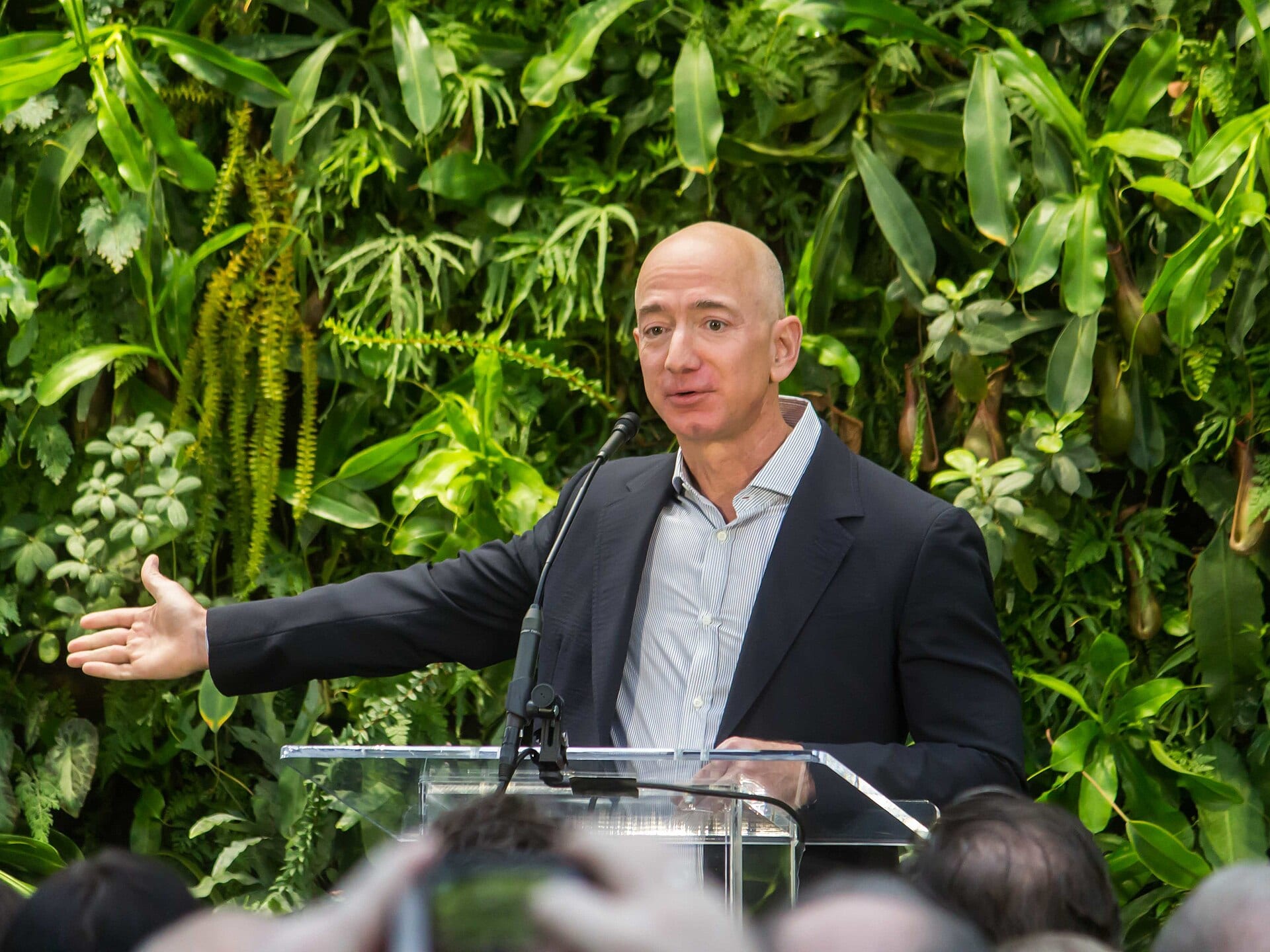
From Blue Origin's factory floor at Cape Canaveral, in an interview aired October 7, Jeff Bezos told Bret Baier where AI productivity leads 1. "Some people will also decide, you know what? I can support my family by working three days a week," he said, predicting double-digit productivity gains and, eventually, difficulty hiring, because people who do not want two jobs will not need them 1.
Elon Musk has sold the same abundance since May 2025, promising "universal high income" for anyone who wants it 7. The forecast is on the table; the payments so far are not.
Thirty thousand cuts, a payroll that still grew
Baier's follow-up was Amazon's+3.31% — Amazon, up 3.31 percent today own org chart: roughly 30,000 corporate roles gone since late 2025, about 14,000 cut in October 2025 and 16,000 more in January 2026, with fewer than 1,000 further cuts landing on October 7 inside the Stores business 123. Bezos blamed pandemic-era overhiring, and the record backs the arithmetic: headcount doubled from 798,000 in 2019 to 1.608 million by 2021 3.
The counterweight matters just as much. Total headcount was 1.595 million at the end of Q2 2026, up 3% year over year 3, and recruiter emails show Amazon courting its own laid-off veterans for open AI and machine-learning roles 2. The record reads less like a shrinking payroll than a remixed one.
Headcount doubled into 2021, then held near its peak
Data
| Total headcount | |
|---|---|
| 2019 | 0.8M |
| 2021 | 1.61M |
| Q2 '26 | 1.6M |
The ledger the thesis has to beat
The productivity Bezos promises is already arriving. Nonfarm business output per hour rose 2.2% year over year in the second quarter 4. What has not arrived is the worker's share: real hourly compensation fell 0.1%, labor's share of output hit 52.8%, the lowest in a series that begins in 1947, and unit profits at nonfinancial corporations jumped 17.8%, their best four-quarter run since 2021 4.
Q2 2026: productivity and unit profits rose, real hourly pay did not
Data
| Value | |
|---|---|
| Nonfarm productivity | 2.2% |
| Real hourly compensation | -0.1% |
| Nonfinancial unit profits | 17.8% |
Amazon's books make the corporate case
Amazon's second quarter is the argument in miniature: revenue of $200.6 billion, up 19.6%; operating income of $27.5 billion, up 43%; AWS up 36.7% to $42.2 billion, its fastest growth in 18 quarters 58. The cash is leaving faster than it arrives. Quarterly capex hit $53.1 billion against that $27.5 billion of operating income, and the 2026 cash capex guide rose to about $220 billion from $200 billion, a raise Andy Jassy tied to memory prices while warning of free-cash-flow headwinds until the new data centers earn 56.
Amazon's quarterly capex has pulled far ahead of its operating income
- Operating income
- Capex
Data
| Operating income | Capex | |
|---|---|---|
| Q3 '23 | $11.2B | $11.3B |
| Q4 '23 | $13.2B | $13.4B |
| Q1 '24 | $15.3B | $13.9B |
| Q2 '24 | $14.7B | $16.4B |
| Q3 '24 | $17.4B | $21.3B |
| Q4 '24 | $21.2B | $26.1B |
| Q1 '25 | $18.4B | $24.3B |
| Q2 '25 | $19.2B | $31.4B |
| Q3 '25 | $17.4B | $34.2B |
| Q4 '25 | $25B | $38.5B |
| Q1 '26 | $23.9B | $43.2B |
| Q2 '26 | $27.5B | $53.1B |
Two dated tests decide it
Two dated tests decide which side keeps the dividend. The BLS prints preliminary third-quarter productivity on November 5, 2026: if output per hour accelerates while labor's share and real pay stay flat, the gains keep their current address 4.
Amazon's Q3 report, guided to $197 billion to $202 billion of sales and $22.5 billion to $26.5 billion of operating income, tests whether the capex converts 78. The consumer test belongs to new Alexa chief Aidan Marcuss, who takes over a unit that has lost money since 2014 and now sells Alexa+ at $20 a month, with triers converting to Prime at nearly 25% higher rates 89.
A $70 gap only conversion can close
The stock already trades the answer. AMZN closed October 9 at $262 against a $332 street target, a gap that holds only if Q3 shows capex of this scale converting into operating income rather than into memory-price inflation 68. The productivity is real. So far, the dividend keeps a different address.
Deepdive
AI-generated from this story and its cited sources. Not investment advice.