Canada's top court reopens SS&C's US$890 million damages claim against BNY Mellon
Canada's Supreme Court has affirmed BNY Mellon destroyed evidence in a data-licensing fight with SS&C, scrapped a US$5.7 million damages award, and sent the number back for reassessment with the bank's missing records now counting against it. SS&C claimed US$889.8 million, and where the reassessment lands is the only number left to fight over.
 Vincent Jiang · 3 min read
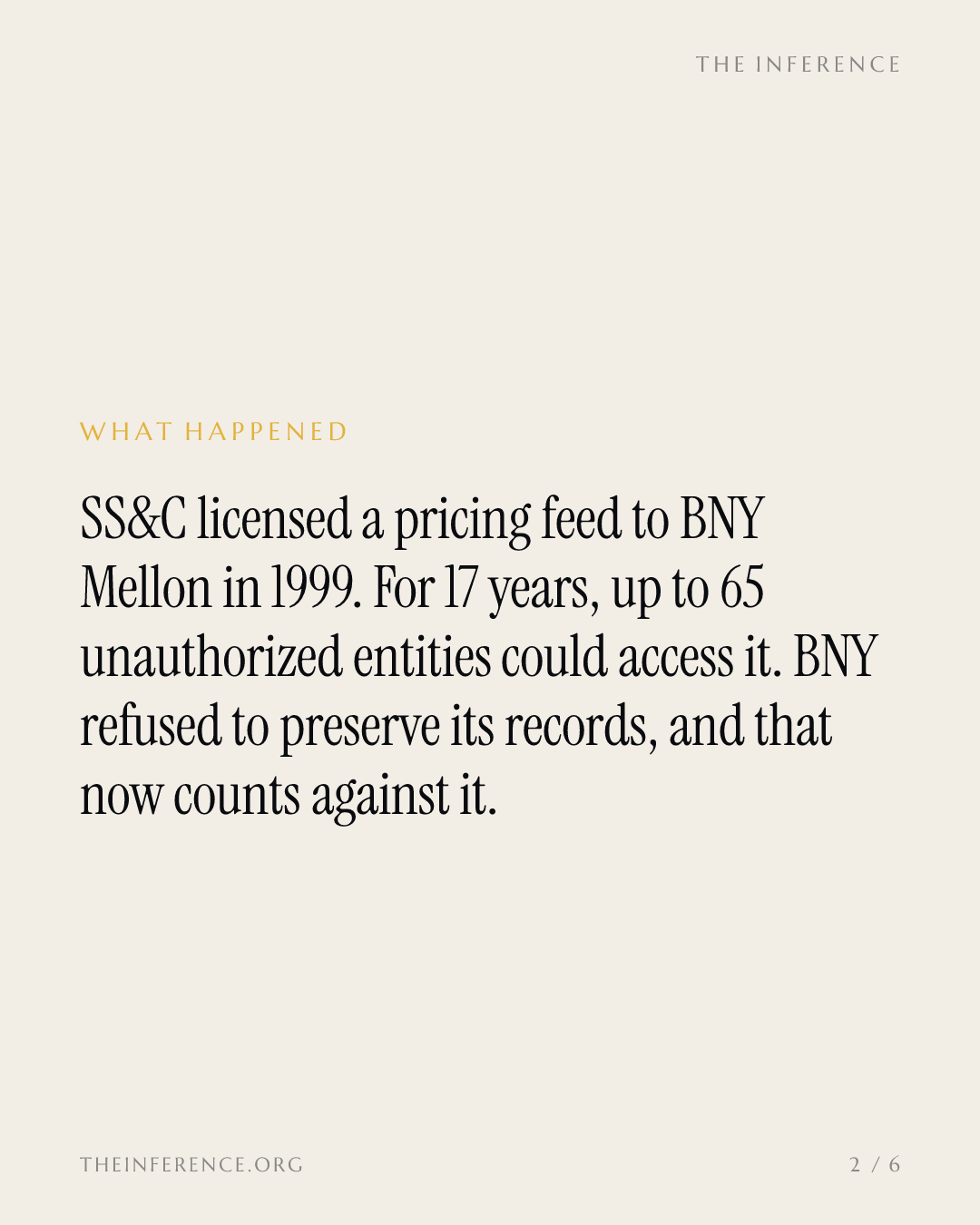
For 17 years, as many as 65 unauthorized entities had access to a securities-pricing feed licensed from SS&C Technologies Canada+0.47% — SS&C Technologies Canada, up 0.47 percent today, and the records of what they took were never preserved 1. In 2016 SS&C asked BNY Mellon−0.08% — BNY Mellon, down 0.08 percent today to preserve its redistribution and earnings records; the bank refused, on the stated ground that it rejected the allegations 2.
On July 31, 2026, the Supreme Court of Canada decided what that refusal should cost 14. In SS&C Technologies Canada Corp. v. Bank of New York Mellon Corp., 2026 SCC 29, it affirmed that BNY had committed spoliation, the intentional destruction or concealment of evidence meant to subvert the truth-finding process, and ruled that the resulting uncertainty now counts against the bank 12.
SS&C claimed US$889.8 million and was awarded under 1 percent of it
SS&C, the world's largest hedge fund and private equity administrator 3, licensed the feed to BNY, the world's largest custodial bank 2, under 1999 agreements that barred redistribution to third parties, including BNY's own affiliates 1.
A Canadian custody joint venture dropped its license in 2011; the data kept flowing anyway, and SS&C found out in 2016 1. At trial SS&C claimed US$889,752,087 and was awarded US$5,696,850 2. The Supreme Court has scrapped that award, in unanimous joint reasons by Justices Côté and Moreau, its first substantive ruling on spoliation since St. Louis v. The Queen in 1896 4.
The trial judge assumed the missing data was shared once
BNY's defense, that its affiliates fell inside the license, failed at every level of court; what reached the Supreme Court was the price 2. The trial judge found BNY could account for only 44.6 percent of the data, then priced the unaccounted 55.4 percent with a "rateable approach" that assumed it was shared once 24.
The Supreme Court called those inferences weak and incomplete, and its worked example runs the other way: the trial judge could have inferred that each of the 65 entities used all the data it could access 2. Destroy the logs, and the court may price the data as if everyone who could take it took everything.
Licensors get a template, licensees the inference
The precedent reaches past these two. A data licensor that assumed unauthorized redistribution was unpriceable now has a Canadian template, and a licensee that ignores a litigation hold now knows what its missing records will be taken to mean 12.
The claim is an option, not a number
What the reassessment produces is open. The scope of the adverse inferences is discretionary and must be proportionate, there is no automatic maximum penalty, BNY can bring evidence to narrow them, and the new hearing runs on the existing record 42. The US$889.8 million is SS&C's allegation, not a finding.
The scrapped award was under 1 percent of the claim, and the claim is half a quarter of BNY profit
Data
| US$ millions | |
|---|---|
| Trial award, set aside | $5.7M |
| SS&C's claim | $889.75M |
| BNY Q2 '26 net profit | $1,761M |
EDGAR's full-text search of quarterly filings returns no BNY Mellon document naming SS&C's Canadian unit 6, and the ruling has surfaced in Canadian law-firm bulletins rather than the financial press 245.
The next numbers are dated: October 22, then the Ontario docket
Sized from the filings, the claim is small for the bank and real for the licensor. SS&C earned $864 million across its last four reported quarters, on revenue that just printed $1.696 billion, up 10.3 percent 78. The stock has climbed about 20 percent since that print, closing at $81.03 on October 9 83. BNY earned US$1.761 billion in the second quarter alone, so the alleged damages are about half of one quarter of its profit 9.
The claim runs to about half a quarter of SS&C revenue
Data
| SS&C revenue | |
|---|---|
| Q3 '24 | $1.47B |
| Q4 '24 | $1.53B |
| Q1 '25 | $1.51B |
| Q2 '25 | $1.54B |
| Q3 '25 | $1.57B |
| Q4 '25 | $1.65B |
| Q1 '26 | $1.65B |
| Q2 '26 | $1.7B |
SS&C reports Q3 on October 22 3. The damages go back to the Ontario Superior Court, where a judge must make concrete findings about usage and value from evidence that no longer exists 14. The reassessment has no date yet, which is why it is still unpriced.
Deepdive
AI-generated from this story and its cited sources. Not investment advice.