Cloudflare blocked 13.47% of AI bot requests in Q3, up from 5.98%; vendors sell agents the way in
Cloudflare's September 15 default change flipped agent access into a paid privilege, and the Q3 denial numbers already show it. The quiet winner may be the bypass vendors selling agents a way over the wall.
 Vincent Jiang · 3 min read
The wall around the web got taller this quarter, and two companies are on opposite sides of it, collecting rent in different currencies.
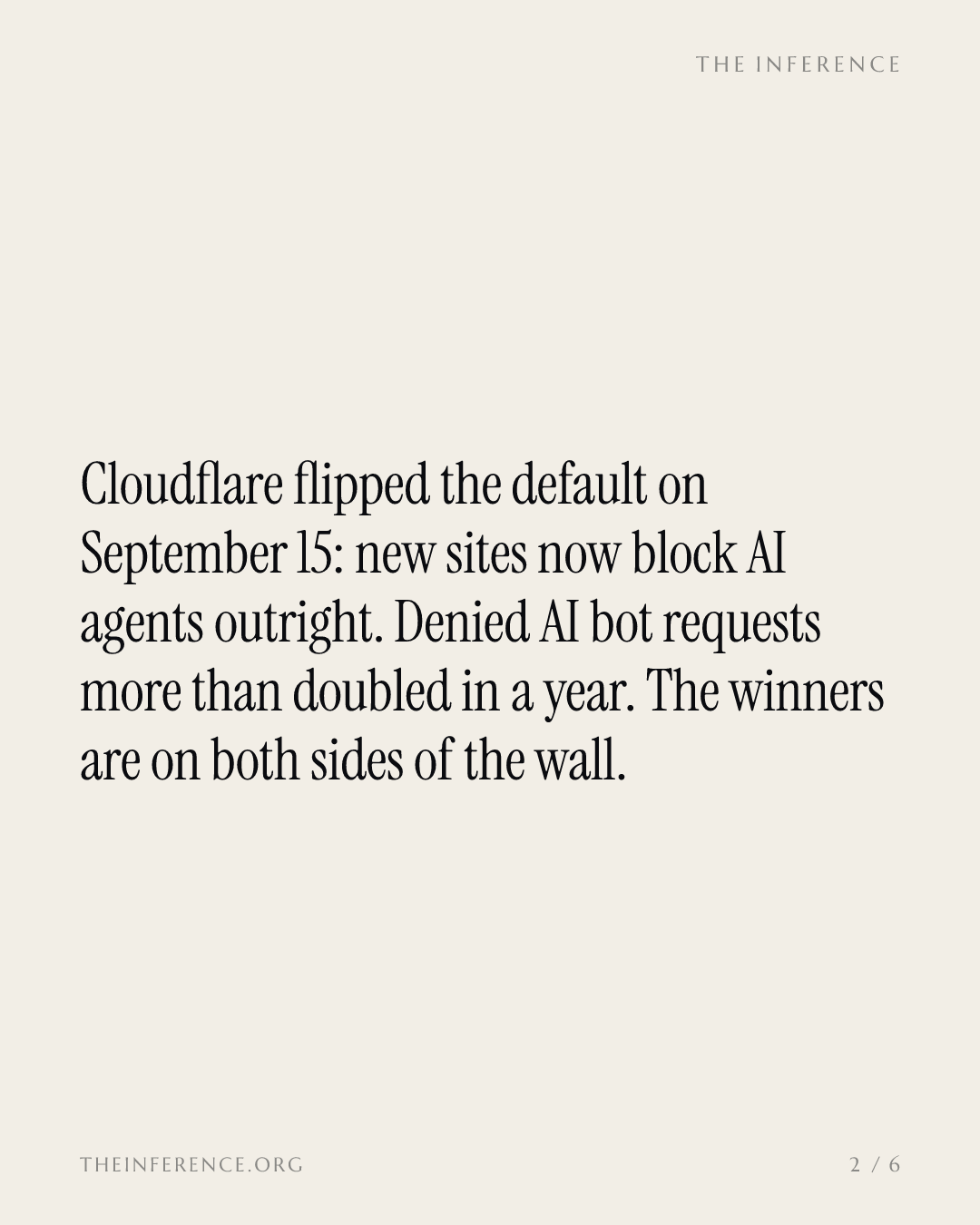
Cloudflare+5.45% — Cloudflare, up 5.45 percent today flipped the default on September 15: new domains on its network now block AI agents outright, and existing sites were shifted to block agents on any page carrying ads 1. The timing shows in the traffic data: websites on Cloudflare's network returned access-denied responses to 13.47% of AI bot requests in the third quarter, up from 5.98% a year earlier, preliminary Radar-derived figures 2. Demand is not shrinking to fit. Search and user-triggered requests, the purpose-driven crawl behind agent answers, jumped from 6.51% to 11.92% of AI crawl activity between the second and third quarters 2. By September, Cloudflare's own data put bots and agents beyond half of all web requests 3.
AI bot denials more than doubled in a year as the default flipped
- Access denied to AI bots
- Search/user-triggered share of AI crawl
- Estimate
Data
| Access denied to AI bots | Search/user-triggered share of AI crawl | |
|---|---|---|
| Q3 2025 | 5.98% | — |
| Q2 2026 | — | 6.51% |
| Q3 2026 (estimate) | 13.47% | 11.92% |
Agents get stranded at the checkout
The blocks are already costing consumers. Amazon+2.70% — Amazon, up 2.70 percent today now blocks Meta's−0.37% — Meta, down 0.37 percent today Muse from browsing or buying on its retail site. Walmart, a Muse partner, strands agents on human-verification buttons it says are accidental. Yelp refuses all non-human traffic unless the agent pays into its data-licensing program 1. Meta's answer is an open agent-to-business standard drafted with Walmart, Stripe, Sierra~$10B — Sierra, private, latest valuation ~$10B, Genesys, Rocket, NiCE and Decagon~$1.5B — Decagon, private, latest valuation ~$1.5B, eight named partners working to separate good bots from bad 1.
The landlord sells both ways
Cloudflare sits in front of roughly a fifth of web traffic 3, and it monetizes the wall from both ends: a marketplace where AI bots pay for the data they access, and a test of a browser built specifically for AI agents 1. Enforcing scarcity is the pitch when the same company sells the key: the more agents it turns away, the more valuable paid entry through its marketplace becomes. A security feature is becoming a tollbooth whose operator controls the queue.
The vendor side is quieter but more pointed. Anakin (YC S21) published its builder guidance on October 6, the same day TechCrunch documented the block wave 4. Its Wire catalog spans 940+ platforms and 4,500+ actions, with bypass of Cloudflare, Akamai, PerimeterX and DataDome built in, per its own marketing and untested here 5. Pricing runs 1 credit per scrape, a flat 2 per Wire action, $12 to $900 monthly, and failed jobs are not billed 6. That last term is the business model in miniature: as defaults harden, failure becomes the default experience for DIY agents, and unbilled failures push volume toward whoever guarantees the crossing.
The fork for the money
If the eight-party standard formalizes paid access, the toll operators win twice and bypass vendors get squeezed toward licensed partnerships; the draft's breadth (Stripe for payments, Walmart for retail, Sierra for enterprise agents) is the signal it means business 1. If the standard stalls, the moat deepens. Either way, the free web agents were promised is being repriced, one 403 at a time.
Deepdive
AI-generated from this story and its cited sources. Not investment advice.