Coinbase's futures just stopped expiring. CME's still do.
A CFTC division letter now lets any US futures exchange delete the expiration date on stock-index perpetuals, with conversions due by October 20. The single-stock filings everyone is waiting on are still pending, and CME is already in court against the regime.
 Vincent Jiang · 3 min read
A letter with a fifteen-day fuse
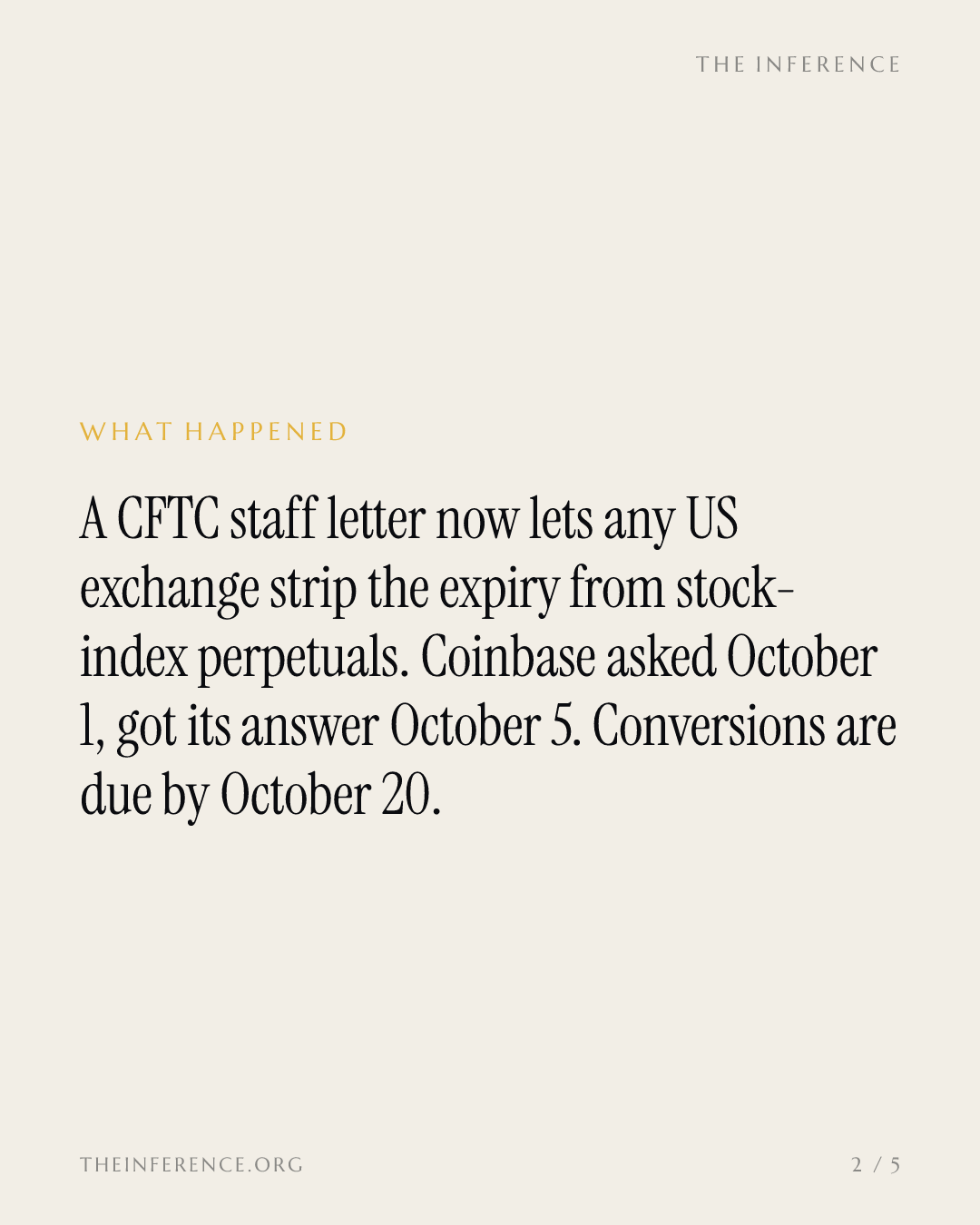
On October 5, 2026, the CFTC's Division of Market Oversight answered a October 1 request from Coinbase Derivatives: any designated contract market may now strip the expiration date from broad-based stock-index futures, contracts listed with expiries as far as 25 years out 1. The relief waives the 10-business-day wait that follows a self-certified rule change and expires on October 20 1.
Holders get the protections. Before converting, an exchange must ask traders with open positions about possible harm, give at least five calendar days' notice and let them close out under the old terms; staff wrote the repricing "may be impossible to anticipate" 1.
Eighteen weeks from bitcoin to the S&P
Each clearance forced the next filing. On May 29 the CFTC cleared bitcoin perpetuals and sent anything else to full Commission review 1; Coinbase's 25-year expiries were a hedge against that uncertainty, the letter says 1.
Kalshi took the product route around the policy. Its August 18 filing for a broad-based index perpetual, tracking a MerQube index of 500 large US companies 2, was deemed approved on October 2, which the division treats as confirmation such contracts are futures 1.
The pile-on followed on September 18, when Coinbase, Kalshi and Kraken parent Payward, the last through Bitnomial, filed for single-stock and ETF perpetuals, still pending 13; Kalshi's list reaches 58 names above $100 billion apiece 4.
Whose money this moves
CME took the dated route, 77 single-stock futures launched July 27 15, 55 names plus 22 micros 5. The design sells the calendar: two consecutive quarterly contracts per name, so holders close and re-establish the position every quarter, paying rollover cost and spread risk 5.
The toll shows in margin: 15% of notional for an outright position, 5% of the higher leg for the calendar spread that executes the roll 5. A perpetual deletes the roll and the expiry, paying funding instead 1.
The push comes on a shrinking base. Quarterly revenue has fallen from $2.27 billion in Q4 2024 to $1.22 billion in Q2 2026, the last three quarters GAAP losses 67; the bet is derivatives, live offshore at 10x leverage 6. Kraken puts 2025 crypto perpetual volume above $60 trillion, a company figure 1.
Coinbase's quarterly revenue has almost halved from its Q4 2024 peak
Data
| Total revenue | |
|---|---|
| Q3 '24 | $1.21B |
| Q4 '24 | $2.27B |
| Q1 '25 | $2.03B |
| Q2 '25 | $1.5B |
| Q3 '25 | $1.87B |
| Q4 '25 | $1.78B |
| Q1 '26 | $1.41B |
| Q2 '26 | $1.22B |
Two regulators, one courtroom
The letter binds the Division of Market Oversight, not the Commission, and staff kept the right to end it 1. CME sued the CFTC on June 18, arguing perpetuals are swaps under Dodd-Frank; the agency's September 2 dismissal motion called the alleged competitive harm "much ado about nothing" 6.
Coinbase is hedging the jurisdiction: its September 1 SEC notice rests on the Commodity Futures Modernization Act of 2000, apart from the self-certification route CME attacks 6. The securities corridor moved too: OKXICE, OKX's venture with NYSE owner ICE, noticed a 24/7 tokenized-stock venue on October 4, 60-plus names, Cerebras objecting 89.
The filings that decide it
Watch the paperwork, not the letter. Regulation 40.6 amendments due by October 20 name which contracts convert 1; the single-stock and ETF applications sit pending with no schedule 13.
CME's single-stock suite has been live a month with no product-level volume or open interest published 5, so the displacement trade is priced on paper, not data. CME sells time; the CFTC's staff just let its rivals sell the absence of it.
Deepdive
AI-generated from this story and its cited sources. Not investment advice.