CoreWeave Mortgages the Future. Its Founders Take Cash.
A $104 billion backlog proves customers want the compute. Interest already equals a quarter of sales, and CoreWeave's newest loan runs about two years past the average contract behind it.
 Vincent JiangSeptember 10, 2026 · 4 min read
Michael Intrator sold approximately $25.1 million of CoreWeave shares on September 1 through personal and LLC holdings. The sales followed a November 2025 trading plan; he still holds substantial stock.1 His liquidity is real. So is his remaining exposure.
For public shareholders, the excitement is a September 9 forecast: CoreWeave's backlog could exceed $150 billion before 2028.2 That forecast could come true while the stock disappoints. A customer ordering more compute has not promised you a good return.
The backlog and the bill
CoreWeave rents the computing infrastructure AI companies need. Its June backlog was $104.2 billion, according to its August earnings presentation.3 Earning that revenue requires delivering the capacity and meeting service requirements. The equipment, power and financing have to be paid for along the way.
This is where backlog worship gets expensive.
In Q2, CoreWeave reported $2.575 billion of revenue and $640 million of net interest expense. Interest alone equaled about 25% of sales. The company finished the quarter with a $626 million net loss.5 These are unaudited results; the percentage is calculated.
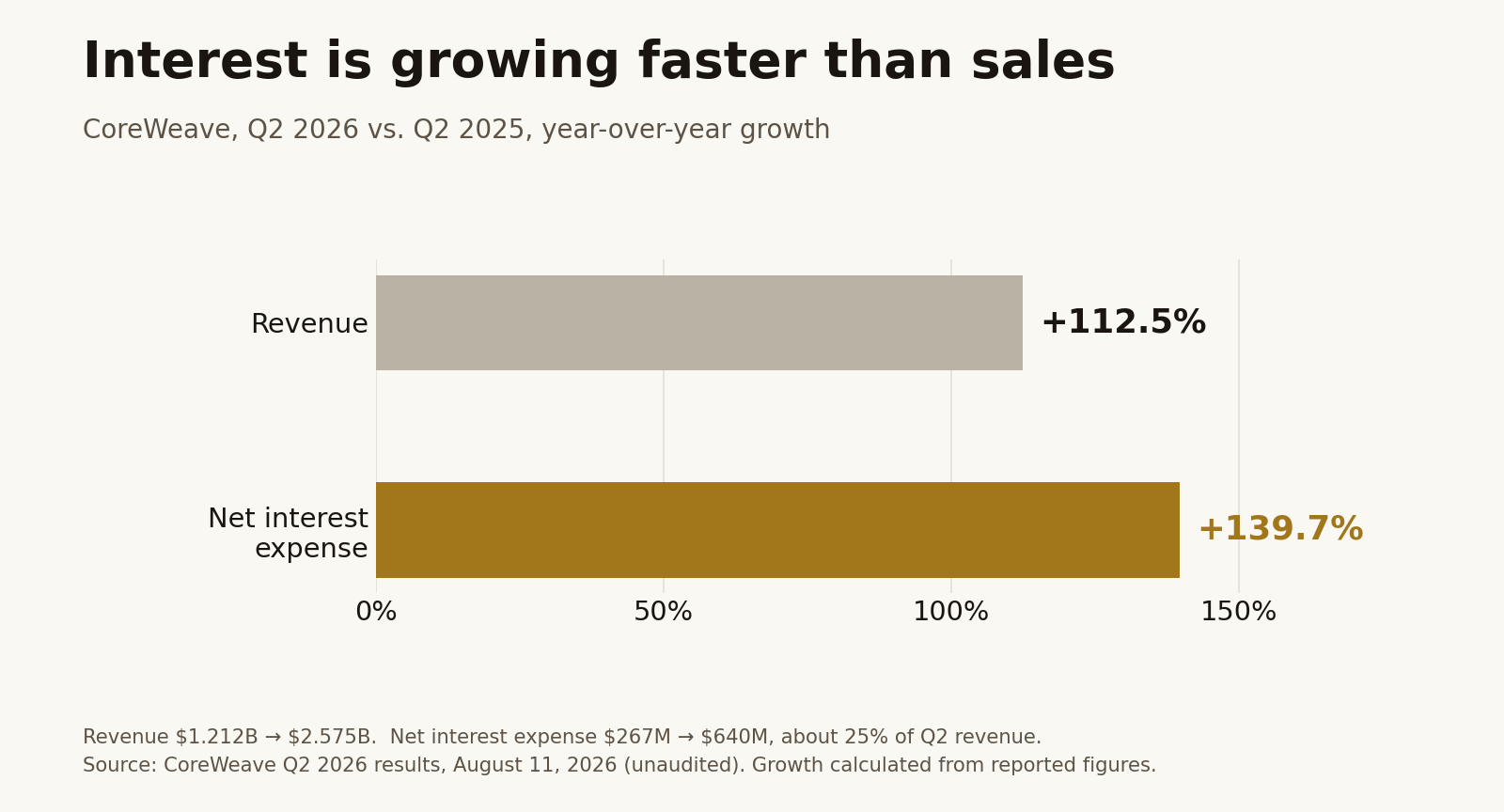
CoreWeave's customers can get their GPUs, its lenders can collect interest, and its shareholders can still lose money.
A loan that outlasts its contracts
The more revealing announcement came August 10. CoreWeave closed a $2.6 billion loan facility with an approximately five-year maturity. Its underlying customer contracts average three years.6 Earlier facilities had customer contracts extending through debt maturity. This one stretches beyond the average initial customer commitment.
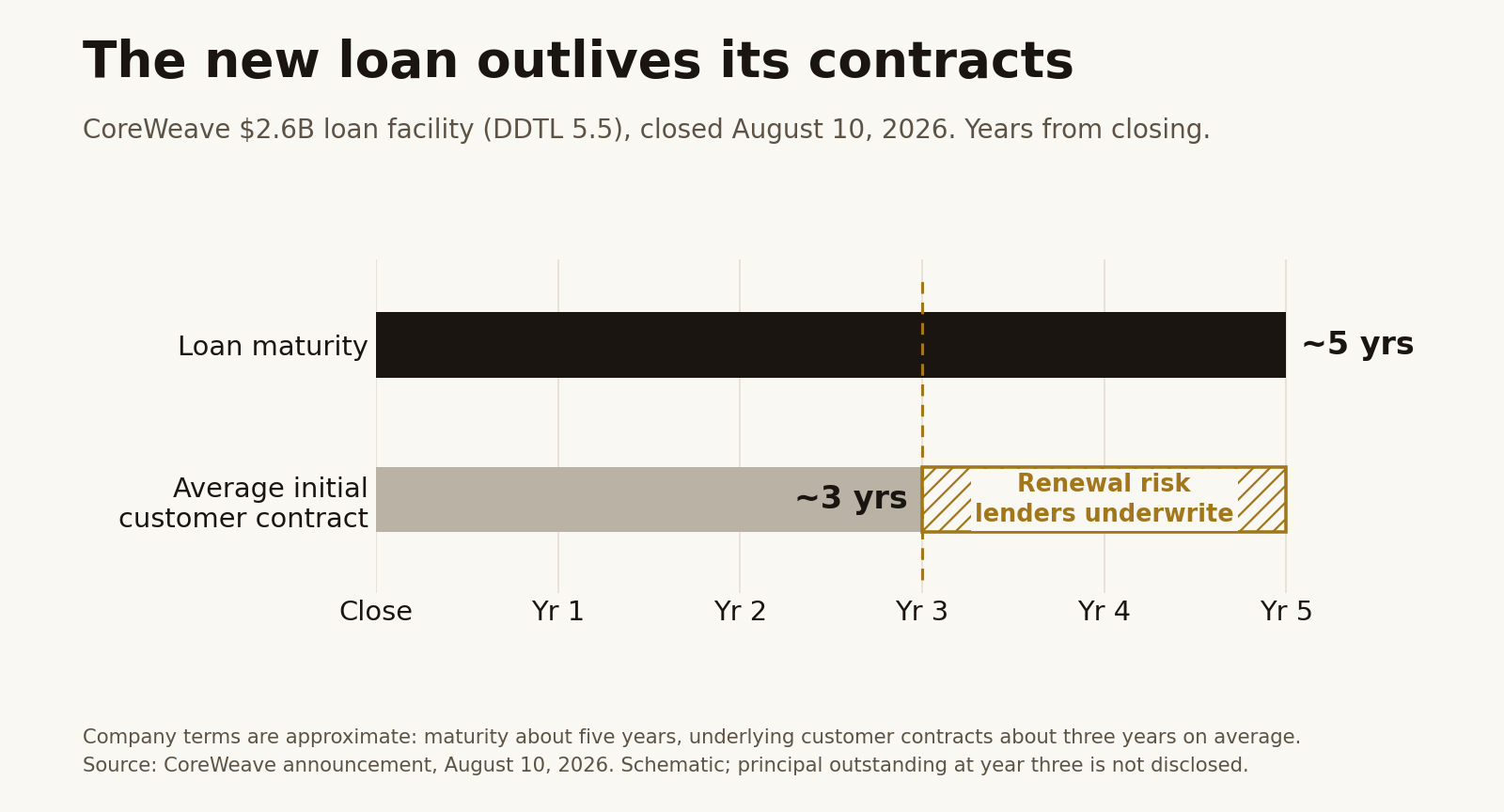
Co-founder Brannin McBee called the financing a “major unlock.” The company explicitly says lenders are willing to underwrite renewal risk.6 Shorter contracts can command higher prices and attract more customers. That flexibility has value. It also makes the economics after the first contract expires part of the underwriting.
How much principal will remain at that point? The announcement does not establish it. That is the number investors need before declaring the structure safe or doomed.
The parent is still on the hook
Subsidiaries do not automatically insulate the parent, either. Before this new facility, approximately 90% of June's reported debt carrying value was classified as recourse: direct parent obligations or obligations unconditionally guaranteed by the parent.4
The bull case, and what it leaves out
The strongest bull argument is that the machines earn enough to justify the borrowing. CFO Nitin Agrawal says a typical five-year contract delivers attractive returns while fully repaying the asset-level debt used to fund it. He also reported an A100 contract extending into 2029.11 Older chips can keep working after newer chips arrive.
There is physical evidence behind the growth: Core Scientific reported approximately 395 MW of CoreWeave-related capacity had begun billing by June 30.12 CoreWeave also generated positive operating cash flow in the first half while investing heavily.4 Expansion can consume cash before it produces returns.
But a profitable original contract and an attractive public stock remain separate achievements. Shareholder returns depend on the cash remaining after debt service and necessary reinvestment.
What to ask at the next earnings call
At the next earnings call, Intrator should show what mature deployments have earned after financing, how much of their debt they have repaid, and what remains at renewal. Another giant booking would demonstrate demand again.
Ask him about the contracts already delivered.
How this brief was made
01Gathered & sourced328 channels · 1,171 articles▾
Agents swept 328 channels and ingested 1,171 articles, then de-duplicated and ranked them for signal.
02Verified & cross-validated24 claims · 34 data feeds▾
Every one of 24 load-bearing claims was checked against primary sources, with 34 live data feeds reconciling the figures and charts.
- 1SEC Form 4, Michael Intrator, transactions Sep 1 2026 (307,692 shares; ~$25.1M gross, calculated from weighted prices; Nov 20 2025 trading plan).
- 2The Motley Fool, Sep 9 2026 (backlog above $150B before 2028; a forecast that acknowledges delivery and financing risks).
- 3CoreWeave Q2 2026 earnings presentation, Aug 11 2026 ($104.2B backlog at June 30; early-Q3 commitments disclosed separately, not added).
- 4CoreWeave Q2 2026 Form 10-Q, filed Aug 12 2026 (Note 10 recourse split; first-half operating cash flow; unaudited).
- 5CoreWeave Q2 2026 results, Aug 11 2026 (revenue, net interest expense, net loss; unaudited; interest is an accounting measure, not cash paid).
- 6CoreWeave, Aug 10 2026 ($2.6B DDTL 5.5; ~5-year maturity against ~3-year average contracts; lenders underwrite renewal risk).
- 7Nvidia, Jan 26 2026 ($2B equity investment and expanded collaboration; context, not evidence of demand).
- 8CoreWeave and Jane Street, Apr 15 2026 (~$6B compute commitment; separate $1B equity investment, which is not cloud revenue).
- 9CoreWeave and Meta, Apr 9 2026 (~$21B expanded agreement through Dec 2032; not added to backlog again).
- 10CoreWeave, Apr 10 2026 (multiyear Anthropic agreement; no dollar value disclosed or inferred).
- 11CoreWeave Q2 2026 earnings call transcript, via The Motley Fool, Aug 18 2026 (CFO Nitin Agrawal on five-year contract economics and an A100 contract into 2029).
- 12Core Scientific Q2 2026 Form 10-Q (about 395 MW of CoreWeave-related capacity billing by June 30; a separate reporting company).
- 13CoreWeave docs changelog, Mar 20 2026 (Omni product; no disclosed earnings contribution).
- 14CoreWeave, Sep 10 2026 (Physical AI Field Engineering launch; not booked revenue).
- 15CoreWeave and Parallel Works, Sep 9 2026 (DARPA NODES research deployment; no deal value disclosed).
- 16Forbes, Sep 22 2025 (founder profile; background only, historical wealth figures not reused).
- 17All-In podcast, Mar 23 2026 (Intrator interview via transcript; the founder's own account).
- 18Bloomberg Law, Jun 9 2026 (executives sold over $2.3B since IPO, Washington Service data).
- 19r/CRWV, Aug 2026 (bullish Q2 discussion; hypotheses, not verified results).
- 20r/BetterOffline, Aug 2026 (backlog-versus-obligations post; its shortcut is not used here).
- 21r/CRWV, Sep 2 2026 (shareholder frustration over insider selling; establishes neither motive nor price effect).
- 22r/CRWV, Sep 8 2026 (Goldman Sachs conference discussion; quotations not independently verified).
- 23TechCrunch, Mar 29 2025 (co-founder Brian Venturo interview; crypto-to-cloud background).
- 24Axios, Aug 13 2026 (shares rallied after earnings despite deeper losses).
03Reviewed & edited1 human editor▾
One editor read the draft against the evidence, tuned the framing, and signed off before it shipped.
Confidential tips
Know something about this story? We protect our sources. Reach the editor directly, or read our guide to sharing securely.
Deepdive
AI-generated from this story and its cited sources. Not investment advice.