F5 lands Telenor's sovereign AI contract, then patches three 9.2-severity NGINX flaws
In one week, Telenor made F5 the service plane of its Nvidia-powered sovereign cloud and F5 rush-patched three 9.2-severity NGINX flaws, on top of a nation-state breach record. The company selling the trust layer of AI clouds keeps supplying evidence against its own premium.
 Vincent Jiang · 2 min read

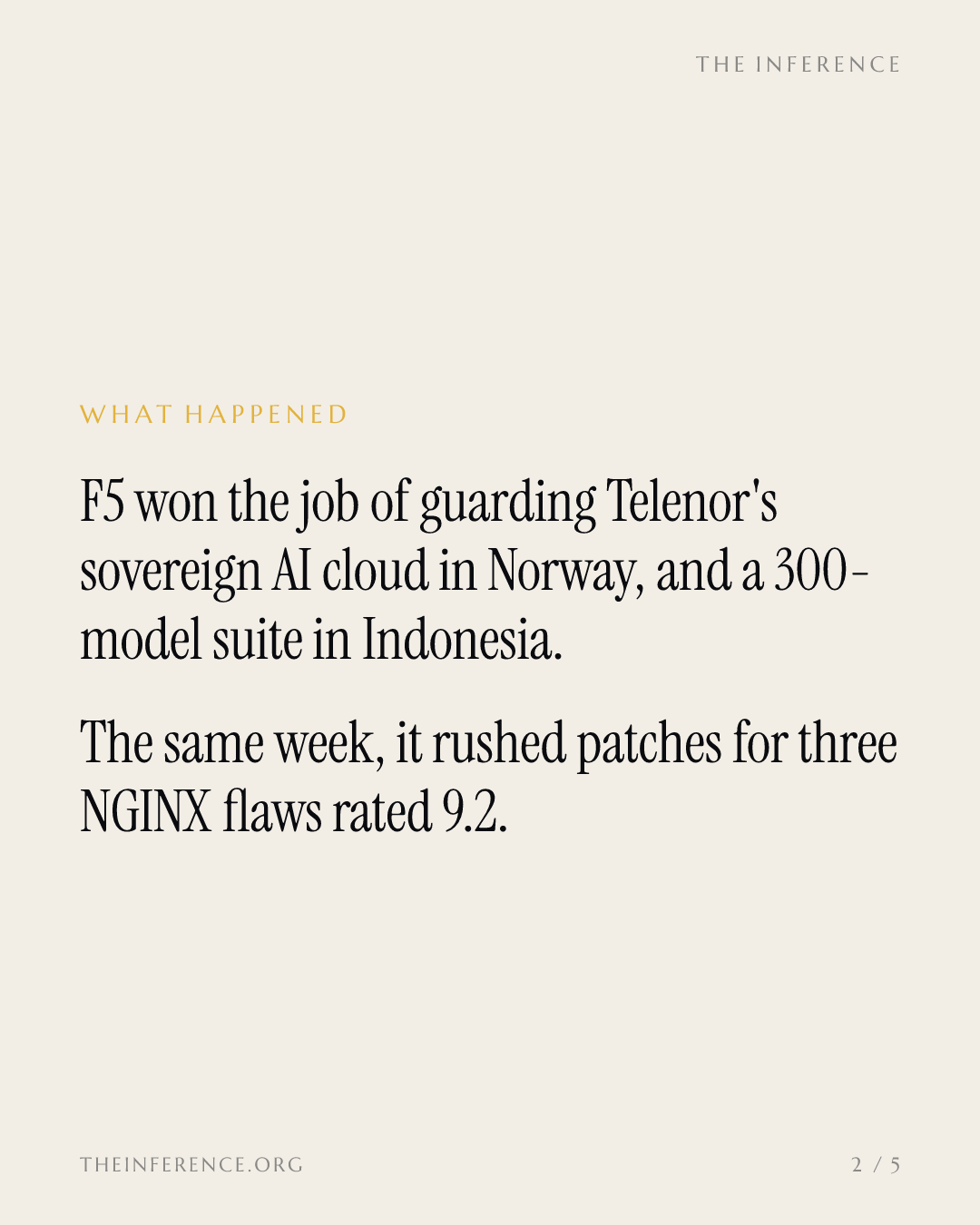
On October 21, Norway's Telenor named F5 the AI service plane of its sovereign cloud: BIG-IP Next for Kubernetes, running on Nvidia+2.47% — Nvidia, up 2.47 percent today BlueField-3 DPUs, sits in the data path of Telenor AI Factory to enforce tenant isolation, policy and traffic control, with token-aware governance planned for entitlement and billing workflows 2. The day before, Indosat's Intelligence Suite in Indonesia put F5 in the same seat: one governed layer over more than 300 AI models, with F5's+0.41% — F5, up 0.41 percent as of its last quote technology metering, routing and logging what enterprises consume 345.
The same week, F5 shipped out-of-band emergency patches for three NGINX flaws rated 9.2 in CVSS v4, CVE-2026-15176, CVE-2026-97205 and CVE-2026-93479, each able to crash servers, execute code or take services down 1.
The lock and the rap sheet belong to the same product
The complication is that these are not separate businesses. NGINX is the reverse proxy and load balancer where transport layer security terminates, so code execution there means seeing passwords, session cookies, API tokens and private keys in the clear, as Frank Dickson of Dickson Research put it 1.
And the record is not clean. Over five years, CISA has flagged eight actively-exploited F5 vulnerabilities, four used in ransomware; a 2025 nation-state breach of BIG-IP drew Emergency Directive 26-01 1. May's NGINX Rift bug shipped with a public proof of concept 1. NGINX hides inside ingress controllers, appliances and Linux distributions that patch on their own clocks, so a fix on F5's site does not patch the servers 1.
F5 revenue, eight straight quarters, now 865 million dollars a quarter
Data
| Revenue | |
|---|---|
| Q3 '24 | 746.67$M |
| Q4 '24 | 766.49$M |
| Q1 '25 | 731.12$M |
| Q2 '25 | 780.37$M |
| Q3 '25 | 810.09$M |
| Q4 '25 | 822.47$M |
| Q1 '26 | 811.7$M |
| Q2 '26 | 865.08$M |
The growth engine is real, and so is the clock
The receipts say the revenue is real. F5's quarterly sales have climbed from $746.7 million to $865.1 million over eight quarters, growing 10.9% year over year in the latest, with 80% of the Fortune 500 already among its customers 16. Sovereign AI adds a new buyer: governments that want data kept in-country, from Oslo to Jakarta, and are willing to pay for a governed front door.
The strongest counterpoint: none of this week's flaws are known to be exploited, and they need specific configurations to bite 1. Fair. But a company selling the meter and the lock of sovereign AI clouds has now disclosed critical front-door flaws in May, June and October of one year 1. F5 reports earnings on October 27 5. Watch what it says about AI revenue, and watch whether the patch cadence holds.
No source dates which arrives first, the sovereign-AI revenue or the next breach. The seven days just ran both races at once.
The daily newsletter