FDA orders NAION vision-loss warning on every GLP-1 label; Novo Nordisk up 2.65%, Eli Lilly up 4.28%
The FDA's class-wide vision-loss warning on the world's biggest drug franchise rests on ten probable cases against five among placebo patients; Novo Nordisk and Eli Lilly rose on the news, and hundreds of blindness suits now hold a federal exhibit.
 Vincent Jiangthree-minute read
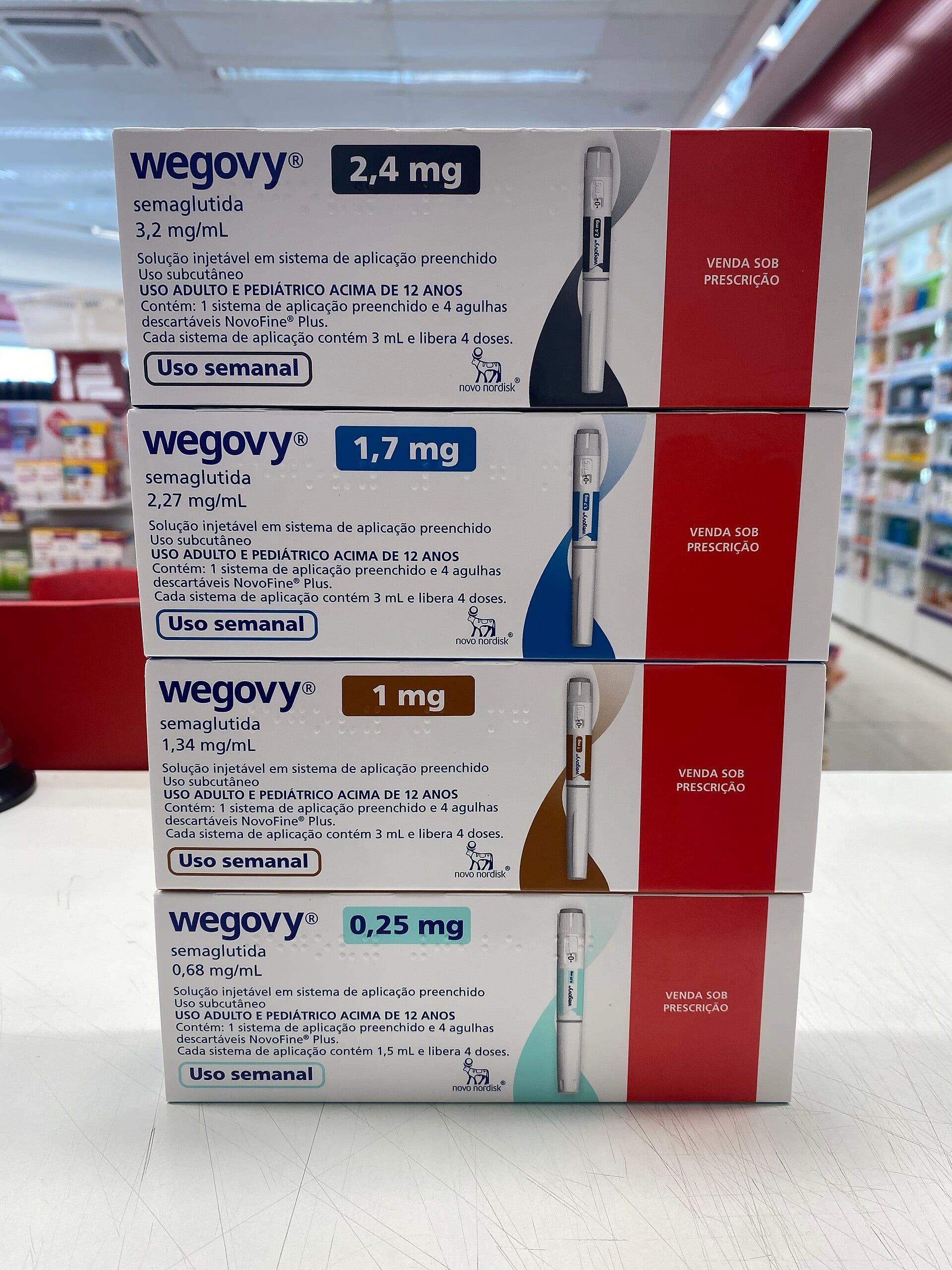
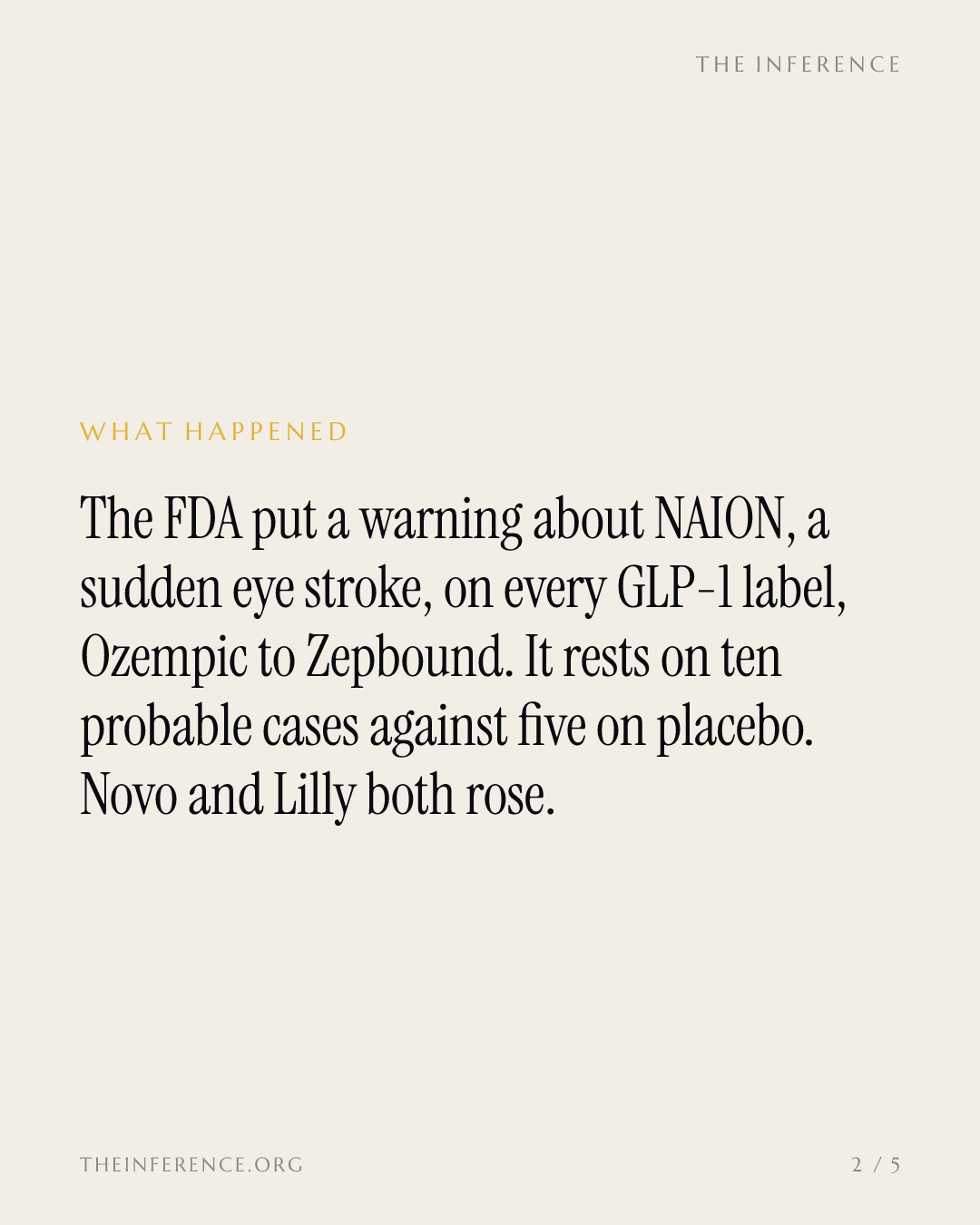
On Monday the FDA required every maker of a GLP-1 drug, the class behind Ozempic, Wegovy, Mounjaro and Zepbound, to add a warning about NAION to the Warnings and Precautions section of the label 1. NAION, nonarteritic anterior ischemic optic neuropathy, is an eye stroke: blood flow to the optic nerve drops, vision in one eye goes suddenly and painlessly, and no treatment reverses it 2. The order reaches the whole class, from liraglutide and dulaglutide through tirzepatide to the oral pill orforglipron, sold as Foundayo 3.
Novo Nordisk−1.56% — Novo Nordisk, down 1.56 percent today said the data "do not establish a cause-and-effect relationship"; Eli Lilly+1.44% — Eli Lilly, up 1.44 percent today said the action "does not reference any findings specific to Lilly medicines" 2. The same announcement carried the agency's first guidance on GLP-1 use in pregnancy 2.
Ten cases against five
The math that moved the biggest drug franchise on earth is small in both directions 1. The FDA pooled 126 randomized trials covering 134,253 patients and 288,879 person-years of exposure and found 15 probable NAION cases: 10 among GLP-1 users, five on placebo, none on non-GLP-1 diabetes drugs 1. That is 6.4 cases per 100,000 person-years on the drugs against 3.8 on comparators, roughly double the relative risk 1.
Background incidence in adults over 50 runs 2.3 to 10.2 per 100,000 per year 1. Ten cases against five across two decades of trial data is why Novo can say the numbers do not prove cause, and why the FDA put the warning on anyway.
Small trial gap, no real-world gap versus SGLT-2
A doubled relative risk on trial data, none of it visible against SGLT-2
Data
| Value | Range | |
|---|---|---|
| Trials: GLP-1 | 6.4 per 100k PY | — |
| Trials: comparator | 3.8 per 100k PY | — |
| Sentinel: GLP-1 | 31 per 100k PY | 30–32 per 100k PY |
| Sentinel: SGLT-2 | 31 per 100k PY | — |
| Sentinel: DPP-4 | 26 per 100k PY | — |
The evidence cuts both ways
The agency's own real-world Sentinel analysis found no statistically significant excess versus SGLT-2 inhibitors, a hazard ratio of 1.19, but a significant one versus DPP-4 inhibitors, 1.43 1.
Europe moved earlier and narrower: in June 2025 the EMA's safety committee concluded NAION is a very rare side effect of semaglutide, up to 1 in 10,000 users, and told patients to stop the drug if it occurs 4. The US order goes broader, class-wide rather than semaglutide-only, but softer, asking doctors to consider discontinuing rather than to stop 5. Published studies remain mixed, which is the honest reading of a 0.0026 percent absolute difference 6.
Whose money moves
The market read it as noise: Novo Nordisk closed up 2.65 percent and Eli Lilly up 4.28 percent on the day 7. The plaintiff bar will not.
A federal multidistrict litigation consolidated in December 2025 held 247 NAION plaintiffs as of October, and the FDA's own class-wide warning is now a government document those suits can quote 8. Patients with diabetes and obesity carry elevated NAION risk already, and they get a warning with no cure attached 2.
What to watch
Prescription trends, not the label. Watch monthly US prescription data for prescribing friction, MedWatch reports for case counts, and MDL filings, where the FDA's words now circulate as an exhibit. The tell is whether the stricter European rule, stop the drug on diagnosis, migrates into US practice; the FDA has so far declined to go that far 14.
Get Health by email, free
AI in medicine, pharma and biotech. In our daily email, every weekday.