GM pays interest to wait in line for chips as automobile industry experiences memory shortage
AI data centers absorbed the memory supply that cars run on, and GM is answering with a direct Micron deal plus a $4.5 billion prepay facility backed by JPMorgan and Santander. The buyer now borrows at SOFR plus 1.55%; the seller runs an 84.6% gross margin.
 Vincent Jiangthree-minute read

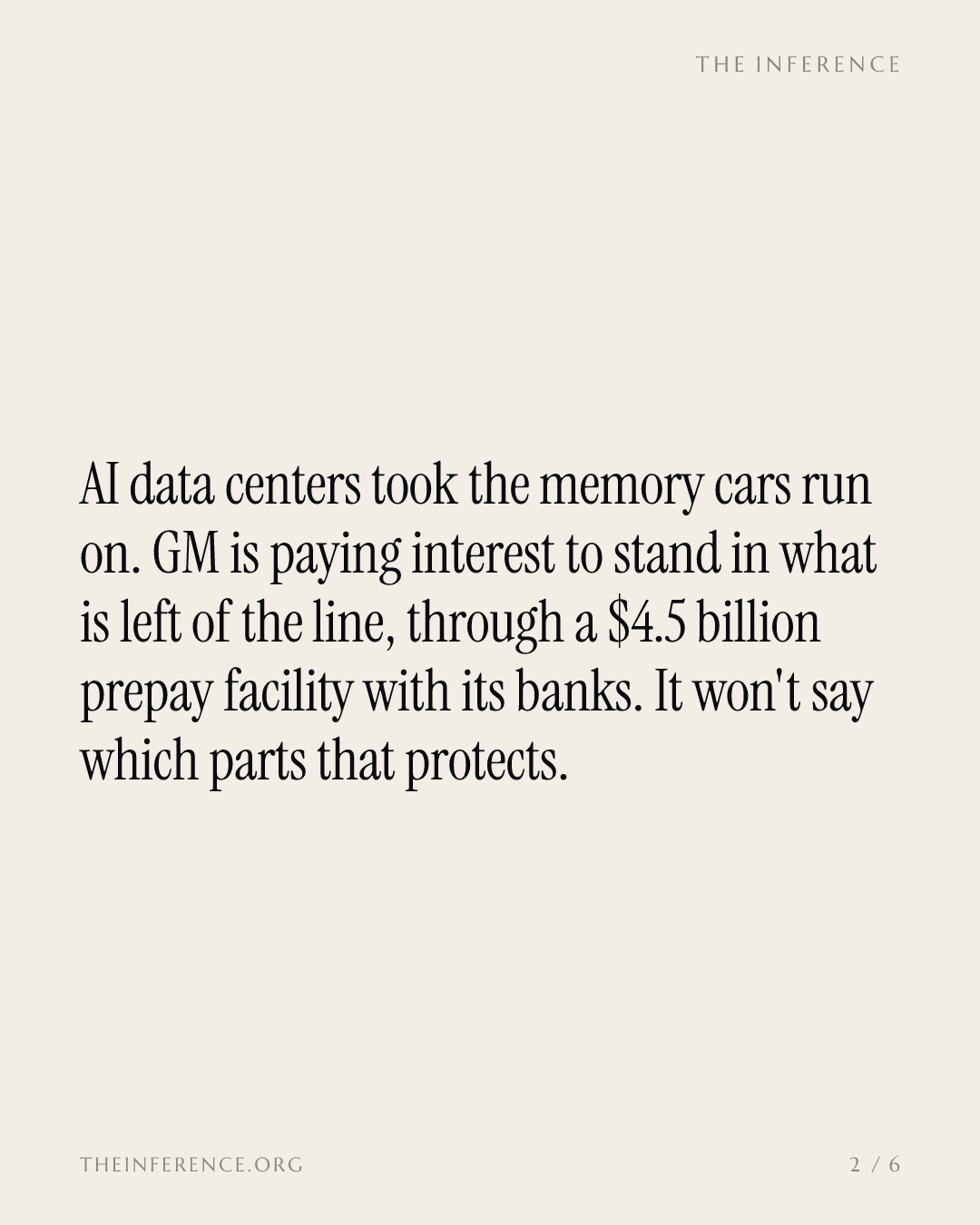
The chips that watch the road in a Chevrolet now compete for fab time with the GPUs training AI models, and the carmaker gets what the cloud leaves over. On 1 July, General Motors signed a Strategic Customer Agreement with Micron for LPDRAM, NOR and UFS NAND, the certified memory behind driver assistance and digital cockpits, supplied in part from the $2 billion Manassas, Virginia fab 12. Data centers were the first stop, as The Inference charted in Memory Is Eating the AI Boom. The assembly line is next.
A $4.5 billion parts warehouse, kept off the books
The hedge goes further than a contract. In an 8-K filed 7 August, GM set up a purchasing facility of up to $4.5 billion: Procura Auto Parts, funded by a JPMorgan Chase and Santander syndicate, prepays suppliers to buy and hold inventory set aside for GM's production lines 34.
GM guarantees the banks repayment with irrevocable payment undertakings that accrue interest at SOFR plus 1.55% a year and fall due by 6 August 2029. The prepayments stay outside adjusted automotive free cash flow until GM consumes the parts 14.
Which parts the money protects, GM has not said 34.
The buyer borrows; the seller sets the price
The filing stack sets one piece of arithmetic against another: GM pays interest at SOFR plus 1.55% to hold inventory it declines to specify, while Micron−4.50% — Micron, down 4.50 percent today, the chipmaker it just signed, keeps 85 cents of every sales dollar 135. The buyer finances the stockpile. The seller prices it.
Sixteen contracts and a sold-out fab
Micron's May quarter booked $41.46 billion of revenue, up 346% year over year, at an 84.6% gross margin, with the September quarter guided to roughly $50 billion 56. High-bandwidth memory is sold out through 2026 6.
Micron's gross margin has run from 18.5% to 84.6% in ten quarters
Data
| GAAP gross margin | |
|---|---|
| Q1 '24 | 18.5% |
| Q2 '24 | 26.9% |
| Q3 '24 | 35.3% |
| Q4 '24 | 38.4% |
| Q1 '25 | 36.8% |
| Q2 '25 | 37.7% |
| Q3 '25 | 44.7% |
| Q4 '25 | 56% |
| Q1 '26 | 74.4% |
| Q2 '26 | 84.6% |
The lock-in runs wider than GM. Around the May quarter Micron signed its first multi-year strategic customer agreements, partially fixed-price deals worth roughly $22 billion, and the GM contract is one of 16 26. Ford followed five days later with its own, and seven more sit with automotive partners including Denso, Hyundai Mobis and Qualcomm−3.52% — Qualcomm, down 3.52 percent today, understood to lock volumes and prices for three to five years 79.
A cycle, all the same
GM calls the deal proactive, not a response to any current disruption 1. S&P Global Mobility still puts automotive DRAM contract prices up 70 to 100% in 2026 against 2025, and Morningstar prices the supplier accordingly: "a particularly strong and particularly durable up-cycle, but a cycle all the same" 16.
Buyers have a second door: Samsung overtook Micron in automotive memory last year, 40% to 36%, per S&P Global Mobility data 7. Denso's withdrawn bid for Rohm, followed by power-chip integration talks among Rohm, Toshiba and Mitsubishi Electric, shows the industry reaching for the same control 18.
September 30 sets the queue
Whether car buyers pay for all of this is the part no source can prove yet; nothing ties DRAM escalation to 2027 sticker prices. Micron reports fiscal Q4 on 30 September, and the tell is fiscal Q1 guidance 69. If the sold-out era stretches into 2027, the line GM is paying interest to stand in gets longer, not shorter.
Revenue has gone from $5.8B to $41.5B in ten quarters, with roughly $50B guided for September
- Revenue
- Estimate
Data
| Revenue | |
|---|---|
| Q1 '24 | $5.82B |
| Q2 '24 | $6.81B |
| Q3 '24 | $7.75B |
| Q4 '24 | $8.71B |
| Q1 '25 | $8.05B |
| Q2 '25 | $9.3B |
| Q3 '25 | $11.32B |
| Q4 '25 | $13.64B |
| Q1 '26 | $23.86B |
| Q2 '26 | $41.46B |
| Q3 '26 (guide) (estimate) | $50B |
Get Chips by email, free
How AI demand is reshaping chipmakers, memory and the fabs behind them. In our daily email, every weekday.




Reader comments
0 comments