Google's Gemini Robotics 2.5 hit 96% on live Mercedes production lines, with no order or price attached
The model belongs to Alphabet, and the hardware's one US-listed pure-play just posted $1.8 million of revenue against a $138.1 million net loss. The question the eight-outlet coverage skipped is who gets paid, and how much, when a 96% demo becomes an order.
 Vincent Jiangthree-minute read
A robot worked the line, and no register rang
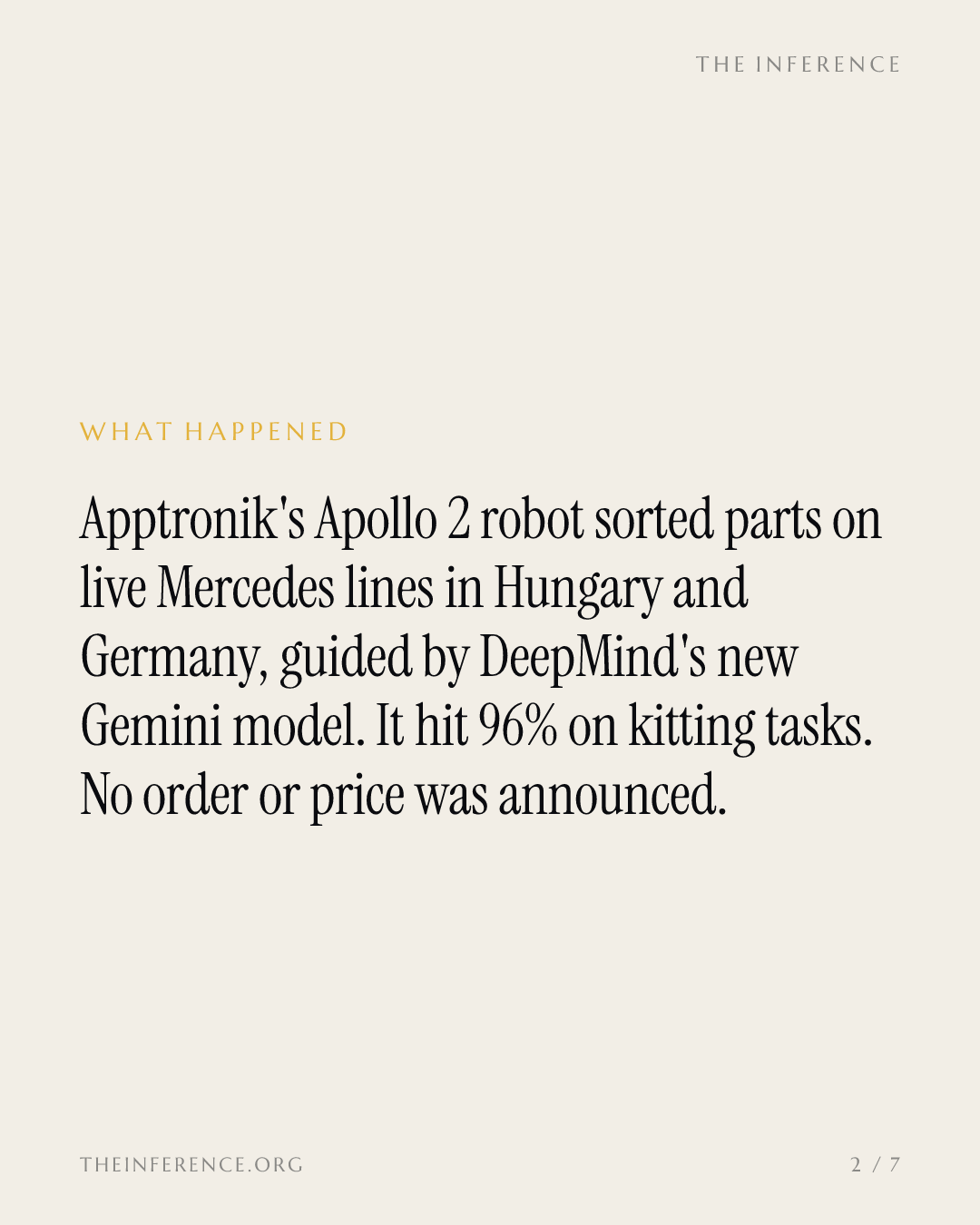
On November 10, 2026, Apptronik's~$1B — Apptronik, private, latest valuation ~$1B Apollo 2 humanoid reached into supply bins on live Mercedes-Benz production lines in Kecskemét, Hungary and Sindelfingen, Germany, and kitted metal brackets into build-order trays at a 96% success rate, directed by Google DeepMind's new Gemini Robotics 2.5 model 1. Kitting is the repetitive job of sorting parts into the exact sequence each vehicle needs. The model is a vision-language-action system: instructions and live camera video become robot movement. Across 200 lab tasks it beat its predecessor by 30 to 100% on success and 20 to 30% on speed 1.
The win carried no terms
DeepMind's post calls the factory work a proof-of-concept, names no contract, no order count and no price for robot or model, and says the software is merely "rolling out to our robotics partners" 1. Eight outlets compared by one aggregator led with the same 96% 2. Apptronik, the Austin maker of Apollo, is private: nearly $1 billion raised at a valuation of about $5.5 billion, one-seventh of Figure AI's$34.81B — Figure AI, private, latest valuation $34.81B $39 billion 34. Mercedes-Benz, which owns the lines, has announced no order.
Google stands on both sides
Alphabet's+2.69% — Alphabet, up 2.69 percent today lab built the brains; Google also holds a stake in the body. It joined Apptronik's $350 million Series A in February 2025 5, and industry reporting says it has invested in every Apptronik round 4. The fine print is thinner than the headline: DeepMind director Kanishka Rao calls the remaining four points of reliability a "steep road", the launch video ran at twice real speed, and the model still runs on cloud servers rather than on the robot 6.
The only filed economics are Agility's
The sector's one US-listed pure-play, Agility Robotics, reached Nasdaq on November 5, 2026, through a $465 million SPAC merger 3. Its filings show $1.8 million of revenue against a $138.1 million net loss, about 1,400 times last year's sales 37. Its $300 million order book is, in the company's own wording, not current-period revenue, it comes largely from a single customer with financial ties to Agility, and 64% of 2025 revenue came from related parties 37.
Digit 5's materials bill falls to $30K only at 10,000 robots a year
The cheap humanoid exists only in Agility's projections
- Materials cost per Digit 5
- Estimate
Data
| Materials cost per Digit 5 | |
|---|---|
| Initial build (estimate) | $150K |
| 1,000 robots a year (estimate) | $75K |
| 10,000 robots a year (estimate) | $30K |
Weeks, not years, says the other side
Apptronik chief executive Jeff Cardenas calls the Mercedes pilot "what we built Apollo for", and says the models improved "dramatically in just a few weeks of post-training" with "very little drop-off" on live production 1. Apollo 3, the first fully commercial machine, is due in 2027 4. Apptronik discloses no revenue, so the pace claim has no money against it.
What converts the demo into a business
The dated event to watch is Mercedes-Benz turning a pilot into an order with a price attached. This newsroom reported in October that Gemini had taught Apollo to land seven straight shots from video alone 8; the live production line is the step since. The 96% belongs to Alphabet's model; the losses, so far, all belong to the hardware 8.
Get Robotics & Defense by email, free
Robots, self-driving vehicles, drones and AI in defense. In our daily email, every weekday.