Greptile drops the seat fee and charges $1 a review
Customers found the meter the week of November 6, and one engineering team has already made the agent its merge gate. Whose money moves: the seat-priced holdouts, and anyone marked on Greptile's $750 million valuation.
 Vincent Jiangthree-minute read
The merge gate got a meter
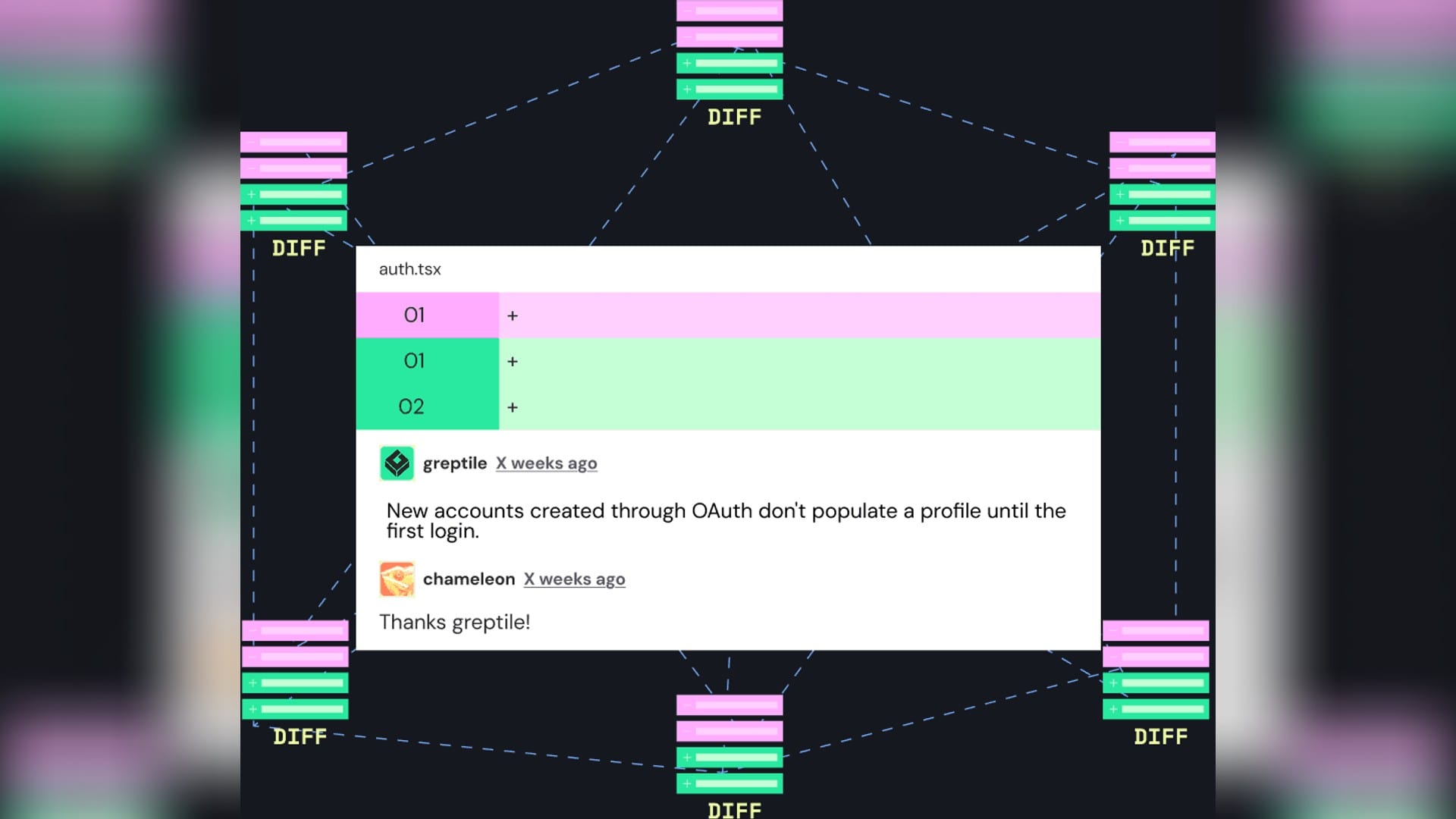
Greptile sells the AI agent that reviews your pull requests before they merge. This month its customers discovered the agent bills by the review: $1 per credit shared across the whole organization, one credit for a standard review, ten for an Apex review of a large change 12. The company's own pricing page states it plainly, and the same page drops the old seat fee: "Pro has no seat fees." 12
Customers found out in public the week of November 6 34. Thomas (@bentlegen) posted an investor update and asked followers to guess when the $1 charge began; Collin Qian called the bill "tough." 34 Founder and CEO Daksh Gupta answered the only way a usage biller can: the goal is for Greptile to block merges on bad pull requests, the correctness bar is high, and more tokens cost more, so price tracks the model. 5
Verification became the bottleneck
The workload behind that meter is compounding. Greptile's own State of AI Coding report puts lines of code per developer at 3.5x between June 2025 and June 2026, with median pull request size up 79%, and the company says it reviews more than 1% of all pull requests opened on GitHub daily for customers including Nvidia−3.21% — Nvidia, down 3.21 percent today, Coinbase−3.34% — Coinbase, down 3.34 percent today, Decagon~$1.5B — Decagon, private, latest valuation ~$1.5B and Vanta. 17
Brex's fall 2026 data shows why: firms that bought a coding agent were about six times as likely to add a companion service such as a sandbox, testing or hosting within six months (13.7% versus 2.3%), and about sixteen times as likely to add a sandbox or testing service specifically (3.3% versus 0.2%). 8
Coding-agent buyers are six times likelier to add a testing or sandbox service within six months
- Bought a coding agent
- Did not
Data
| Bought a coding agent | Did not | |
|---|---|---|
| Added a sandbox, testing or hosting service | 13.7% | 2.3% |
| Added a sandbox or testing service | 3.3% | 0.2% |
The last seat in town
Every dedicated vendor has followed the meter except one. 1 Cursor Bugbot left its $40 seat for usage billing averaging $1.00 to $1.50 a run; Qodo sells pooled credits at about $1.67 a review; GitHub−0.28% — GitHub, down 0.28 percent today Copilot code review draws on AI credits and, since June 1, 2026, on Actions minutes. 1 CodeRabbit alone still prices per developer: $24, $48 and $72 a month. 1 The comparison's own math gives the decision rule: a CodeRabbit Essentials seat at $24 beats Greptile's $1 review only past roughly 24 reviewed pull requests per developer per month. 1
The same review volume bills four ways, $400 to $667 a month
The meter and the seat land within $200 of each other
Data
| Value | Range | |
|---|---|---|
| Greptile standard | $400 | — |
| CodeRabbit Essentials | $480 | — |
| Cursor Bugbot | $400–600 | 400–600/mo |
| Qodo credits | $667 | — |
On Gupta's own logic, Greptile's revenue tracks inference cost and pull-request volume, a second charge for code a model already charged to write. The reported $50 million Series B at a $750 million valuation, led by Menlo Ventures on October 19, was set under three weeks before the bill went public. 1
The team that dropped the second reviewer
On November 6, engineer Devon Estes described his team's month-long experiment: a pull request merges when continuous integration passes, Greptile returns a clean review and the ticket owner approves, with no second engineer required on every change 6. One month of practice, his own caveat. 6
Volume has to outrun the price of models
Watch pull-request volume against model prices: per-review revenue only beats deflation if volume outruns it. The next reading is Greptile's next investor chart, the one Thomas promised this time. 3
The bill for AI-written code is paid twice, once to write it and once to check it.
Get Platforms by email, free
The cloud, data and developer software AI is built on. In our daily email, every weekday.




Reader comments
0 comments