Index funds paid $300.91 for Twilio the week Meta and Verizon raised the fees Twilio bills as growth
Index trackers took 34.89 million shares at $300.91 on the eve of Twilio's S&P 500 debut, the same week its pricing pages began passing through new Meta WhatsApp fees and a higher Verizon toll. Ten points of Q2 messaging growth was carrier pass-through, and the CEO filed to sell again.
 Vincent Jiang · 3 min read
Index funds paid $300.91, then went home
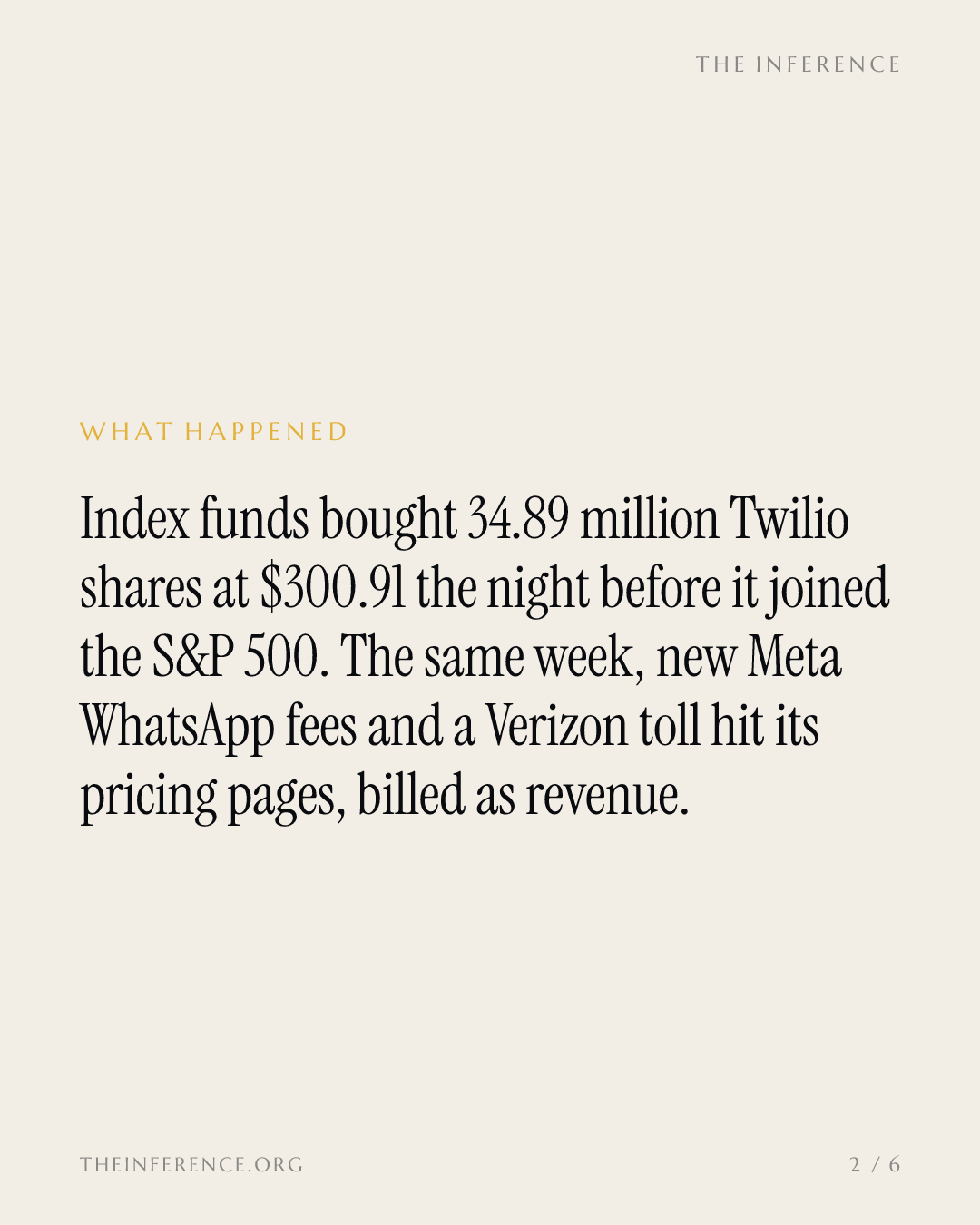
Twilio opened its first session as an S&P 500 member on October 6, promoted from the MidCap 400 to replace Warner Bros. Discovery, now part of Paramount Skydance 5. The night before, the passive machine did its one day of work: 34.89 million shares at the $300.91 close, ten times normal volume, roughly $10.5 billion of stock 2. That buyer does not come back.
Two days earlier, the tolls went up
On October 4, Twilio's WhatsApp pricing page changed course.1 It now warns that inside the 24-hour customer service window, Meta charges for utility template messages and non-template outbound service messages, where the page had said no Meta fee applied 6. The US SMS page now lists a Verizon long-code carrier fee of $0.005 per outbound segment and $0.0042 for every other carrier, up from $0.0045 and $0.004 71. Twilio passes the fees through and bills them as revenue 7. Meta and the US carriers set these tolls and keep the cash; Twilio's shareholders get the growth optics 17.
Verizon's long-code fee rose 11% the week Twilio joined the index
- Before October 4
- After
Data
| Before October 4 | After | Change | |
|---|---|---|---|
| Verizon long-code | $0.005 | $0.005 | +11.1% |
| All other carriers | $0.004 | $0.004 | +5.0% |
Ten points of the growth is a receipt
Management has already done this arithmetic. Second-quarter messaging revenue rose 28%, and about 10 points of that was carrier pass-through fees 8. The fees added 5 points to the 116% net expansion rate and will shave roughly 210 basis points from 2026 non-GAAP gross margin while, in management's framing, leaving absolute profit dollars untouched 8. Tolls raise the top line and nothing else, at a 48.6% gross margin 3. The underlying acceleration is still real: reported growth climbed from 4% to 22% in ten quarters 10.
Revenue growth climbed from 4% to 22% in ten quarters, into the index debut
Data
| Revenue growth, year over year | |
|---|---|
| Q1 '24 | 4% |
| Q2 '24 | 4.3% |
| Q3 '24 | 9.7% |
| Q4 '24 | 11% |
| Q1 '25 | 12% |
| Q2 '25 | 13.5% |
| Q3 '25 | 14.7% |
| Q4 '25 | 14.3% |
| Q1 '26 | 20% |
| Q2 '26 | 22% |
The selling is scheduled; the AI traffic is real
Chief executive Khozema Shipchandler filed a Form 144 on October 5 proposing to sell 14,442 shares, about $4.2 million, after $4.09 million on September 30 and $3.04 million in July 4. EDGAR lists the same notice roughly monthly back to mid-2023, under a Rule 10b5-1 plan adopted on February 18 9. Nothing in the record ties the sales, or the page change, to the debut. Voice revenue did grow more than 20% on AI agent traffic, and organic growth ran 17% against the reported 22 82.
The CEO's proposed sales have grown as the stock ran to $300
Data
| Proposed sale value | |
|---|---|
| July 2026 | $3.04M |
| September 30, 2026 | $4.09M |
| October 5, 2026 | $4.2M |
What the forced buyers paid
The 41.87 trailing price-to-earnings multiple rests on second-quarter GAAP earnings of $6.68 a share, which carried a one-time non-cash tax benefit of $5.91 28. The average analyst target sits at $262.18, consensus at $263.04, both below the price index funds just paid 23. Third-quarter organic growth is guided down to 11 to 12% 28. Index funds bought the toll road the week the tolls went up; the Q3 print shows who else is driving on it.
Deepdive
AI-generated from this story and its cited sources. Not investment advice.