Lilly sells a modelled 57% diabetes-risk cut on Foundayo just as its drug prices fall
Lilly's new ATTAIN-1 post-hoc data sells a modelled cost-savings case to payers in the same year management told investors Zepbound prices are falling and volume must carry the growth. That makes the pill's evidence both the volume engine and the discount lever.
 Vincent Jiangtwo-minute read

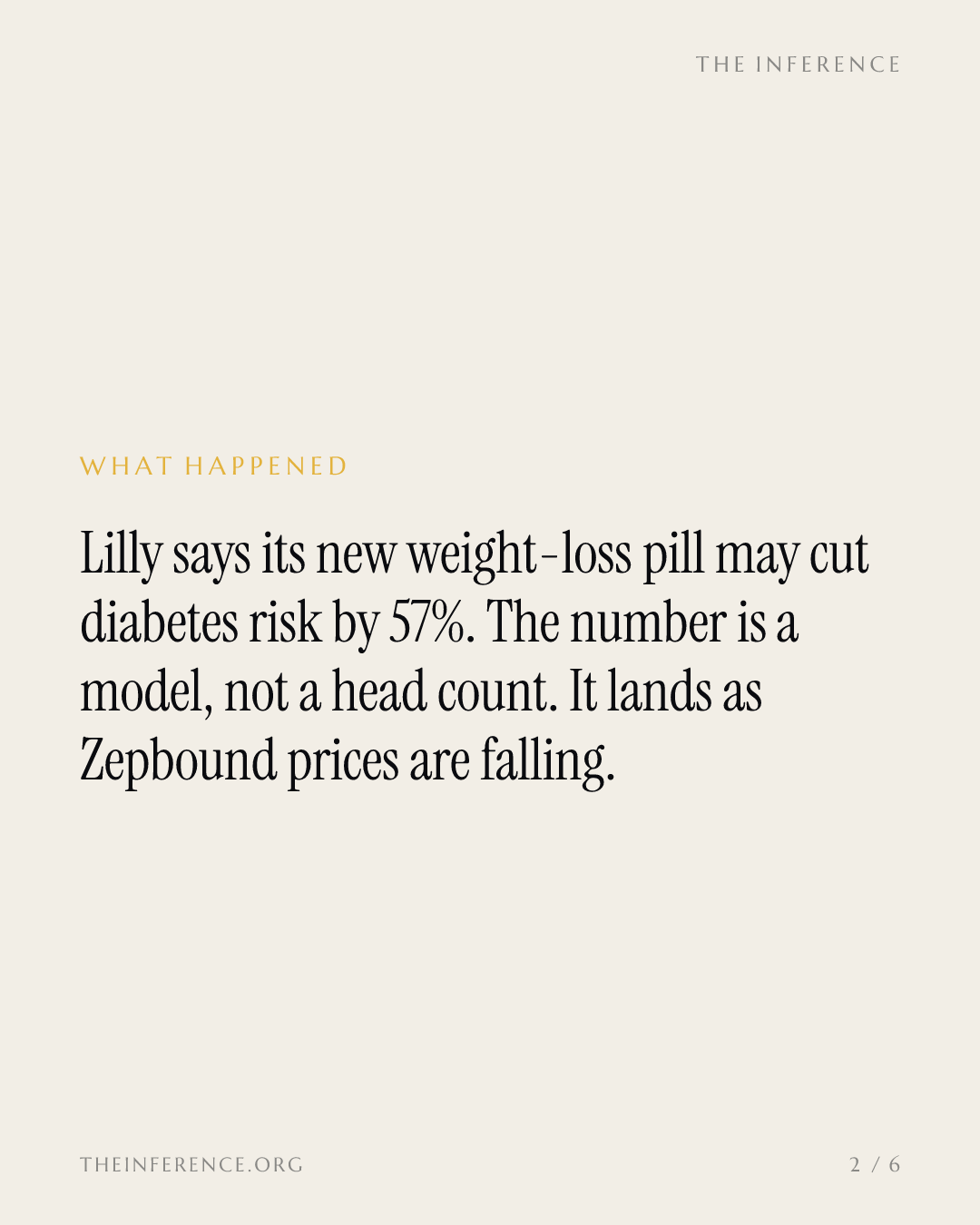
Eli Lilly's+1.77% — Eli Lilly, up 1.77 percent today oral weight-loss pill Foundayo (orforglipron) on 1 October delivered new modelled evidence that it does more than cut weight: post-hoc analyses of the Phase 3 ATTAIN-1 trial tied the top 17.2 mg dose to an estimated 57% lower predicted 10-year type 2 diabetes risk (HR 0.43) and an 18% lower predicted cardiovascular risk (HR 0.82) versus placebo, published in Diabetes, Obesity and Metabolism 1. The stock closed Wednesday down 2.33% at $1,157 anyway 4.
The numbers are modelled, not observed
These are risk-engine projections, not head counts of people who got diabetes or heart attacks. Lilly ran the trial's data through the CMDS diabetes engine and a BMI-based Framingham cardiovascular engine and reported hazard ratios from the models 1. The trial randomized 3,127 adults without diabetes, with the dose ladder showing estimated diabetes-risk reductions of 45%, 50% and 57% at 5.5, 9 and 17.2 mg 14. Lilly paired the data with an explicit pitch to payers: treating obesity can "meaningfully lower healthcare costs," so long-term Foundayo use could reduce spending for patients and health systems 1.
The 17.2 mg dose carries the biggest modelled risk cut on both measures
- Predicted 10-year diabetes risk reduction
- Predicted 10-year cardiovascular risk reduction
Data
| Predicted 10-year diabetes risk reduction | Predicted 10-year cardiovascular risk reduction | |
|---|---|---|
| 5.5 mg | 45% | 13% |
| 9 mg | 50% | 15% |
| 17.2 mg | 57% | 18% |
The same evidence cuts both ways
That pitch is also the pricing problem. Lilly took in $23.0 billion of revenue in Q2 2026, with Zepbound and Mounjaro at $14.9 billion of it, while US price across all sales fell 3%, driven by those same two drugs 2. Management said on the Q2 call that Zepbound's price will fall as more insurance plans cover it, and that volume growth must more than offset the decline, which is already in the raised 2026 guidance 2. In other words, the cost-offset case Lilly is building is what wins coverage, and winning coverage is what presses its net prices down.
Revenue doubled in ten quarters while US price fell 3% last quarter
Data
| Revenue | |
|---|---|
| Q1 '24 | $8.77B |
| Q2 '24 | $11.3B |
| Q3 '24 | $11.44B |
| Q4 '24 | $13.53B |
| Q1 '25 | $12.73B |
| Q2 '25 | $15.56B |
| Q3 '25 | $17.6B |
| Q4 '25 | $19.29B |
| Q1 '26 | $19.8B |
| Q2 '26 | $22.97B |
What the options market is pricing
At about $1,161, options expiring 17 September 2027 put a floor near $803 and a ceiling near $1,679 on LLY, with a 21% chance of finishing below the floor against 12% above the ceiling 2. The bet is volume. If the pill's cost-offset evidence converts payers at scale, volume replaces falling price and the stock walks toward the ceiling; if coverage comes but only at deep discounts, the walk is toward the floor 2. Payers, meanwhile, are being asked to fund a chronic pill on projected risks, and Lilly's own filings caution that future results may not match study results to date 1.
Get Health by email, free
AI in medicine, pharma and biotech. In our daily email, every weekday.




Reader comments
0 comments