Malaysia buys 100,000 Coursera passes and hasn't said what they cost
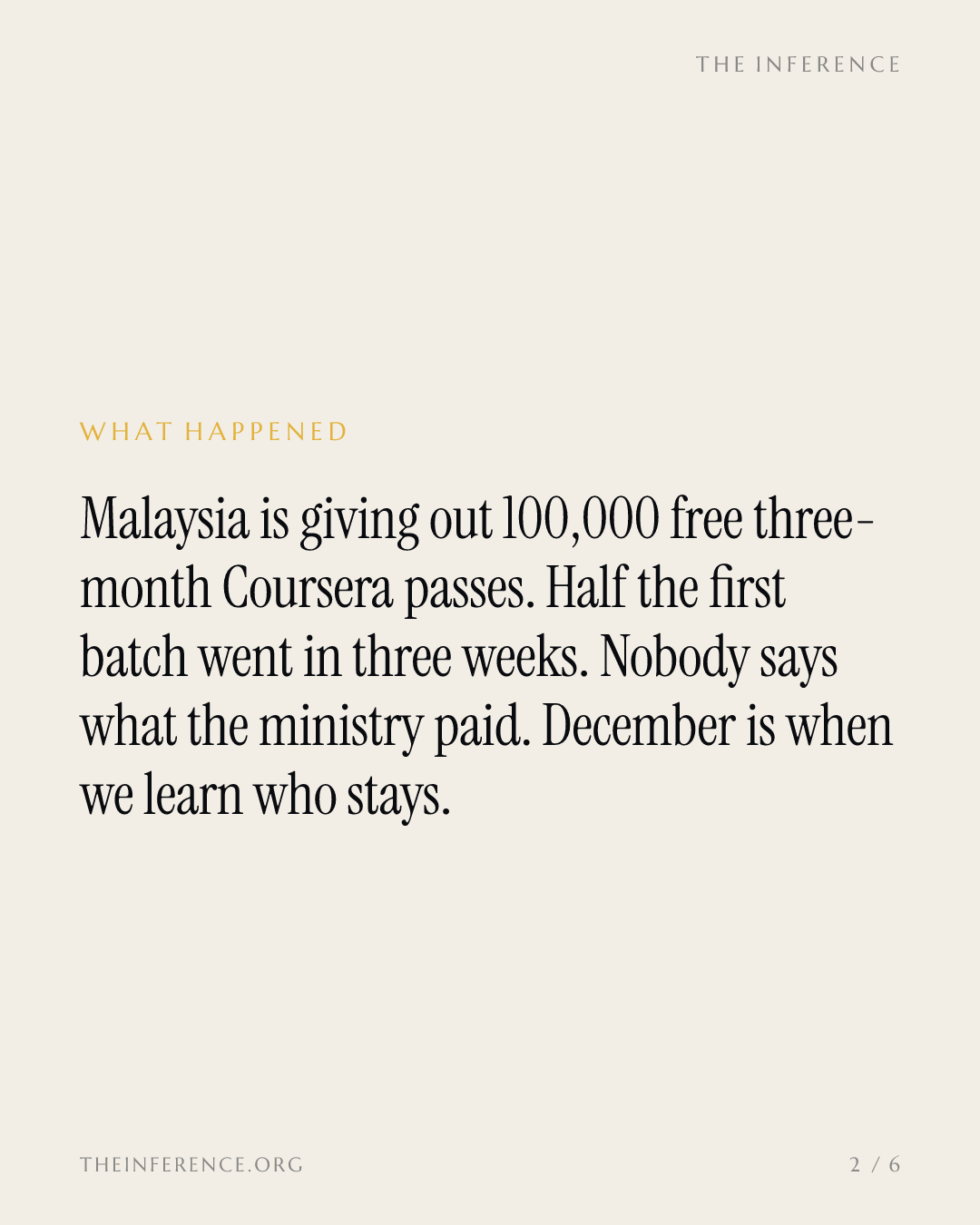
Half of Malaysia's first 25,000 government-funded Coursera passes were claimed in three weeks. What the ministry paid for them, and whether free users convert at month three, decides whether Coursera's reach becomes revenue.
 Vincent Jiang · 3 min read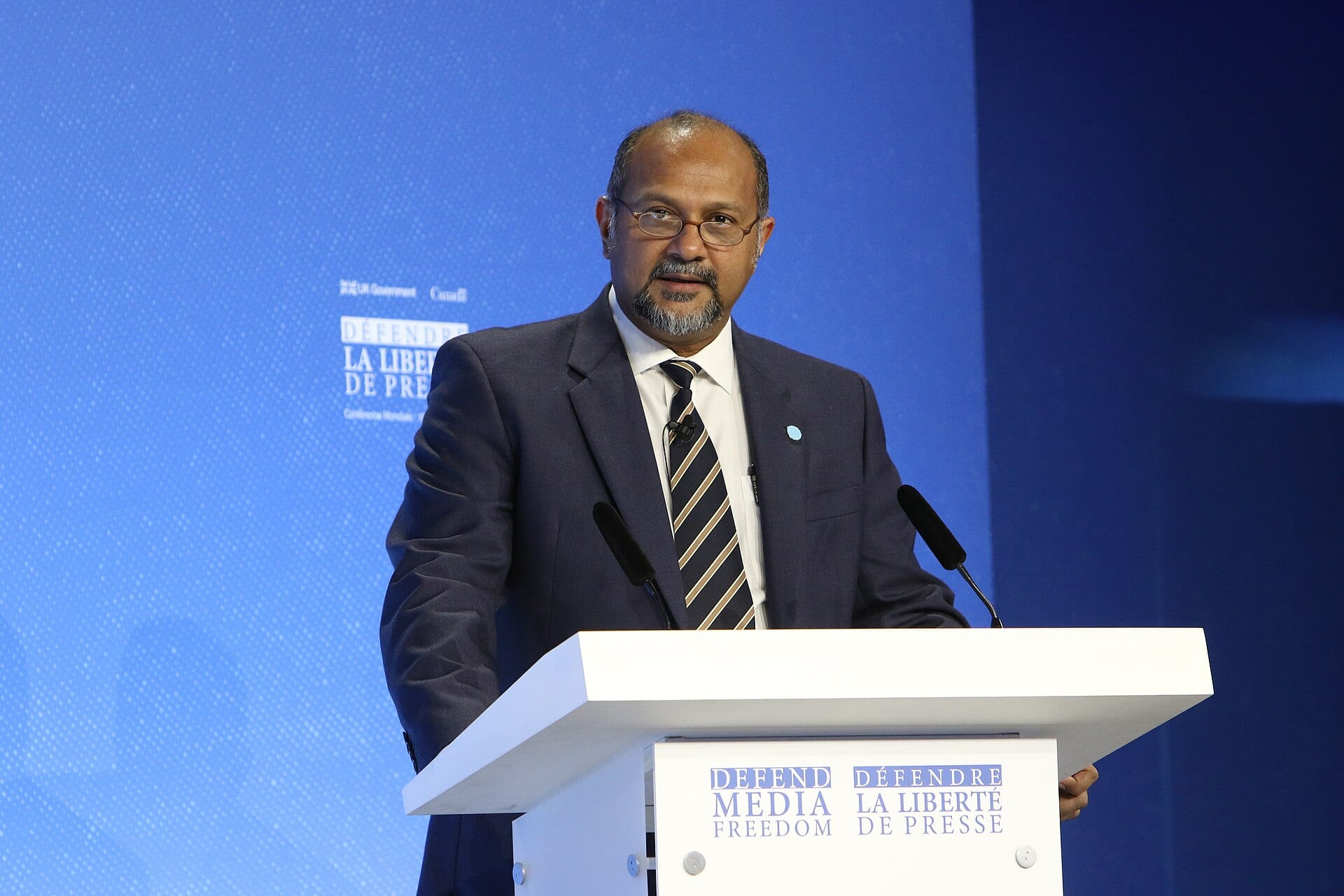
A free pass, a missing invoice
Since September 16, Malaysians with a MyDigital ID, the national digital-identity login, have been claiming three months of free Coursera−1.55% — Coursera, down 1.55 percent today access on the government's Rakyat Digital portal 12. In the first three weeks, 12,900 learners enrolled in 43,000 courses 1. A Coursera Plus subscription costs $59 a month, so each pass carries roughly RM720 of catalog; all 100,000, fully used, would be worth about $17.7 million at retail, roughly 1.5% of the $1.22–1.245 billion Coursera has guided for this year 26. What the Digital Ministry actually paid appears nowhere in the announcement 13.
Half the first tranche, gone
The ministry is releasing the licenses in four phases of 25,000 toward five million e-learners by 2030, from about 1.6 million registered today 14. Invitations expire in seven days and return to the waiting list 2. Malaysian enrolments in generative-AI courses have accelerated from one every 19 minutes to one every eight 1.
The growth story is borrowed
The complication for anyone pricing COUR at a consensus $8.55 against its $5.03 close 5: Q2 revenue of $298.6 million beat estimates, but the 60% jump exists only because Coursera consolidated its acquisition of Udemy, the rival course platform, from the May 11 close. Normalized revenue fell 1%, consumer revenue fell 5%, and enterprise net revenue retention, the share of prior-period revenue kept from existing customers, sat at 91% 6. A commentary on AInvest argues that laid-off workers are the signup Coursera cannot keep 7.
The 60% revenue jump is the Udemy deal; normalized revenue fell 1%
Data
| Revenue | |
|---|---|
| Q3 '23 | $165.54M |
| Q4 '23 | $168.92M |
| Q1 '24 | $169.1M |
| Q2 '24 | $170.3M |
| Q3 '24 | $176.1M |
| Q4 '24 | $179.2M |
| Q1 '25 | $179.3M |
| Q2 '25 | $187.1M |
| Q3 '25 | $194.2M |
| Q4 '25 | $196.9M |
| Q1 '26 | $195.7M |
| Q2 '26 | $298.6M |
The whales are split
CEO Gregory Hart filed a Form 4 covering a October 1 sale of 10,308 shares at $5.11, about $52,674, leaving him 1.54 million shares 58. In Q2, BlackRock and Caledonia Private Investments, both new to the register, each opened stakes near $115 million; Pale Fire Capital, an existing holder, nearly doubled its position to 20.4 million shares; and Coursera itself bought back $90 million at an average $5.45 56.
The bull case, and its hole
Goldman lifted Coursera from sell to neutral at $6.50 in August: recurring subscriptions are 85% of revenue, guidance rose to $1.22–1.245 billion, and the full-year margin target is near 14% 96. The hole is retention. At 91% net revenue retention, with normalized consumer revenue shrinking, the business leaks learners. Free passes add learners now; they say nothing about who renews 6.
Coursera has lost money every quarter for three years; Q2 2026 lost $80.4M
Data
| Net income | |
|---|---|
| Q3 '23 | -$32.09M |
| Q4 '23 | -$20.4M |
| Q1 '24 | -$21.3M |
| Q2 '24 | -$22.9M |
| Q3 '24 | -$13.7M |
| Q4 '24 | -$21.6M |
| Q1 '25 | -$7.8M |
| Q2 '25 | -$7.8M |
| Q3 '25 | -$8.6M |
| Q4 '25 | -$26.8M |
| Q1 '26 | -$20.5M |
| Q2 '26 | -$80.4M |
December is the real test
The 75,000 licenses still to roll out, and month three, when the first cohort's access lapses in mid-December, will show whether reach turns into revenue 4. Malaysia says it will grade the program on course completion and recognized credentials rather than signups 4; for shareholders, the number that matters is how many of the 12,900 are still paying when the free months end.
Deepdive
AI-generated from this story and its cited sources. Not investment advice.