McKinsey's AI math gives insurers the front door and doctors the deskilling bill
A September 28 analysis of 2024 claims says AI can already perform the care behind 16 to 22 percent of U.S. outpatient claims, and names payers, not providers, as the winners of the shift. Even the health-system leaders who call the number realistic say the money flows to the insurers.
 Vincent Jiang · 3 min read
The visit a model can already take
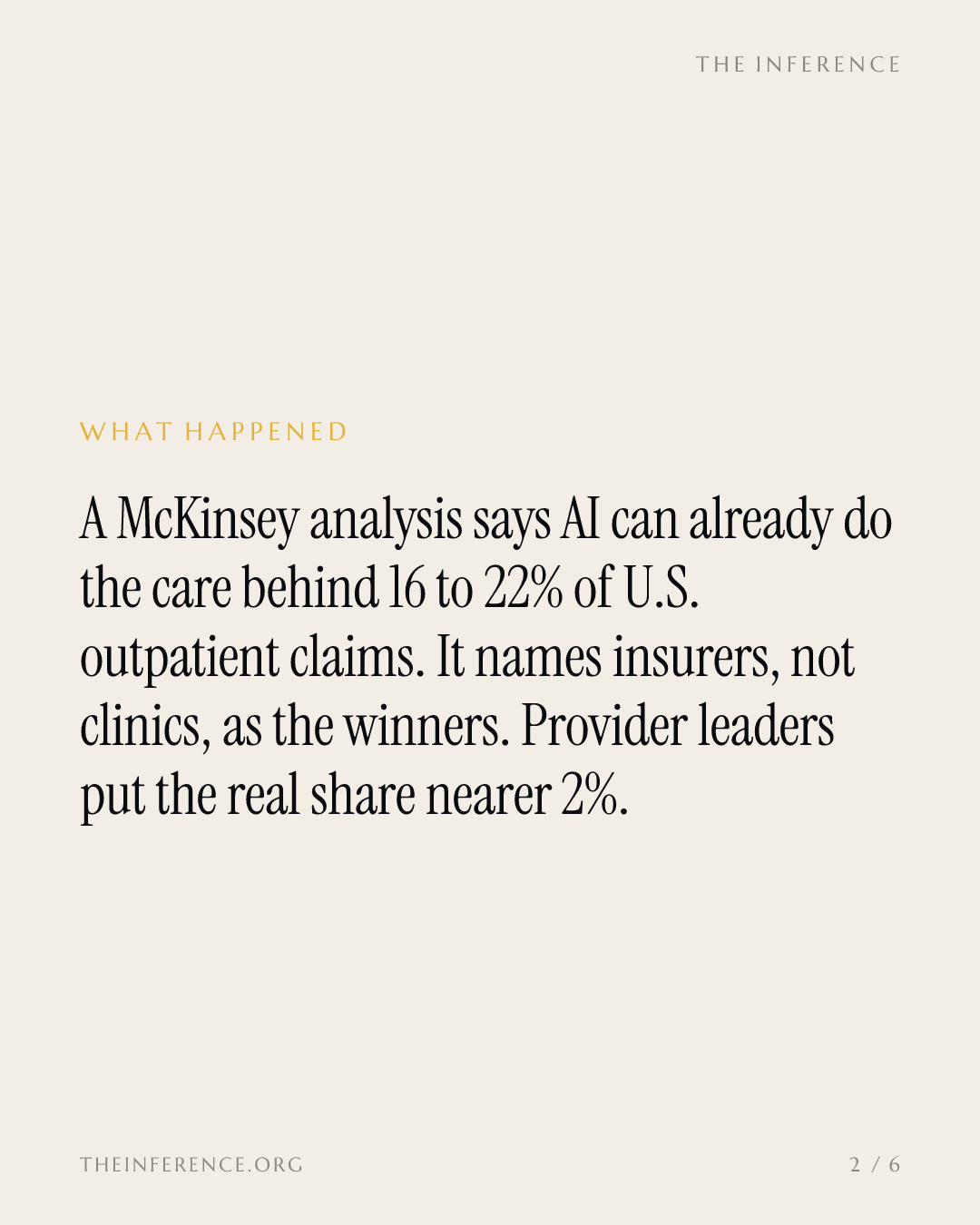
Ninety-two million Americans live in primary-care shortage areas, and the average wait for an appointment runs 31 days 3. A September 28 McKinsey analysis of 2024 commercial, Medicare and Medicaid claims concludes that AI can already perform the care behind 16 to 22 percent of U.S. outpatient claims, 13 to 19 percent of outpatient spending, roughly two to three billion claims a year 12. The category is "discursive care": intake, triage, diagnosis, referrals and follow-up, work that needs reasoning and dialogue but not hands 1.
McKinsey puts up to 22% of U.S. outpatient claims inside AI's reach
- Low estimate
- High estimate
Data
| Low estimate | High estimate | Change | |
|---|---|---|---|
| All AI-performable care | 16% | 22% | +37.5% |
| E&M visits, no or low complexity | 11% | 15% | +36.4% |
| Diagnostic and imaging reads | 5% | 7% | +40.0% |
Insurers get the front door
The money line is not the percentage. It is the winner. McKinsey says payers stand to gain more than providers as AI becomes the patient's "front door" to care, and that a payor-deployed AI clinician could become the primary interface patients use to reach the system 3.
Fee-for-service operators risk losing exactly the volume the analysis counts, since 11 to 15 percent of claims are no- or low-complexity evaluation and management visits, while value-based organizations could use AI to improve their care-management economics 1. The document supports one sector decision: price payer control of intake against low-acuity visit books.
Displacement the firm insists is not displacement
The same week, McKinsey Global Institute estimated 11 million U.S. workers may need new occupations by 2035, about 770,000 switching occupational groups each year, 3.6 times the historical average of 215,000 45. Only about one in seven has what the report calls a direct pathway: minimal retraining, no wage loss 45.
The claims analysis puts a substantial share of core tasks for 11 million of 19 million healthcare workers within AI's reach, and still predicts headcount will not shrink because demand rises 1. It also flags deskilling: clinicians who lean on AI without deliberate practice lose the ability to do the work themselves 1. That bill lands on training programs, not on the insurers at the door.
Ontario shows the invoice
Ontario's public accounts show the Ministry of Health paid McKinsey Canada $2,090,500 in fiscal 2025-26, booked under "other payments," to implement a 2022 health-data report, while Premier Doug Ford hunts savings in a health budget he puts above $91 billion 6. A post on X pairs the payment with nurse layoffs; the disclosure records carry no such line 67.
Providers put the real number nearer 2 percent
Parkview Health's chief medical informatics officer calls the estimate doubtful and puts the AI-performable share at 1 to 2 percent of primary and urgent care, because claims data is built for reimbursement, not to record what happened in the room 8. TidalHealth's CIO calls the estimate realistic for primary and urgent care, then attacks the economics instead: "There is not enough money in these low level visits to pay for the AI and take the liability risk" 8.
The provider camp puts AI's reach at a tenth of McKinsey's estimate
- Low estimate
- High estimate
Data
| Low estimate | High estimate | |
|---|---|---|
| McKinsey: outpatient claims | 16% | 22% |
| Parkview CMIO: primary and urgent care | 1% | 2% |
A rural New Hampshire CIO calls the shift plausible and warns that payer capture of the benefit weakens the delivery systems patients still depend on 8. Parkview attacks the size; the leaders who accept the number say the money still flows to the payers.
The next signal is a payer that ships an AI clinician
Watch which way low-acuity fee-for-service volume moves as the tools spread, and whether a major payer actually deploys an AI clinician as the primary interface for care 3. McKinsey drew the map and named the landlord; the bids on the door are coming from insurers.
Deepdive
AI-generated from this story and its cited sources. Not investment advice.