Microchip joins the AI rack power fight just as its pricing power comes back
The 800-volt power designs Navitas is placing in Nvidia's rack ecosystem switch on Microchip silicon, a design win inside a fight the market reads as Navitas versus Vicor. Pricing power is back after Microchip's worst downturn, but the design has no production date and the balance sheet carries $5.1 billion of net debt.
 Richard Tang · 4 min read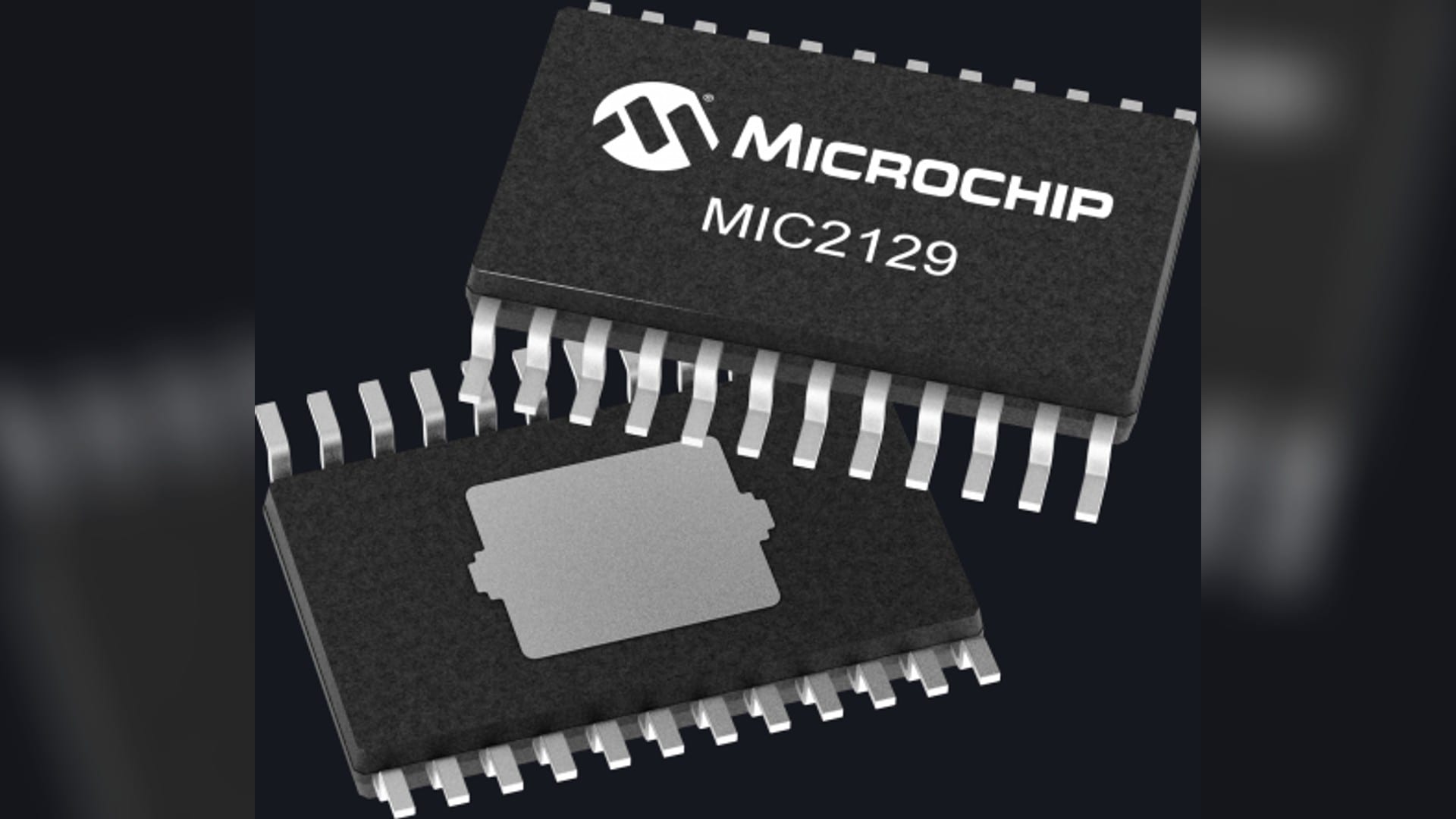
Microchip's silicon runs the power inside the 800-volt rack
The fight over who gets paid for AI rack power has been priced as Navitas against the power-chip maker Vicor−7.24% — Vicor, down 7.24 percent today, whose complaint we detailed earlier today 1. That read misses a third company. Inside one of the 800-volt designs, the chip that controls the switching and the chip that guards the firmware both come from Microchip Technology−4.21% — Microchip Technology, down 4.21 percent today.
On October 5, Navitas−9.14% — Navitas, down 9.14 percent today and Microchip published a reference design that takes an 800-volt rack feed down to 6 volts beside the GPUs 2. Sixteen Navitas 650-volt gallium-nitride transistors do the switching in a stacked half-bridge, an arrangement that shares the high voltage across parts each rated well below it 23.
Microchip's dsPIC33AK digital controller holds the output voltage steady through the load swings accelerators cause, and its TA100 chip verifies the power supply's firmware at boot and signs its updates 2. The same sixteen-transistor stage powers the 24 kW, 800-volt-to-12 board Navitas built with Nvidia−2.97% — Nvidia, down 2.97 percent today for the MGX rack ecosystem, showing at Nvidia's partner wall in this week's Open Compute Project Global Summit in San Jose 45.
Higher voltage is what puts a Microchip part beside every GPU
The move to 800 volts is physics before strategy. The same watts flow at lower current, and resistive loss in the copper rises with the square of current; Igor's Lab works the example at about 125 amps versus more than 2,000 at 48 volts 3. The makers describe the converter as about a fifth thinner than a smartphone 2.
That placement is where the new content sits. The Nvidia board reaches 12 volts in a single stage, deleting the existing 50-volt intermediate conversion 4; the Navitas-Microchip design instead combines its two internal stages into one converter 2. Either way the board needs fast digital control and a hardware root of trust, slots that look new to the rack rather than moved within it, though no source counts boards per rack. No volume availability date was given 3.
Pricing is back; the shipment is not
Microchip, an embedded-control chipmaker for industrial and automotive markets 6, reported on August 6 that June-quarter revenue rose 38% from a year earlier, earning 76 cents a share against a 70-cent consensus 6. Mid-year price increases held and lead times are lengthening; the September quarter is guided to 91 to 95 cents, and data center sales are projected to grow about 69% to nearly $1 billion 7.
Microchip's revenue has climbed out of its worst downturn
Data
| Quarterly revenue | |
|---|---|
| Q3 '23 | $2.25B |
| Q4 '23 | $1.77B |
| Q1 '24 | $1.33B |
| Q2 '24 | $1.24B |
| Q3 '24 | $1.16B |
| Q4 '24 | $1.03B |
| Q1 '25 | $0.97B |
| Q2 '25 | $1.08B |
| Q3 '25 | $1.14B |
| Q4 '25 | $1.19B |
| Q1 '26 | $1.31B |
| Q2 '26 | $1.49B |
That sets up the trade: a September print at or above the guide says pricing power is compounding faster than the balance sheet can bite, while a miss hands the argument straight to the $5.1 billion of net debt 7.
Microchip buys small while its rivals pay billions
The comeback is not being bought. Microchip announced the radiation-hardened chipmaker VORAGO on October 10 at an undisclosed price it calls immaterial 8, after completing the edge-AI chipmaker Hailo acquisition in September 8. Rivals paid between $1.35 billion and $7.5 billion for microcontroller and edge-AI targets: Analog Devices−2.44% — Analog Devices, down 2.44 percent today for Alif Semiconductor, Texas Instruments−2.41% — Texas Instruments, down 2.41 percent today for Silicon Labs, onsemi−5.33% — onsemi, down 5.33 percent today for Synaptics 8. Its October 12 additions, a compact PCIe Gen 6 switch and storage controllers prepped for post-quantum security requirements 9, fill the AI rack socket by socket.
Vicor's patent probe hangs over the whole conversion layer
On Vicor's complaint, the US International Trade Commission is investigating 20 companies across the AI server supply chain, among them Foxconn, Delta Electronics, Quanta and Monolithic Power Systems, over systems that feed power to top-end chips from directly beneath them 1. Vicor wants those products barred from the US 1; an import ban could only follow a full hearing and a final ruling, and it would stop affected AI server systems at the border and halt the named companies' US sales of them 1.
Nothing has been ruled 1, and nothing in the record puts Microchip's parts inside the accused products; what the record shows is a shared power stage and a shared Open Compute standard 24.
AI made the rack a power electronics problem, and 800 volts is turning the power supply into a Microchip socket. Until one of these boards ships in volume, the win rests on one reference board and a demo wall, and the September-quarter report is the next hard evidence that the pricing recovery is real. On today's record, Microchip holds the two slots nobody was watching in this fight: the control loop and the lock.

More about NVIDIA
NVDA · Fiscal Q2 2027Revenue rose 106% to $96.2B, 92.5% of it from Data Center, “driven by the ramp of our Blackwell Ultra infrastructure”. Gains on equity stakes of $7.8B lifted net income to $59.7B.
Show as a table
| Line | Value |
|---|---|
| Revenue | $96.2B |
| Gross margin | 75.0% |
| Operating margin | 66.2% |
| Net income | $59.7B |
| Hyperscale | $48.7B |
| AI clouds & enterprise | $40.3B |
| Data Center | $89.0B |
| Edge Computing | $7.2B |
| Gross profit | $72.1B |
| Cost of revenue | $24.1B |
| Other income | $7.8B |
| Operating income | $63.7B |
| Operating expenses | $8.4B |
| Tax | $11.8B |
| R&D | $7.1B |
| SG&A | $1.4B |
Deepdive
AI-generated from this story and its cited sources. Not investment advice.