Modal moves $300 million of AI-agent work to Nvidia's Vera CPU after its own tests showed up to 2x throughput
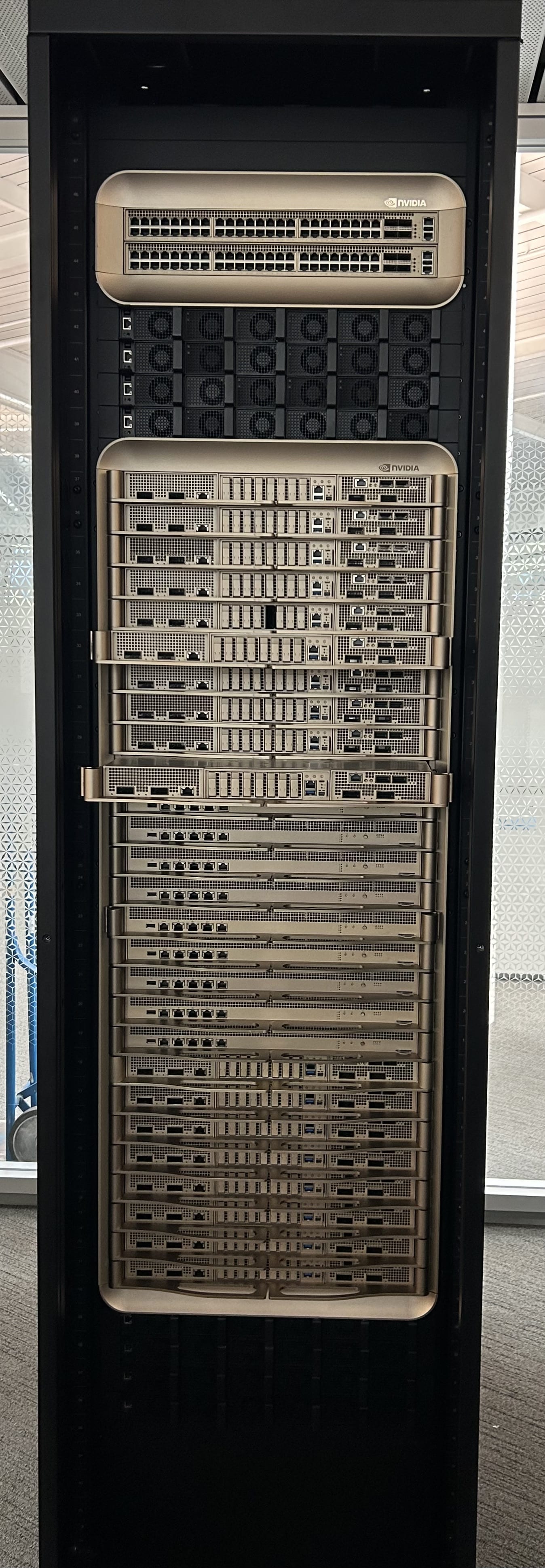
Modal will run the product that earns it $300 million a year on Nvidia's Arm-based Vera CPU, after its own tests showed up to twice the packed-server throughput of an Intel machine. Its stated reason, that GPUs sit idle until CPU work finishes, turns a CPU choice into a decision about how much the expensive chips earn.
 Richard Tang · 3 min read
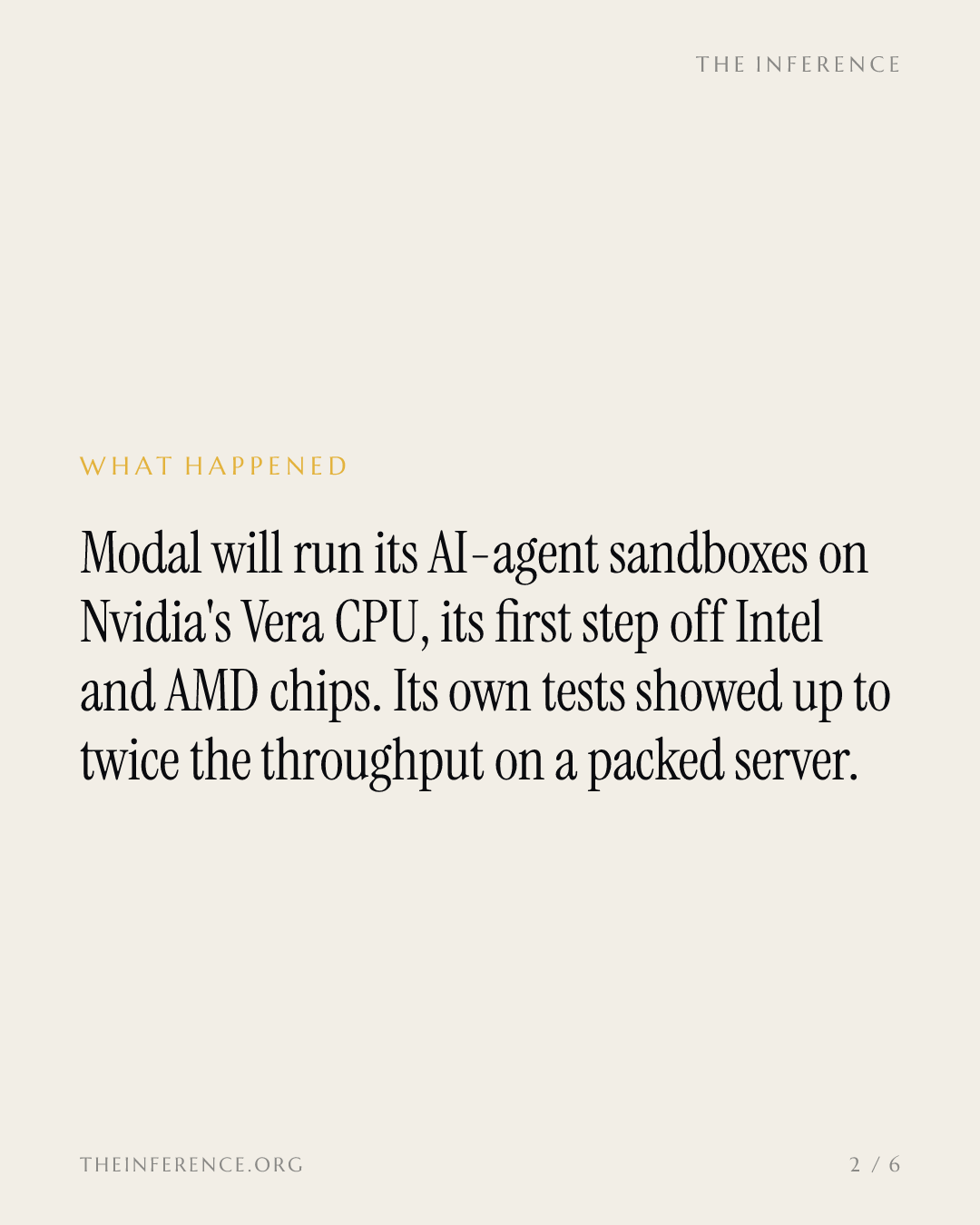
Modal$87M — Modal, private, latest valuation $87M is moving its agent sandboxes onto Nvidia's+2.41% — Nvidia, up 2.41 percent today Arm+2.28% — Arm, up 2.28 percent today-based Vera CPU, its first step off the Intel+1.01% — Intel, up 1.01 percent today and AMD+3.80% — AMD, up 3.80 percent today silicon it has always run, after its own benchmark showed up to twice the task throughput on a server packed with containers 1.
About a third of the company's revenue rides on this layer: sandboxes, the isolated computers where AI agents write and run code, bring in $300 million annualized of Modal's stated $1 billion run rate, and nearly 3 billion have been created 12. The reason Modal gives is a claim about utilization: in reinforcement learning, expensive GPUs often sit idle until the CPU work finishes 1.
Why the CPU decides what the GPUs earn
Modal says most training setups are still synchronous: each rollout, one complete attempt by the model at a task whose outcome becomes training signal, spends part of its time on the CPU, and the whole set of rollouts must finish before the idle GPUs move to the next step, so time saved on CPU is time saved on GPU 3. The cheaper processor therefore decides how much of the costly one gets used. A faster CPU effectively buys GPU hours.
Agent work is spiky, and Vera's bandwidth absorbs it
Sandbox tenants are noisy: an agent sits idle waiting on a language model, then draws ten times its usual computing power during a software install, and hundreds share one host, so one customer's spike can slow another's work 1.
In Modal's benchmark of 50 coding tasks, Vera beat Intel, AMD and Amazon+0.63% — Amazon, up 0.63 percent today chips one task at a time, but only slightly; the gap opened under load, where Vera held its pace as containers piled up and the others hit a ceiling, which Modal credits to Vera's memory bandwidth 13. The result is Modal's own and has not been independently checked 1.
The premium is moving from isolation to the training loop
Modal raised $750 million at a $15.75 billion valuation on October 14 and said the money buys higher layers, reinforcement learning and post-training tools among them 2. Together AI~$3.3B — Together AI, private, latest valuation ~$3.3B, a rival cloud, opened exactly that layer on October 19: reserved B200 GPUs, the training loop defined by the customer, at an introductory $9 per GPU-hour 45.
The layer beneath is commoditizing: Perplexity has open-sourced its production sandbox, SPACE, with CoreWeave−0.02% — CoreWeave, down 0.02 percent today, Akamai+0.68% — Akamai, up 0.68 percent today and Crusoe$26.61B — Crusoe, private, latest valuation $26.61B already offering it 68. Agent shops still pay Modal about 41% more per virtual CPU hour than at E2B or Daytona for that isolation 6.
That is roughly three times Modal's own ordinary compute rate 6. Modal rents its capacity from more than twenty clouds and owns no data centers, so a chip that doubles packing density raises what each rented server earns 2.
Intel and AMD carry the socket risk
Nvidia launched Vera in March as a CPU built for agents, with 88 cores, and named Anthropic$350B — Anthropic, private, latest valuation $350B and OpenAI$1.18T — OpenAI, private, latest valuation $1.18T among its first users 1. Alibaba Cloud, ByteDance, CoreWeave, Nebius+0.59% — Nebius, up 0.59 percent today and Oracle−0.95% — Oracle, down 0.95 percent today are among the clouds planning to deploy it 3. The gain accrues to Nvidia twice, once in the CPU and once in the GPUs it keeps busy, while Intel and AMD lose the socket they held by default in the one layer where agents run code.
The doubling is a claim until it runs in production
Modal gives no date for customers landing on Vera, and Nvidia says partner availability comes in the second half of 2026 13. Modal also hedges, keeping Intel and AMD in rotation and routing each job to whichever chip runs it best 7. What settles the read is whether the packed-server gain holds outside Modal's own benchmark, and whether the 41% premium survives an isolation layer that is now free 6.
The daily newsletter