Modal raised at 15.75 times run rate; default insurance implies better-than-even odds CoreWeave fails
Modal just closed at 15.75 times its claimed run rate and Baseten is raising again, while default insurance on CoreWeave, the GPU landlord beneath them, implies better-than-even odds of a default within five years. The markup in the middle is the one number nobody raising money has published.
 Richard Tang · 4 min read
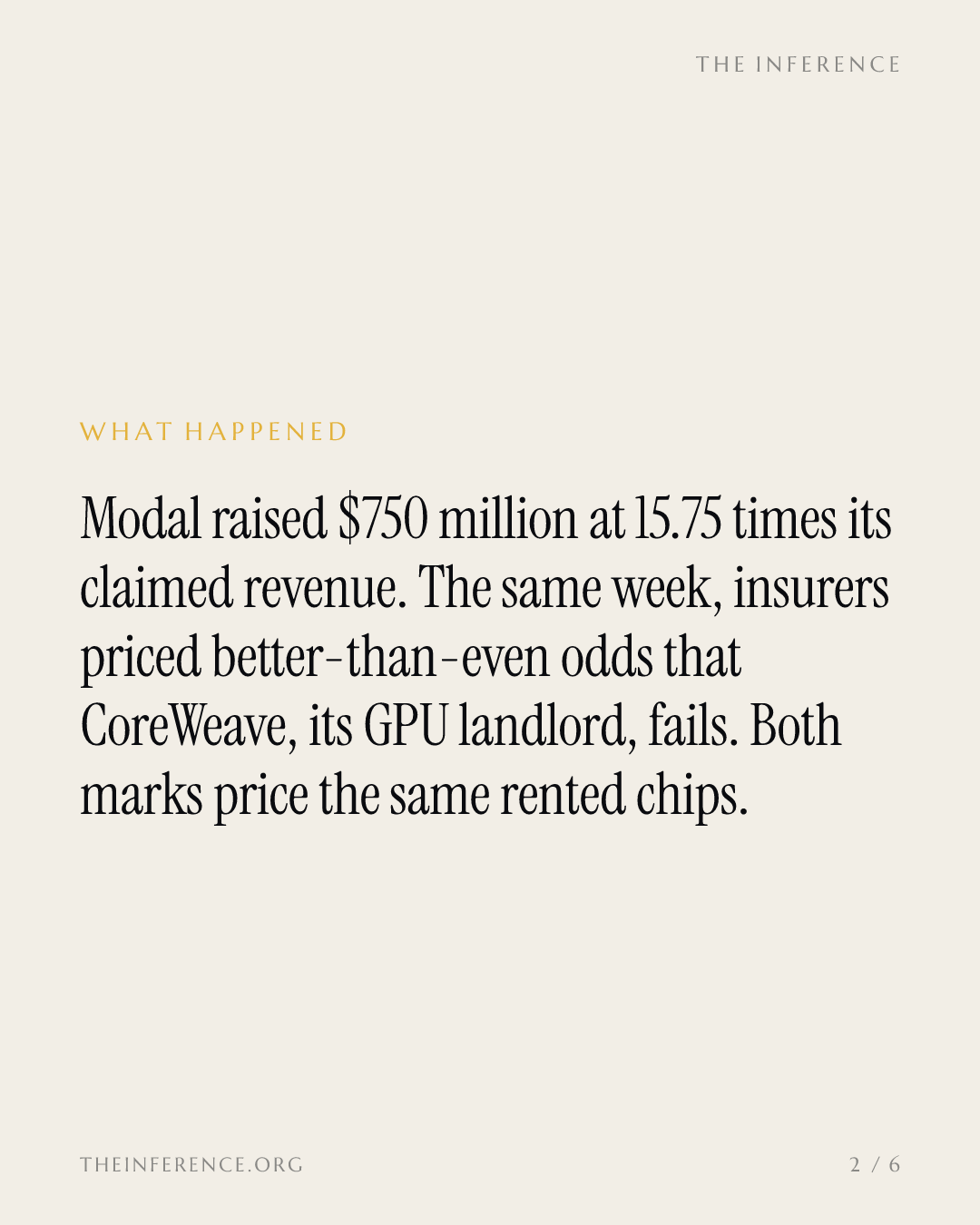
Two marks landed on the same rented compute inside a week. On October 14, Modal$87M — Modal, private, latest valuation $87M, which rents GPUs from more than twenty cloud providers and resells them as serverless computing, raised $750 million at a $15.75 billion valuation 1. That price is 15.75 times the roughly $1 billion of annualized revenue the company claims 1.
Baseten~$1.4B — Baseten, private, latest valuation ~$1.4B, which serves other companies' models through its own API, entered fresh funding talks two days later, Bloomberg reported 2. The same week, the price of insuring the debt of CoreWeave+0.86% — CoreWeave, up 0.86 percent today, the heavily indebted owner of GPU data centers, implied a better-than-even chance of it failing within five years 3. Both marks price the same rented chips. One of them is wrong.
Two frontier releases went free, and the charge moved to serving
Meta−0.53% — Meta, down 0.53 percent today published the weights of Muse Spark Open on October 15, a frontier model it says runs on a pair of desktop Macs, and named Baseten and Modal among the seven platforms selling access to it 45. A day later Reflection released Beam under Apache 2.0, a license that lets anyone download and run the model free, and Baseten posted day-zero prices: $1.30 per million input tokens, $0.13 per million output 6.
OpenAI$1.18T — OpenAI, private, latest valuation $1.18T and Anthropic$350B — Anthropic, private, latest valuation $350B still charge for their models, and their revenue is still growing, just more slowly 3. What changed this week is that two frontier weights went free. A business now pays for the layer in between, the routing, uptime and engineering that turn a download into something a product can call. But seven platforms listed the identical model on the same day 5, and Meta's license requires any model service with more than $20 million of revenue to sign a separate agreement before serving it 4.
Seven platforms, one model, no published take
Neither seller shows the markup. Modal has not disclosed its take on the compute it rents 1; Baseten's price list shows tokens, not the GPU cost underneath 6.
The landlord beneath got repriced
CoreWeave owns the machines and the debt that bought them: more than $51 billion of borrowings and obligations, against a contracted backlog above $100 billion 3. Its 9.75% bond due 2031 yields 15.78% 3. Five-year default insurance traded above 1,140 basis points, about 11 percentage points a year, before settling near 1,040 37. "The market is basically saying no mas to AI debt without operating cash flow support," the Evercore−2.29% — Evercore, down 2.29 percent today ISI trading desk wrote 7.
Capex has outrun operating cash flow in all eight quarters CoreWeave has reported
- Operating cash flow
- Capex
Data
| Operating cash flow | Capex | |
|---|---|---|
| Q3 '24 | $0.64B | $1.22B |
| Q4 '24 | $0.19B | $3.5B |
| Q1 '25 | $0.06B | $1.41B |
| Q2 '25 | -$0.25B | $2.45B |
| Q3 '25 | $1.69B | $2.39B |
| Q4 '25 | $1.56B | $4.06B |
| Q1 '26 | $2.98B | $7.7B |
| Q2 '26 | $0.68B | $6.42B |
CoreWeave trades near 4.5 times trailing sales 1. Modal, which owns no data centers, was worth $4.65 billion in May and now carries more than three times CoreWeave's multiple 1.
CoreWeave's debt is outrunning the revenue meant to service it
- Revenue
- Total debt
Data
| Revenue | Total debt | |
|---|---|---|
| Q4 '24 | $0.75B | $10.62B |
| Q1 '25 | $0.98B | $11.9B |
| Q2 '25 | $1.21B | $14.56B |
| Q3 '25 | $1.37B | $18.81B |
| Q4 '25 | $1.57B | $29.82B |
| Q1 '26 | $2.08B | $35.15B |
| Q2 '26 | $2.58B | $51.61B |
The reseller sits where the squeeze lands
The squeeze runs from both ends. If landlords refinance near 15%, the resellers' input costs rise with the yield; if aging GPUs flood the market instead, the price of serving a free model falls with the hardware. Either way, the markup on rented GPU time absorbs the hit.
The analysts split; three prints will settle it
Weiss Ratings told subscribers this week to sell five neoclouds, the specialized cloud providers that borrow billions to buy GPUs and rent the capacity to AI companies: CoreWeave, Applied Digital+7.67% — Applied Digital, up 7.67 percent today, Nebius+4.27% — Nebius, up 4.27 percent today, IREN+4.21% — IREN, up 4.21 percent today and Hut 8+1.51% — Hut 8, up 1.51 percent today 9. Goldman Sachs−0.63% — Goldman Sachs, down 0.63 percent today upgraded CoreWeave to Buy on Monday, lifting its target to $139 after a sell-off of more than 25% 10. Private capital keeps voting a third way: investors remain eager to back Baseten, Fireworks AI~$1.1B — Fireworks AI, private, latest valuation ~$1.1B and Fal even as Anthropic's slowing growth unsettles talk of a $2 trillion listing 11.
If Baseten's round closes near Modal's 15.75 times revenue, the private mark wins, and Wednesday's neocloud plunge of 9% to 15% in a day was the entry rather than the warning 9. If one of the seven platforms publishes the take on GPU time beneath its token prices, the middle shows up as software margin or as resale markup. If CoreWeave's next refinancing prints near 15%, the bond market wins, and every reseller's cost base rises with it.
Dividing by a number that doesn't exist yet
The weaker number today is the run rate. Modal's trailing revenue sits well below the $1 billion its multiple divides 1. The private mark has more to prove.
Deepdive
AI-generated from this story and its cited sources. Not investment advice.