NXP's Industrial Business Just Matched Automotive's $209 Million Gain
Rafael Sotomayor calls NXP a physical AI company with automotive as its biggest market. The smaller industrial business just added the same $209 million in a quarter.
 Vincent JiangSeptember 14, 2026 · 2 min read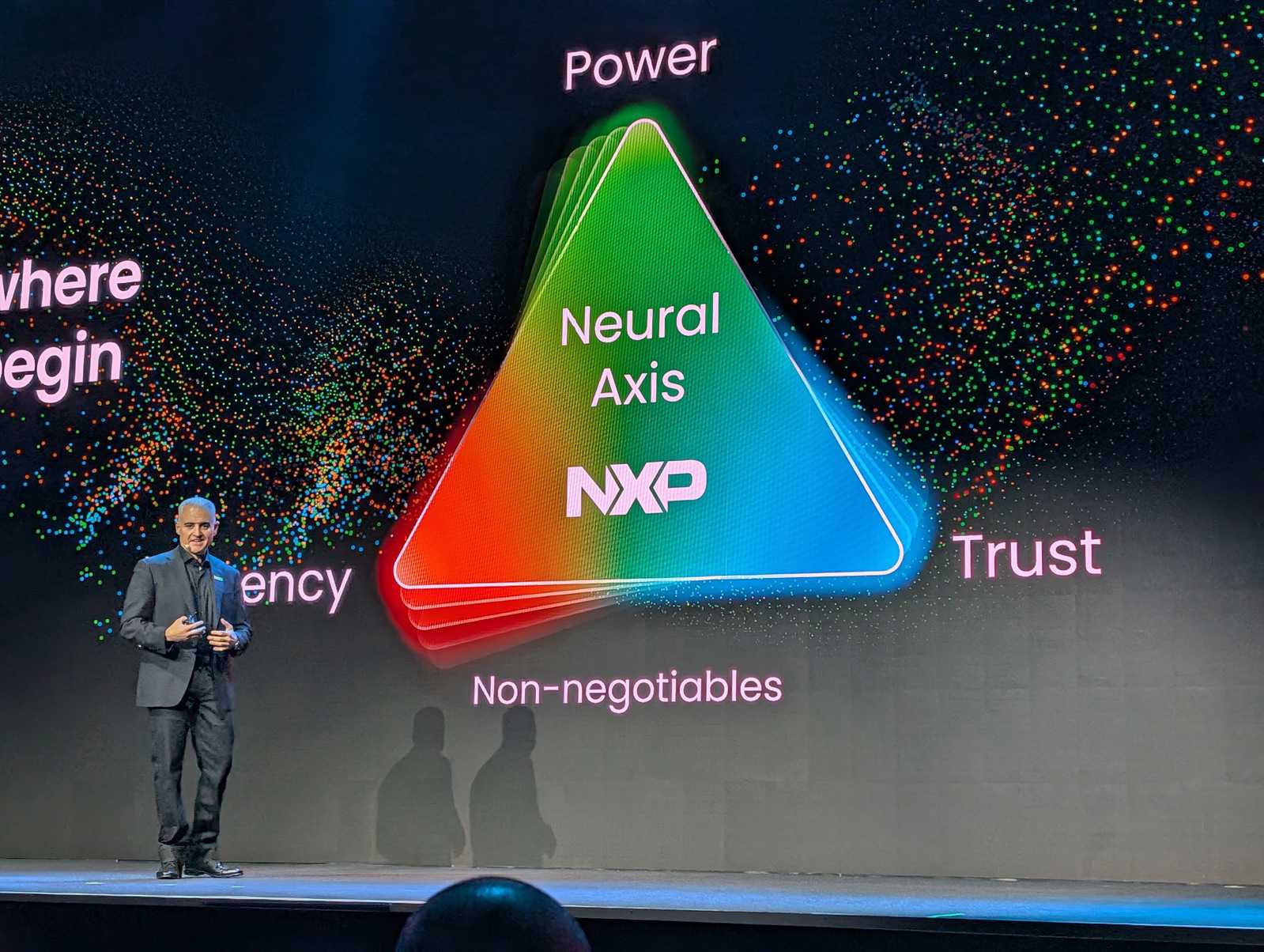
Rafael Sotomayor corrected the analyst who described his acquisitions as bets on cars.
The receipt behind the pivot
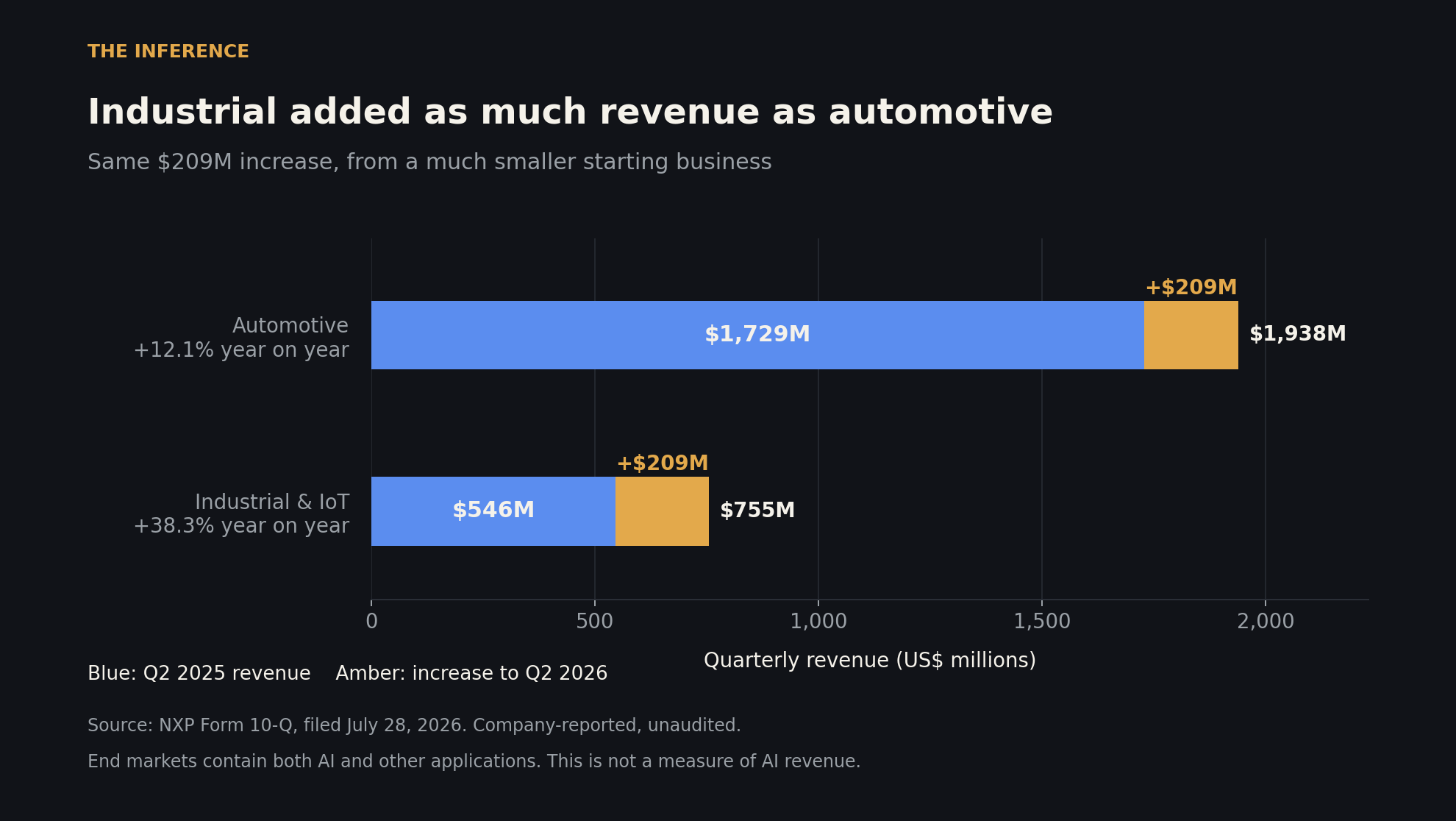
At Goldman Sachs' September 9 conference, NXP's chief executive described a physical AI company with automotive as its biggest market. His smaller industrial business gives that argument a receipt: $209 million of additional second-quarter revenue versus a year earlier, exactly matching automotive's gain.1,2
Automotive still supplies 55% of quarterly sales. Its engineering expertise is the foundation of NXP's expansion. The commercial question is whether the company can sell more valuable combinations of processing, networking and control across more kinds of machines. A broader label only matters if it changes what customers buy.2
A surprising starting point
The surprise is the starting point: automotive was more than three times larger than Industrial & IoT a year earlier. These calculations use company-reported, unaudited figures for the quarter ended June 28. The comparison includes acquisitions and divestitures; it does not isolate organic growth or AI revenue.2
Physical AI earns its money when the machine finishes the job.
Where the strategy gets interesting
That is where Sotomayor's strategy becomes commercially interesting. A robot manufacturer has to make perception, movement and safety work together. NXP's March 16 collaboration with Nvidia combines vision processing, motor control and networking around that problem. The inference: reducing the customer's integration work could help NXP win several parts of a machine's design together. The announcement provides no revenue evidence.4
The need exists outside NXP's presentations. Beckhoff's April 16 account of Dexterity's Mech describes separate motion and safety controls complementing its AI decision system. That demonstrates the engineering requirement, while also showing customers have other suppliers.5
The nearer test: data centers
The nearer commercial test is already in data centers. In April, management put 2025 revenue from those applications at about $200 million and forecast more than $500 million for 2026. Its chips help manage cooling, boards and infrastructure. Those sales already sit inside Industrial & IoT and Communications Infrastructure; adding them again would double-count the opportunity. This remains a company forecast.3
The skeptical read
The strongest skeptical reading is an industrial recovery wearing an AI label. Better factory utilization contributed to NXP's margin improvement, and the company has not isolated AI's contribution to the reported growth. That limits the valuation argument, but it does not erase the opportunity to sell more content into each machine.2
Sotomayor placed the humanoid opportunity around 2032 at the September conference. Investors have a nearer deadline: the full-year results. Watch whether data-center sales clear management's forecast and whether faster industrial growth accompanies stronger company cash flow.1
The next results need to show what customers actually bought.
How this brief was made
01Gathered & sourced269 channels · 1,244 articles▾
Agents swept 269 channels and ingested 1,244 articles, then de-duplicated and ranked them for signal.
02Verified & cross-validated5 claims · 30 data feeds▾
Every one of 5 load-bearing claims was checked against primary sources, with 30 live data feeds reconciling the figures and charts.
- 1NXP at the Goldman Sachs Communacopia conference, Sep 9 2026 (participant transcript hosted by StockAnalysis: Sotomayor's physical-AI framing, the systems strategy and the roughly 2032 humanoid timeframe. Company-claimed strategy and forecast, not independent confirmation; numerical transcription errors elsewhere in the transcript were excluded).
- 2NXP SEC Form 10-Q for the quarter ended Jun 28 2026, filed Jul 28 (primary and unaudited: the end-market table behind the $209 million comparison, the 55% automotive share and factory utilization. Reported growth includes portfolio changes and is not organic growth or AI revenue).
- 3NXP Q1 2026 earnings-call transcript, Apr 28 2026 (company-claimed: about $200 million of 2025 data-center revenue and a forecast above $500 million for 2026. An actual figure and an expectation are not alike, and both sit inside end markets already reported).
- 4NXP's collaboration announcement with Nvidia, Mar 16 2026 (company-claimed product integration across vision, motor control and networking; no revenue is disclosed, and the integration advantage drawn from it is our inference).
- 5Beckhoff's case study on Dexterity's Mech, Apr 16 2026 (single-source participant account; it supports the architectural argument that motion and safety control sit beside an AI decision system, and does not establish NXP content in that machine).
03Reviewed & edited1 human editor▾
One editor read the draft against the evidence, tuned the framing, and signed off before it shipped.
Confidential tips
Know something about this story? We protect our sources. Reach the editor directly, or read our guide to sharing securely.
Deepdive
AI-generated from this story and its cited sources. Not investment advice.