Okta's agent gateway still hasn't shipped; rivals enforce its own protocol
Okta's AI-agent identity premium rests on a product that has not shipped: the Runtime Agent Gateway sits pre-GA while rivals Aembit and TrueFoundry already enforce Okta's own XAA protocol, and the stock has given back a fifth of its October high on no company news.
 Vincent Jiangthree-minute read

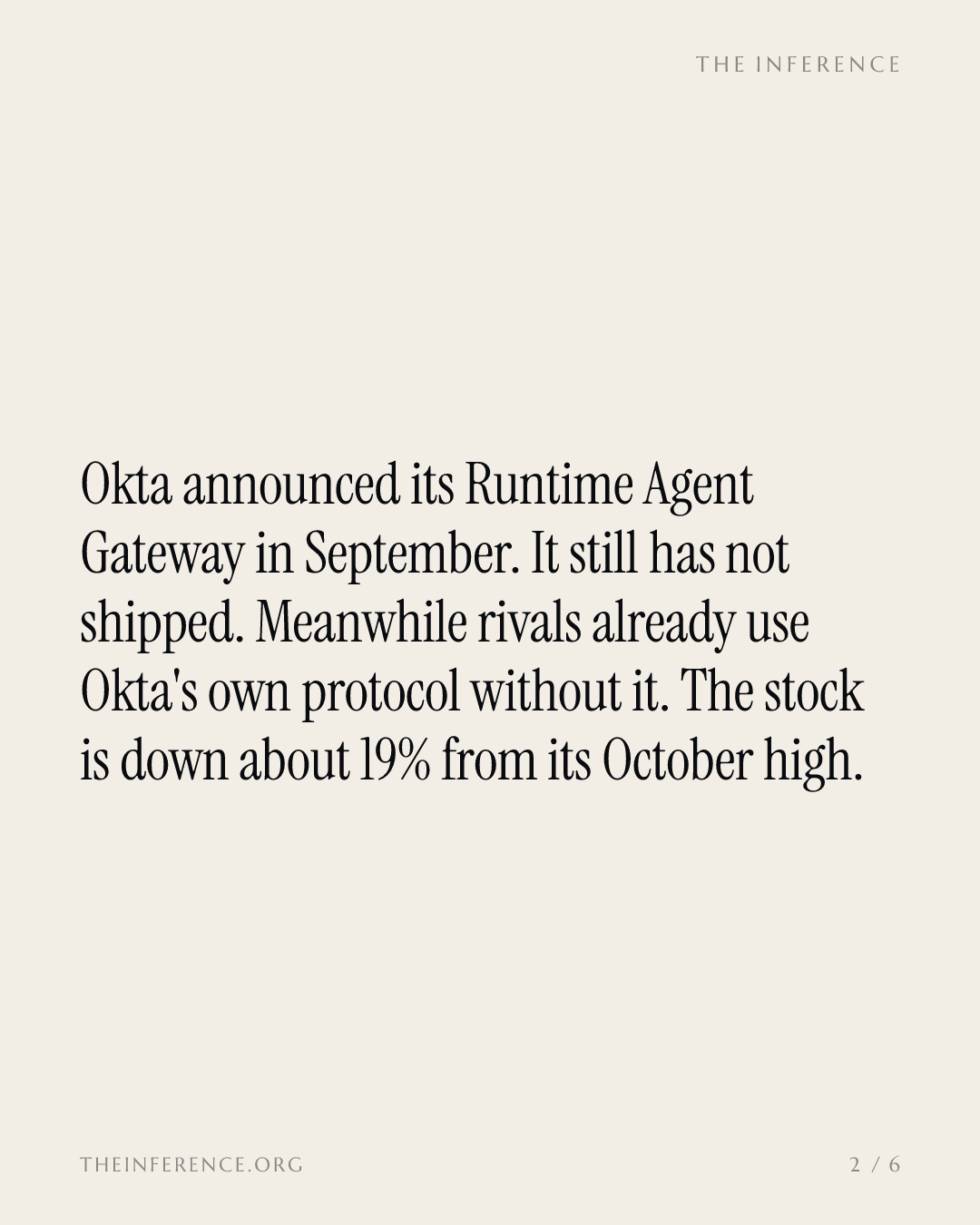
At Oktane on September 22, Okta+2.81% — Okta, up 2.81 percent as of its last quote declared three agent-identity products generally available: Agent SSO, Agent-to-Agent Connections and Resource Access Certifications 2. The piece that actually stands between an AI agent and the tools it calls, the Runtime Agent Gateway, stayed on the roadmap 2. The underlying APIs went to beta on September 16, and a third-party identity tracker found no general availability release through October 7 1.
The market, meanwhile, is not waiting. That same week, Aembit launched enforcement of Okta's own Cross App Access (XAA) protocol through its agentic-AI identity product, with CEO David Goldschlag pitching "a way to adopt XAA now without waiting for every system in their environment to support it natively," and TrueFoundry folded the protocol into its gateway on October 1 41. The market is building around Okta's rulebook without waiting for Okta's product.
Okta's revenue growth has slid from 19% to under 11% across nine quarters
Data
| Revenue growth, year over year (%) | |
|---|---|
| Q1 '24 | 19.1 |
| Q2 '24 | 16.2 |
| Q3 '24 | 13.9 |
| Q4 '24 | 12.7 |
| Q1 '25 | 11.5 |
| Q2 '25 | 12.7 |
| Q3 '25 | 11.6 |
| Q4 '25 | 11.6 |
| Q1 '26 | 11.2 |
| Q2 '26 | 10.6 |
The premium is the product that has not shipped
That nuance became a money problem on October 16, when OKTA fell 10.23% to $187.18 with no new filing, no downgrade and no earnings release, leaving the stock about 19% below its October 9 closing high of $232.13 53. The move was sector-wide, but Okta's exposure is its multiple: roughly 47.5 times the midpoint of fiscal-2027 non-GAAP earnings guidance of $3.90 to $3.94, against revenue guidance of $3.216 billion to $3.226 billion, growth of 10% to 11% 3.
Six firms had raised targets to $215-$240 on the Oktane story days earlier, even as management repeated that agent revenue remains very small relative to the roughly $3 billion base and immaterial to fiscal 2027 64. The growth that carries the price is core identity: cRPO, contracted revenue due within twelve months, accelerated 200 basis points to 14%, and free cash flow ran $227 million at a 28% margin 4.
Insiders sold about $27.1 million of stock in the last 45 days with zero purchases, including CFO Brett Tighe's 80,000 shares for roughly $12.9 million and CEO Todd McKinnon's 48,822 shares for about $9.4 million 5. Sales can be routine; 45 days of them with no buying is a position, whatever the reason 5.
Two outcomes, one quarter
If Agent Gateway ships general availability and the Q4 kill switch, revoking every active token a compromised agent holds through the Shared Signals Framework, the runtime layer stays inside Okta's walls 12. The cRPO acceleration then defends 47.5 times into the Q3 print, expected in late November or early December, with revenue guided to $813 million to $817 million 57.
If Aembit and TrueFoundry capture runtime enforcement on Okta's protocol first, Okta owns the standard while rivals own the toll booth 14. Either way, the gateway, not the guidance, is the product investors are paying for.
Get Security by email, free
The breaches, flaws and security vendors AI is putting to the test. In our daily email, every weekday.