OpenAI's marketplace turns AI commitments into currency, and Decagon holds one of 32 slots
Eligible enterprise customers can spend part of their OpenAI commitment on approved partner software, from Salesforce down to a $4.5 billion startup. OpenAI alone decides what counts, and how much.
 Vincent Jiang · 3 min read
A startup now has a claim on OpenAI's backlog
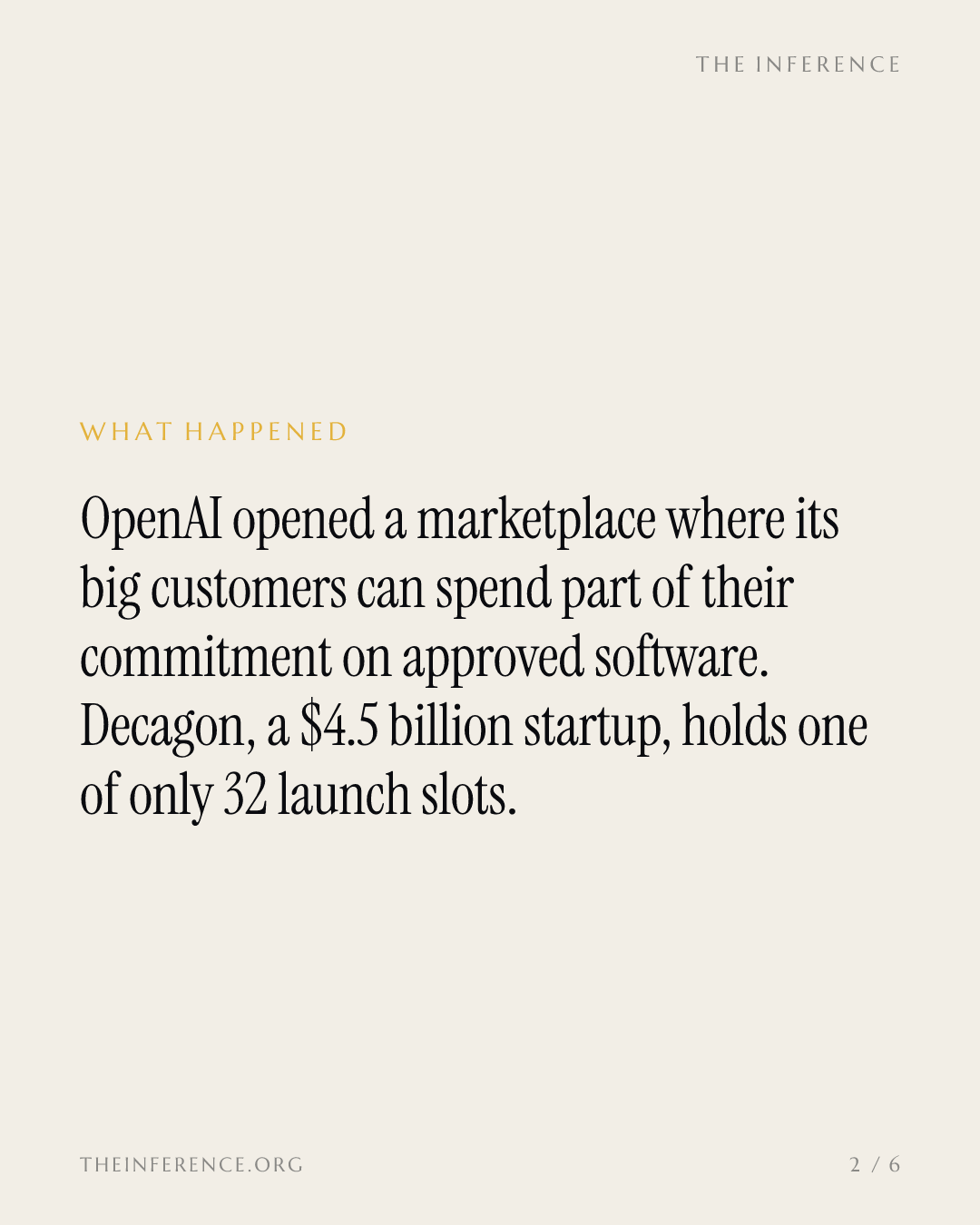
Decagon said on October 2 it is a launch partner of OpenAI Marketplace, the business store unveiled at DevDay on September 29, where eligible enterprise customers can apply part of an existing OpenAI$1.18T — OpenAI, private, latest valuation $1.18T commitment to Decagon's~$1.5B — Decagon, private, latest valuation ~$1.5B support agents and go live in weeks 1. The first cohort runs to 32 storefronts, from Figma+4.07% — Figma, up 4.07 percent today to Harvey$15.5B — Harvey, private, latest valuation $15.5B 1.
The backdrop matters: OpenAI is seeking at least $30 billion at about a $1.4 trillion valuation, after a $122 billion round in March at $852 billion 2. Committed enterprise revenue is now part of the collateral story, and the marketplace is what makes it spendable.
The rail, and the catch
The mechanics are a credit rail, not a checkout. Customers contract with and pay the partner directly, and OpenAI reconciles the eligible amount against the customer's commitment 3. Eligibility is specific to the customer, product and purchase, and the launch experience covers discovery and interest only: no self-service buying 34.
The exposed fine print allows a fixed percentage of spend, up to a cap 4. The sharper warning in the same column: partners "risk depending on OpenAI's eligibility decisions and discovery mechanisms", and the marketplace will in time "begin eating its partners" 4. That lands hardest on the smallest storefront: Decagon's rail revenue rests on approvals granted purchase by purchase 4. An OpenAI commitment used to buy OpenAI. Now it buys whoever OpenAI approves.
The demand is arriving before the rails
Jefferies, reported on October 8, tested Meta's Muse agent on several hundred leading US sites: a third blocked it, a third challenged or restricted it, a third were easy, with new restrictions appearing almost daily 5. Its named beneficiaries of the support traffic agents generate: Salesforce+1.35% — Salesforce, up 1.35 percent today, HubSpot+4.64% — HubSpot, up 4.64 percent today and ServiceNow+1.27% — ServiceNow, up 1.27 percent today among listed vendors, Sierra~$10B — Sierra, private, latest valuation ~$10B and Decagon among private ones 5.
Behind that traffic sits the pool OpenAI claims: 1.2 billion people use ChatGPT every week 6. The gap Decagon is scaling into is wide, with the listed trio's latest quarterly revenue running from $0.9 billion to $11.35 billion 789. Decagon, valued at $4.5 billion in a January Series D, says Duet writes more than 70 percent of its Agent Operating Procedures: it sells the operating layer, not seats 1011.
Salesforce's latest quarter outweighs ServiceNow's and HubSpot's combined
Data
| Value | |
|---|---|
| Salesforce | $11.35B |
| ServiceNow | $3.99B |
| HubSpot | $0.912B ($911.7M) |
Two camps, one budget
Inside the credit rail the CX block is crowded: Salesforce, ServiceNow, HubSpot, Zendesk, Sierra, DevRev and Decagon all hold slots 3. Intercom reached the inside the expensive way, renamed Fin and bought by slot-holder Salesforce for about $3.6 billion in September 12. Outside sits Freshworks, a listed support vendor with $838.8 million of 2025 revenue and no slot: an agent budget spent through an OpenAI commitment cannot reach it at launch 133.
Sierra straddles the line: listed among OpenAI's first 32, and a co-founder with Meta−0.11% — Meta, down 0.11 percent today of the Personal Agent Protocol, whose founders exclude OpenAI 16. No reconciled purchase is public, so how much commitment clears as partner credit is unknowable today. Decagon's pricing listing goes live next; the first invoice reconciled against a commitment will show whether the rail carries real money 14.
Deepdive
AI-generated from this story and its cited sources. Not investment advice.