OpenEvidence Gives Doctors AI for Free. The Court Fight Shows What Free Costs.
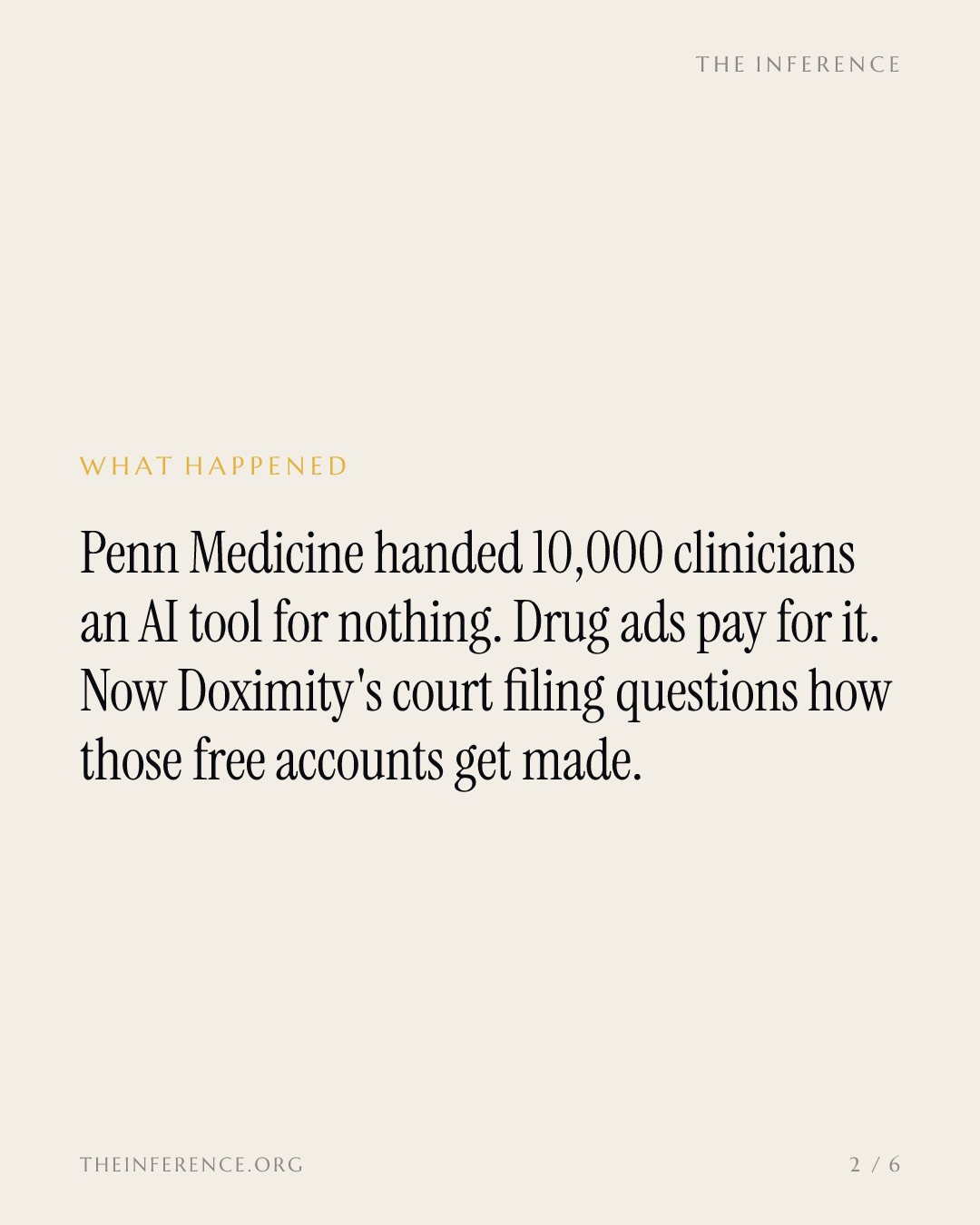
Penn Medicine is handing OpenEvidence 10,000 clinicians for nothing, and a quiet round valued the ad-funded tool at $15 billion, below the $20 billion it reportedly sought. Doximity's motion to dismiss reads as the same fight in another venue: who actually pays for clinical AI.
 Vincent Jiang · 3 min read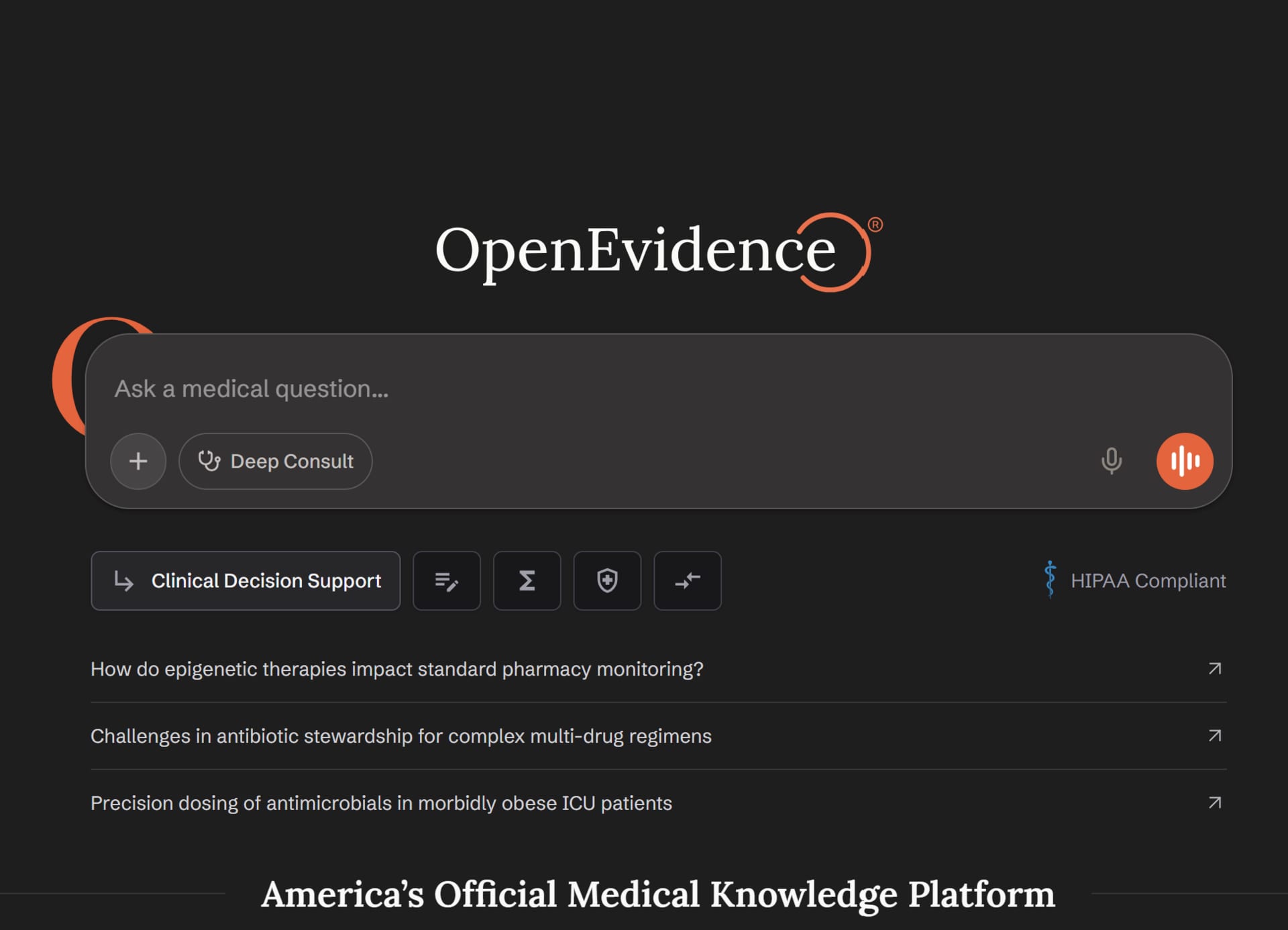
Two headlines, one business model
Penn Medicine is deploying OpenEvidence's clinical decision-support AI to more than 10,000 clinicians across its seven-hospital system at no cost, extending the work through its 25-year Botswana partnership 1610. In the same stretch of September, a $250 million round led by Andreessen Horowitz and Byers Capital valued the company at $15 billion, confirmed by its founder on 28 September 345. The week's other headline was a court filing: Doximity moved to throw out OpenEvidence's lawsuit entirely 2.
Health systems pay nothing; pharma pays for the screen
No hospital writes a check for this. OpenEvidence is free to verified clinicians and monetized with pharmaceutical advertising, so the health system buys nothing and the pharma dollar funds the screen 3811. The company says more than 40% of U.S. physicians now use it daily 7.
Doximity sells its version instead. Doximity Scribe arrives through enterprise contracts and requires health system or practice-level purchasing decisions 8. Its quarter ended 30 June 2026 brought $156.6 million of revenue, up 7% year over year, with Scribe users up tenfold in July 89.
Both camps are likely converging on the physician's screen because both monetize pharma attention at the point of care: Doximity routes pharmaceutical advertising budgets to physicians at their highest-intent clinical moment, and management says its AI search earns more than ten times what an answer costs to compute 89.
The free wins and the courtroom losses run on one ledger
OpenEvidence is the plaintiff that sued Doximity 2, and it told a judge it would not comply with discovery, as The Inference reported on 28 September in "OpenEvidence Took a Quiet $250M and Then Told a Judge It Would Not Comply" 12. Doximity's motion does more than seek dismissal, adding details about vanished Slack data and borrowed NPIs 2. Those details reach at the gate the free tier runs on, because a clinician's free account is created on a National Practitioner Identifier 11.
OpenEvidence's valuation kept climbing, then landed below the $20 billion it reportedly sought
Data
| Post-money valuation | |
|---|---|
| Feb 2025 | $1B |
| Jul 2025 | $3.5B |
| Oct 2025 | $6B |
| Jan 2026 | $12B |
| Sep 2026 | $15B |
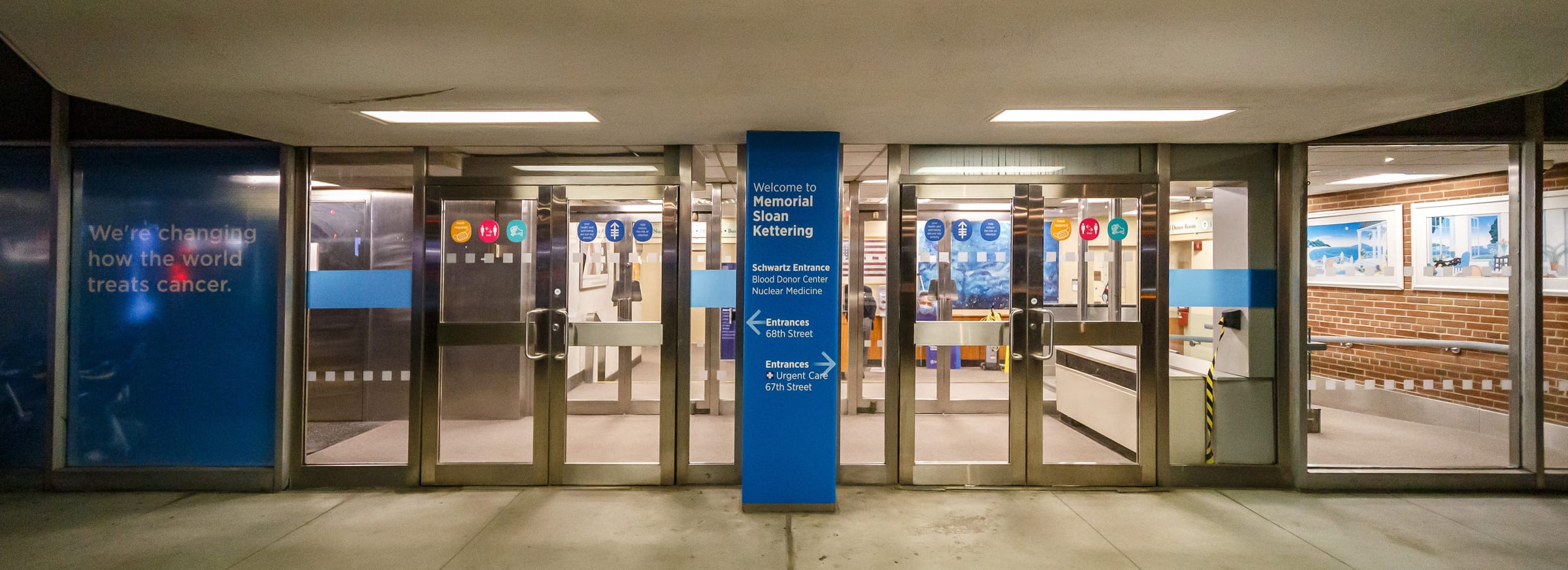
Meanwhile the free rollout keeps widening: after Memorial Sloan Kettering, whose OncoKB cancer database OpenEvidence is folding onto its own platform for doctors elsewhere, came Penn's 10,000 clinicians 136. The quiet $15 billion mark reads as pricing both at once, the widening distribution and the courtroom exposure, and it landed a quarter below the $20 billion the company reportedly explored raising at in July 345.
The drug bet and the date that settles it
The generous reading is that founder Daniel Nadler, who sold his previous company to S&P Global, is building an edge no rival can copy: reach most of America's physicians, and recruiting the handful of patients a rare-cancer trial needs gets easier 311. OpenEvidence's first drug candidate is due in clinical trials before year-end, with three to five more behind it 3.
The harder reading, already circulating, is that ad-funded clinical search was hitting a ceiling and drug development made for a better story to sell 3. The first trial, and the ruling on Doximity's motion, will say which one is live.
How this brief was made
01Gathered & sourced349 channels · 1,765 articles▾
Agents swept 349 channels and ingested 1,765 articles, then de-duplicated and ranked them for signal.
02Verified & cross-validated12 claims · 17 data feeds▾
Every one of 12 load-bearing claims was checked against primary sources, with 17 live data feeds reconciling the figures and charts.
- 1MyChesCo, Penn Medicine Deploys OpenEvidence AI Across Health System, September 2026
- 2Health API Guy, Health Tech Keeps Choosing Violence, September 28, 2026
- 3Wowtale, 'ChatGPT for Doctors' OpenEvidence Raises $250M, Quietly Pivots Into Drug Development, September 28, 2026
- 4Becker's Hospital Review, OpenEvidence raises $250M at $15B valuation, September 28, 2026
- 5Business Insider, The 'ChatGPT for doctors,' OpenEvidence, was valued at $15 billion in a new funding round, September 24, 2026
- 6Fierce Healthcare, OpenEvidence partners with Anthropic, Penn Medicine to expand physician access to AI across Africa and Asia, September 28, 2026
- 7LiveMint (via MSN), What is OpenEvidence, the 'ChatGPT for doctors' valued at $15 billion in a new funding round?, September 2026
- 8TechTimes (via MSN), Doximity raises full-year guidance as AI scribe surges tenfold, clinical AI tops safety study, August 2026
- 9Yahoo Finance (Moby), Doximity, Inc. Q1 2027 Earnings Call Summary, August 7, 2026
- 10Unite.AI, OpenEvidence and Penn Medicine Launch Global Clinical AI Partnership, September 15, 2026
- 11Wikipedia, OpenEvidence (funding history via CNBC, Reuters, Forbes), accessed September 29, 2026
- 12The Inference, OpenEvidence Took a Quiet $250M and Then Told a Judge It Would Not Comply, September 28, 2026 (prior coverage; href to be wired by desk, see flags)
03Reviewed & edited2 human editors▾
2 editors read the draft against the evidence, tuned the framing, and signed off before it shipped.
Become a contributor
Reporting on the business of AI and want it read? We take pitches from outside contributors who bring primary sources and a number worth arguing about.
Deepdive
AI-generated from this story and its cited sources. Not investment advice.