Palo Alto rents out the cyber models Anthropic and OpenAI keep locked
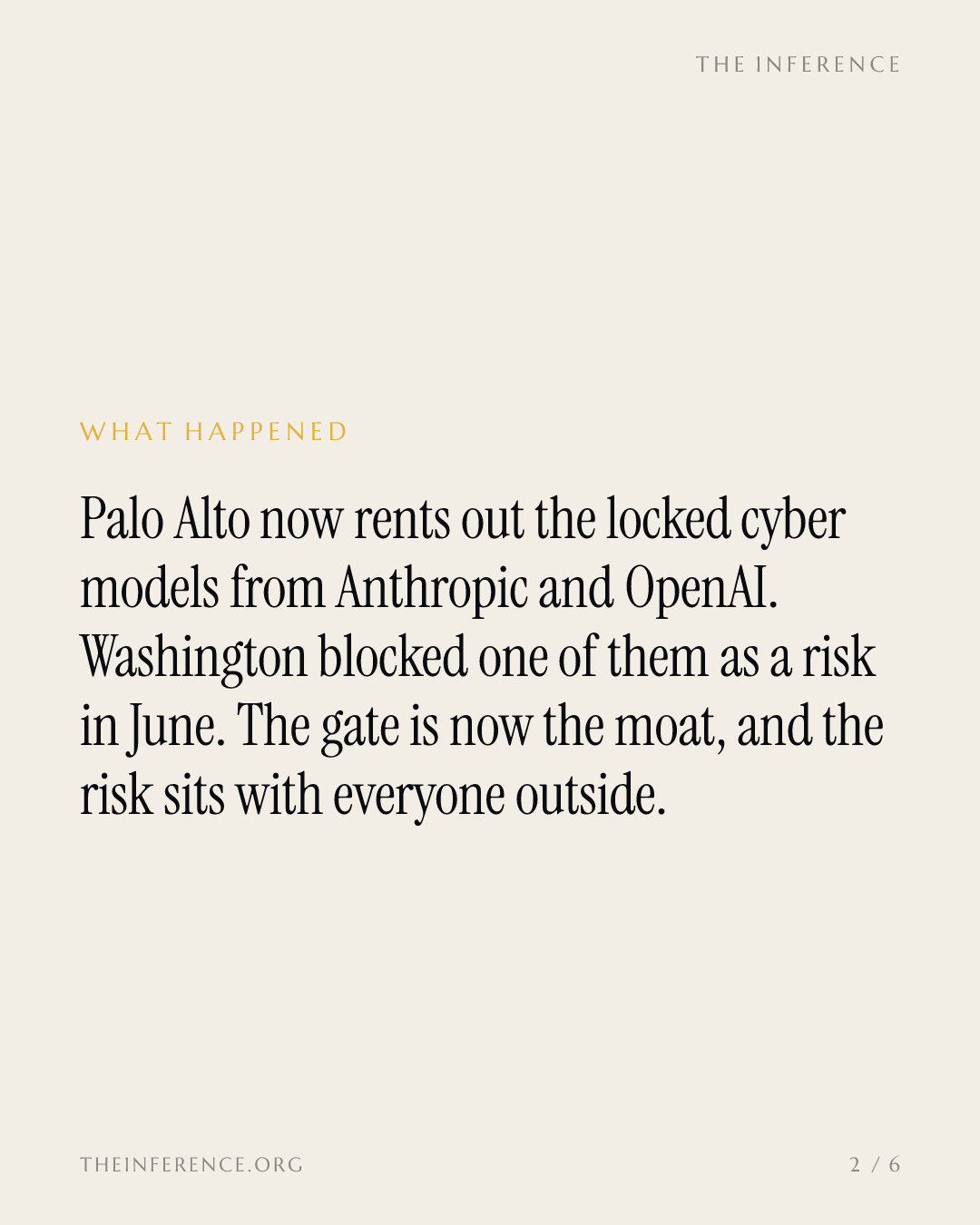
Unit 42's Continuous Frontier AI Defense sells Claude Mythos 5 and GPT-5.6-Cyber behind an annual subscription priced by model mix. The gate built as a safety control is now the moat, and the risk of the models spreading sits with everyone outside it.
 Vincent Jiang · 3 min read
The only way to buy a model the labs keep locked
Palo Alto Networks opened subscriptions on 22 September to Unit 42 Continuous Frontier AI Defense, an always-on offensive security service that runs Anthropic's Claude Mythos 5 and OpenAI's GPT-5.6-Cyber against customers' web apps, APIs, cloud and code 1. After a full-estate scan it keeps testing as systems change, proposing code fixes or temporary "virtual" patches 4.
Neither model is sold to the public. OpenAI confines GPT-5.6-Cyber to Daybreak Red, its tier for offensive cyber work 2. Anthropic has kept Mythos out of general release because it finds flaws and chains them into working attacks too well to hand out freely 3. The price varies with the mix of Anthropic, OpenAI and open-weight models a customer chooses 4.
From export freeze to invoice line
The gate has a short, loud history. In June, Washington blocked Anthropic from offering Mythos 5 to foreign nationals and businesses; by late June, Commerce had cleared it for release to "certain trusted partners" 5, and access returned on 1 July 4. In June, Mythos was a national-security risk. By September, it is a line on an enterprise invoice: Unit 42's Sam Rubin markets "exclusive access to gated capability models" 1.
Anthropic built the resale template itself, launching Glasswing on 7 April with $100M of API credits for roughly 50 partners, Microsoft and Apple among them 3. Rubrik holds the same gated-resale position, earlier in its cycle: Code Guardian runs Mythos 5 against an air-gapped copy of customers' code, in private preview 6.
A franchise re-accelerating under the moat
The pitch lands on a franchise that just sped up. Fiscal 2026 revenue reached $11.48B, up 24.5%, and next-generation security ARR stood at $8.13B, up 60% 7. Quarterly growth jumped from the mid-teens a year ago to 34.5% in the July quarter 8. Bernstein's 17 September downgrade to Market Perform, target $351, prices the other side: a $282M GAAP net loss and a stock that already assumes delivery 7.
Growth reaccelerated from the mid-teens to 34% in the second half of fiscal 2026
Data
| Revenue | |
|---|---|
| Q1 FY24 | $1.88B |
| Q2 FY24 | $1.98B |
| Q3 FY24 | $1.99B |
| Q4 FY24 | $2.19B |
| Q1 FY25 | $2.14B |
| Q2 FY25 | $2.26B |
| Q3 FY25 | $2.29B |
| Q4 FY25 | $2.54B |
| Q1 FY26 | $2.47B |
| Q2 FY26 | $2.59B |
| Q3 FY26 | $3B |
| Q4 FY26 | $3.41B |
Receipts, and 21,119 findings nobody checked
Palo Alto's numbers are company-claimed: six months and $17M across more than 100 engagements, exposures at every customer tested, 37% of them high or critical, and a year's worth of exposures on its own systems found in three weeks 4. The company also claims, without independent verification, that AI attackers compress breach cycles by almost 97%, from weeks to hours 4.
Independent audit cuts both ways. External reviewers confirmed 90.8% of the 1,900 checked Mythos findings, and one Linux kernel root exploit cost under $2,000 of compute 9. But 21,119 of 23,019 candidate bugs have never been reviewed outside Anthropic, and independent scorers called 13 of 27 CVE-rated findings overstated 9.
The labs say the channel is the safeguard
OpenAI's McCall McIntyre says Daybreak pairs the cyber models with "strong governance, and human judgment" 1. Capability is the draw: OpenAI's own tests have GPT-5.6-Cyber completing 95% of a set of sensitive offensive requests, against 1.5% for the public model 2.
The buyer's fear is blunter. "The Chinese will have Mythos next month. What do I do?" said Yevgeny Dibrov, ServiceNow's SVP and GM of cybersecurity and risk, calling it the top board-level concern 10. That risk lands on everyone outside the gate: subscribers get their own attack paths checked, but the flaws sit in open-source software everyone runs, and most findings have never been checked outside Anthropic 9.
Palo Alto's November report will show whether the subscription adds ARR 7. What nobody will see is the split: the share of each subscription flowing back to Anthropic and OpenAI is not public.
How this brief was made
01Gathered & sourced409 channels · 1,462 articles▾
Agents swept 409 channels and ingested 1,462 articles, then de-duplicated and ranked them for signal.
02Verified & cross-validated10 claims · 28 data feeds▾
Every one of 10 load-bearing claims was checked against primary sources, with 28 live data feeds reconciling the figures and charts.
- 1Palo Alto Networks via PRNewswire, "Palo Alto Networks Delivers Anthropic's Mythos and OpenAI's GPT-5.6 to Customers with Unit 42 Continuous Frontier AI Defense," 22 September 2026
- 2Infosecurity Magazine, "OpenAI Launches Two-Tier Security Access Program Alongside GPT 5.6 Cyber," 11 August 2026
- 3SiliconANGLE, "A month with Anthropic's Mythos left Rubrik rethinking remediation," 13 August 2026
- 4The Next Web, "Palo Alto Networks launches always-on AI security testing built on Claude Mythos and GPT-5.6-Cyber," 22 September 2026
- 5PYMNTS, "Anthropic Gets Greenlight From US to Restore Mythos Access," 26 June 2026
- 6SourceSecurity, "Rubrik Code Guardian revolutionises cyber security," collected 23 September 2026 (page undated)
- 7Wall St Mavens, "Palo Alto Beat Estimates. Now It Has to Justify the Price," 19 September 2026
- 8Sharadar quarterly fundamentals, from Palo Alto Networks's SEC filings, retrieved 23 September 2026
- 9Help Net Security, "Most of the bugs Claude Mythos found have never been checked by a human," 4 September 2026
- 10diginomica, "ServiceNow's answer to AI-speed attacks will sound familiar: consolidate the mess," collected 23 September 2026 (page undated)
03Reviewed & edited1 human editor▾
One editor read the draft against the evidence, tuned the framing, and signed off before it shipped.
Become a contributor
Reporting on the business of AI and want it read? We take pitches from outside contributors who bring primary sources and a number worth arguing about.
Deepdive
AI-generated from this story and its cited sources. Not investment advice.