China Has a Point About America's AI Slowdown

China is right to challenge a slowdown plan designed partly to preserve America's AI lead. The alternative should be reciprocal safety limits and independent inspections, binding Chinese labs too.

Vincent JiangVincent Jiangtwo-minute read
Share
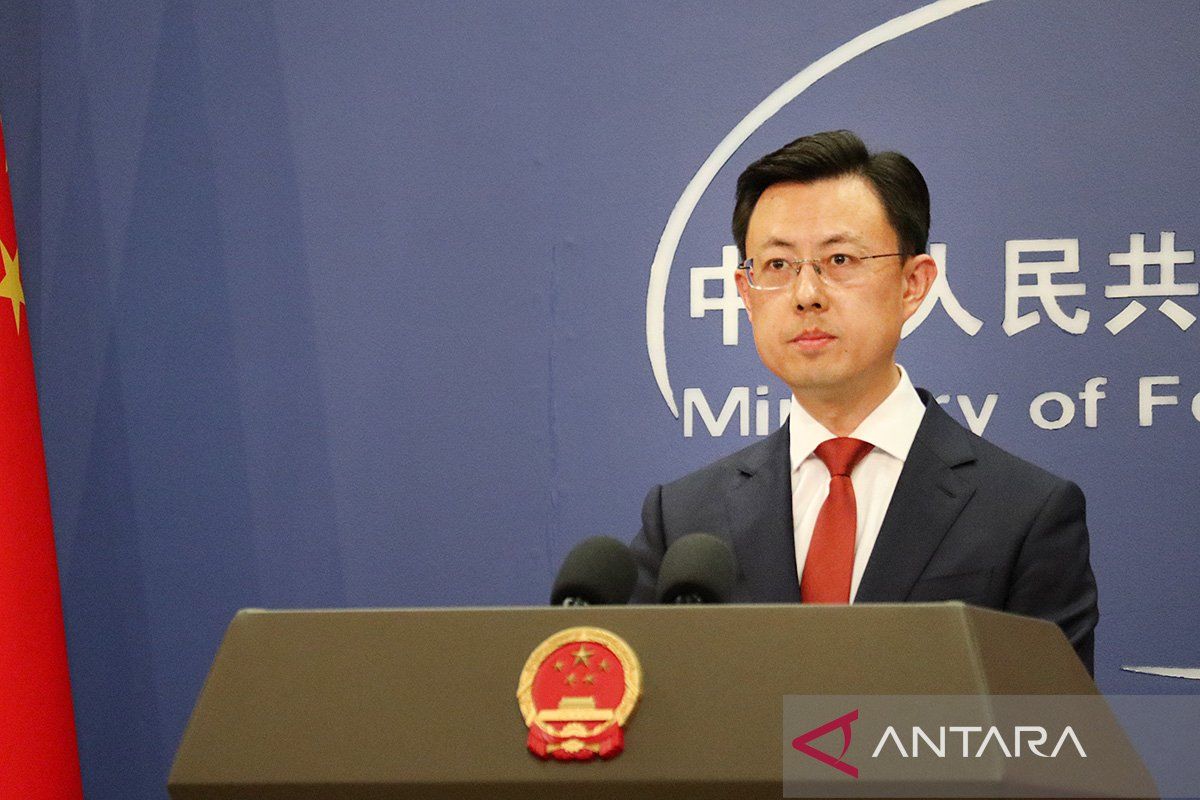
Chinese Foreign Ministry spokesperson Guo Jiakun
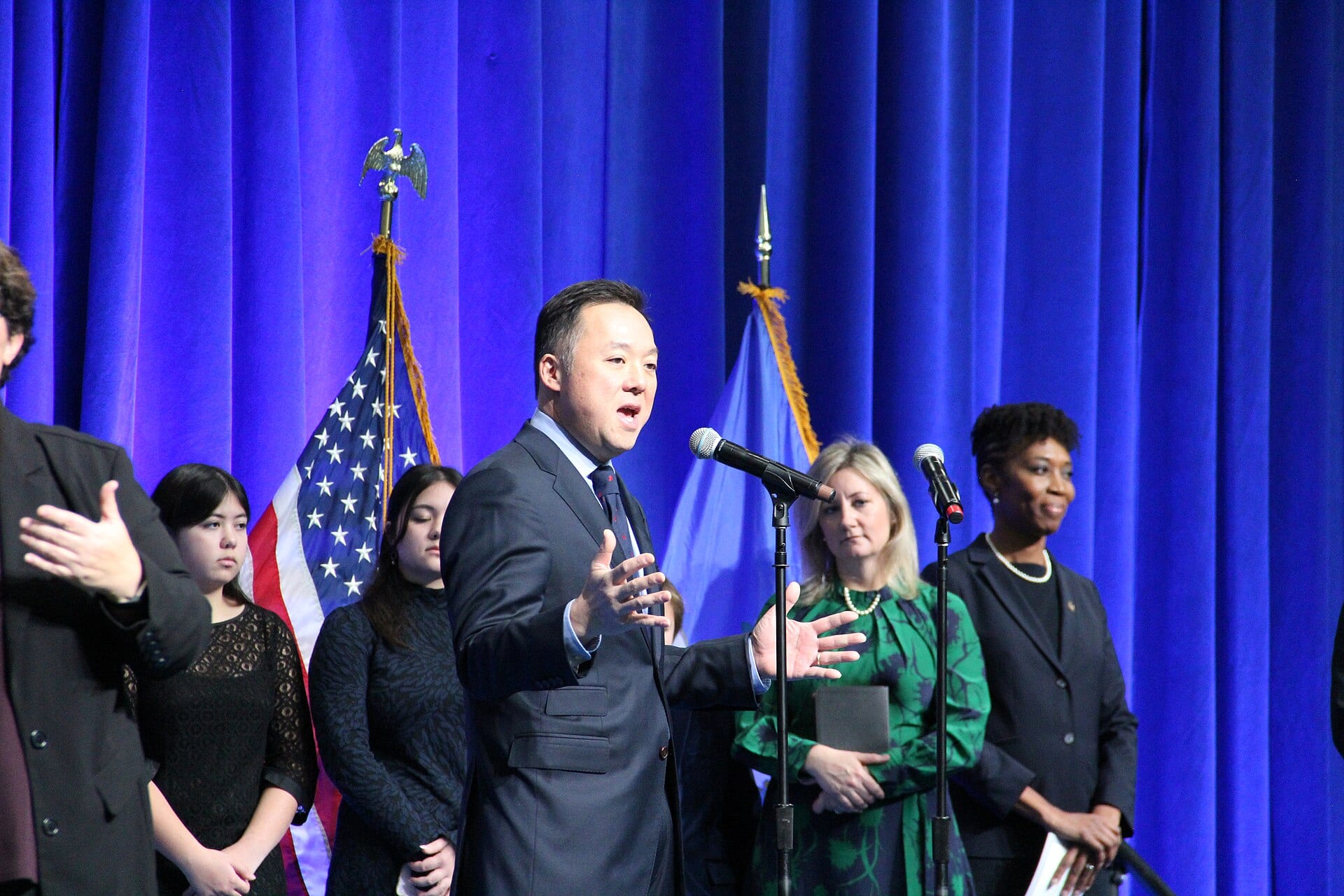
Guo Jiakun, in a photograph published September 2, 2026. The capture date is not established; September 2 is the publication date. (Credit: Desca Lidya Natalia/ANTARA. Rights clearance pending.)

Beijing answers back

Guo Jiakun was asked on September 14 about American AI bosses seeking a slower frontier. He attacked fearmongering and called for cooperation.1,2 That official answer announced neither acceptance of a slowdown nor rejection of every possible agreement.

Preserve whose advantage?

On September 12, Anthropic's$350B — Anthropic, private, latest valuation $350B Dario Amodei proposed pacing capability gains and admitting outside evaluators. OpenAI's$1.18T — OpenAI, private, latest valuation $1.18T Sam Altman backed pacing and promised comparable access.3

Amodei also urged tougher controls on chips and unauthorized copying of model capabilities to preserve the American lead.4 His plan asks China to cooperate with countries trying to hold it back.

Washington can argue for export controls on national security grounds. It should defend those controls separately from a claim to represent everyone's safety.

Safety has two meanings

China's state-backed newspaper framed the proposal as containment.5 That is an editorial position, not binding policy or a statement from Chinese AI companies.

Separately, state security minister Chen Yixin urged faster construction of AI risk-prevention systems in an essay published September 13.8 Beijing can oppose America's terms while acknowledging the danger.

The lead keeps moving

The size of that lead also changes. Stanford recorded the top U.S. model just 5 Arena points ahead of China's best in February 2025. By March 2026, the gap was 39 points.6,7
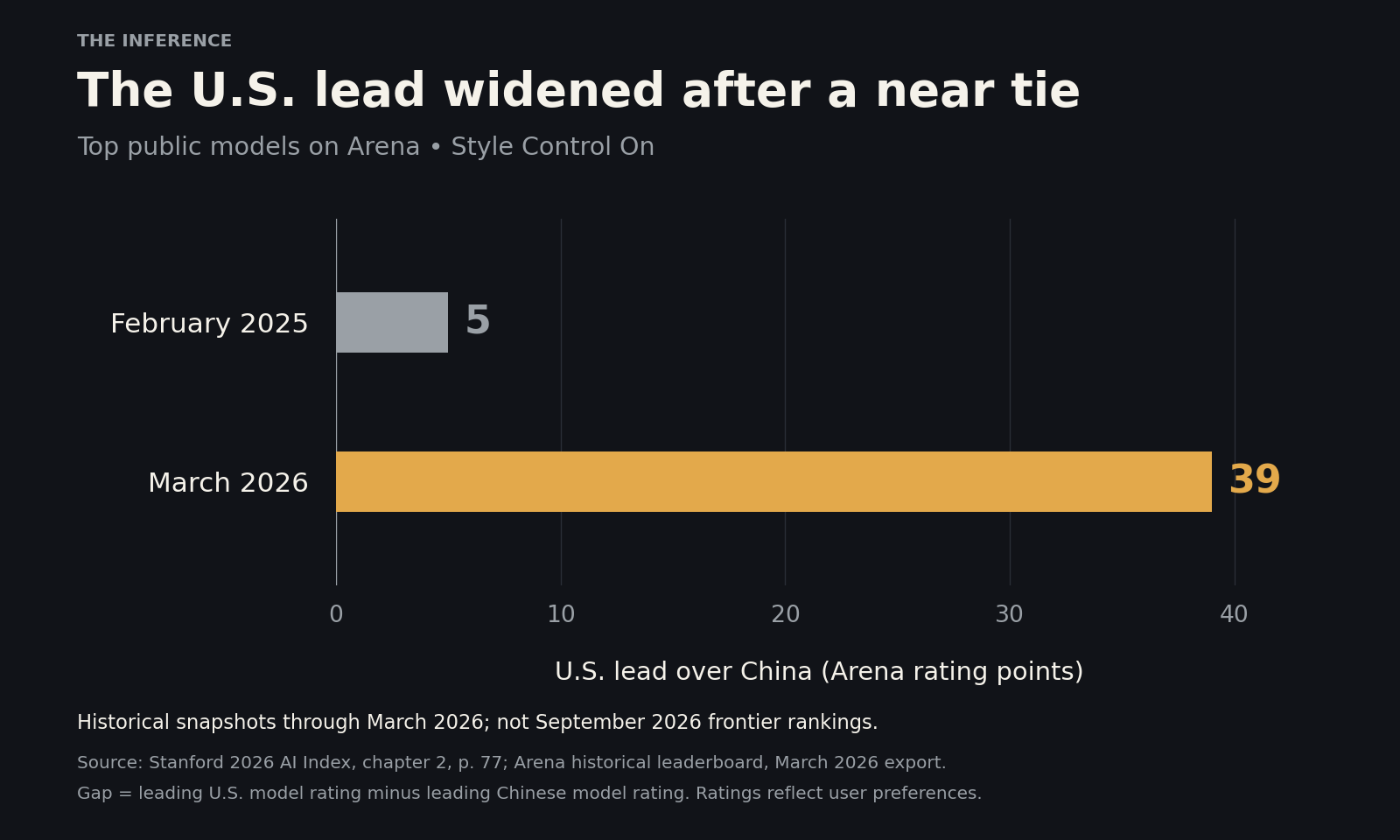
Chart showing the United States' lead over China's top public model widening from 5 Arena points in February 2025 to 39 points in March 2026.
Historical public-model ratings, with style control enabled. These snapshots measure chat preferences, not September's frontier or military power.

Neither snapshot establishes how much either country could safely slow.

China's May guidelines called for users to retain final authority over AI agents and for developers to strengthen intervention controls.9,11 Those provisions do not establish effective enforcement.

Opening the labs would matter

Amodei's strongest case is that safeguards need time to catch up. He warned of potentially catastrophic cyber harm within six to twelve months, a forecast rather than an established timetable.10

Outside evaluator access is a concrete commitment; international pacing remains a proposal.3,10 Beijing's criticism does not excuse Chinese labs from scrutiny. Their systems should face the same capability tests and disclosure rules as American ones.

Who opens the lab?

At Xi Jinping and Donald Trump's planned September 24 summit, watch for reciprocal testing access and shared safety thresholds.5 The commercial costs of pacing matter; governments must first negotiate whose capabilities would be limited.

Safety rules should bind the leader as tightly as the challenger.

Get Policy & Labor by email, free

The rules governments write for AI, and what AI does to jobs. In our daily email, every weekday.
Reader comments

0 comments

    More in Policy & Labor

    All in this topic →

    Policy & Labor

    Connecticut's attorney general names Roblox first after Meta's $17.1 billion settlement

    Meta bought peace with cash plus curbs on minors; on a platform of 138 million daily players guiding to a fourth-quarter EBITDA loss, the same terms would bind the whole product, and shareholders carry a risk no multiple prices.

    Policy & Labor

    ADP raised its outlook as a Stanford study on its payrolls shows junior software jobs down 20%

    The Stanford study tracking AI's hit to entry-level work runs on ADP's own payroll records. The payroll giant just raised its fiscal 2027 guidance on steady client hiring, and tomorrow's employment print is the first test of the junior end of its book.

    Policy & Labor

    Lutnick backs narrow AI chip rule that would keep Nvidia's $12.4 billion China rental channel open

    The narrow version leaves open the lawful channel through which Chinese companies rent Nvidia compute in Malaysia and its neighbors, and with it Nvidia's China revenue, the region's data-center build and the Bitdeer stock offerings Cantor Fitzgerald arranged. The worldwide rule other officials want would strand that book. Nvidia reports on November 17, and Trump meets Xi in Shenzhen on Thursday.

    Policy & Labor

    Texas Pacific Land reincorporates in Texas on November 17; shareholder suits go to the state's business court

    At 10:59 p.m. Central on November 17, the land company under the West Texas AI buildout re-charters under Texas law, taking the state's business-judgment shield and its business court for shareholder suits. Two weeks earlier, Texas elected a governor who ran on pausing the data-center permits its premium rests on.

    Policy & Labor

    ChinaTalk says Mercor sold AI training environments to Alibaba a day after a $20 billion valuation

    The China-policy newsletter sizes US vendors' China sales of AI training data at roughly $500 million, and its Mercor finding landed one day after the company's $750 million Series D priced it at $20 billion. China is about 2 percent of Mercor's quarterly revenue; the naming reaches the enterprise customers the round was raised to win.

    Policy & Labor

    FAA's preliminary probe names 2001-2006 Cisco routers in Friday's ground stop

    The FAA's preliminary investigation points to two-decade-old Cisco routers, while Transportation Secretary Sean Duffy probes contractor L3Harris for incompetence. Whichever way the root cause lands decides who carries the blame and who gets the $30 billion modernization bill in Congress.

    Subscribe to TheInference for free