Schroders letter calls Poolside a growing business whose price is coming down after Nvidia's $7 billion deal
Schroders Capital's Q3 letter names Poolside the largest contributor to its private equity fund's performance on operating leverage and revenue growth, while writing that valuation assumptions have turned more conservative. The first outside read since Nvidia's $7 billion license-and-hire deal says the coding startup Nvidia left standing is a business, and one whose price is coming down.
 Richard Tang · 3 min read
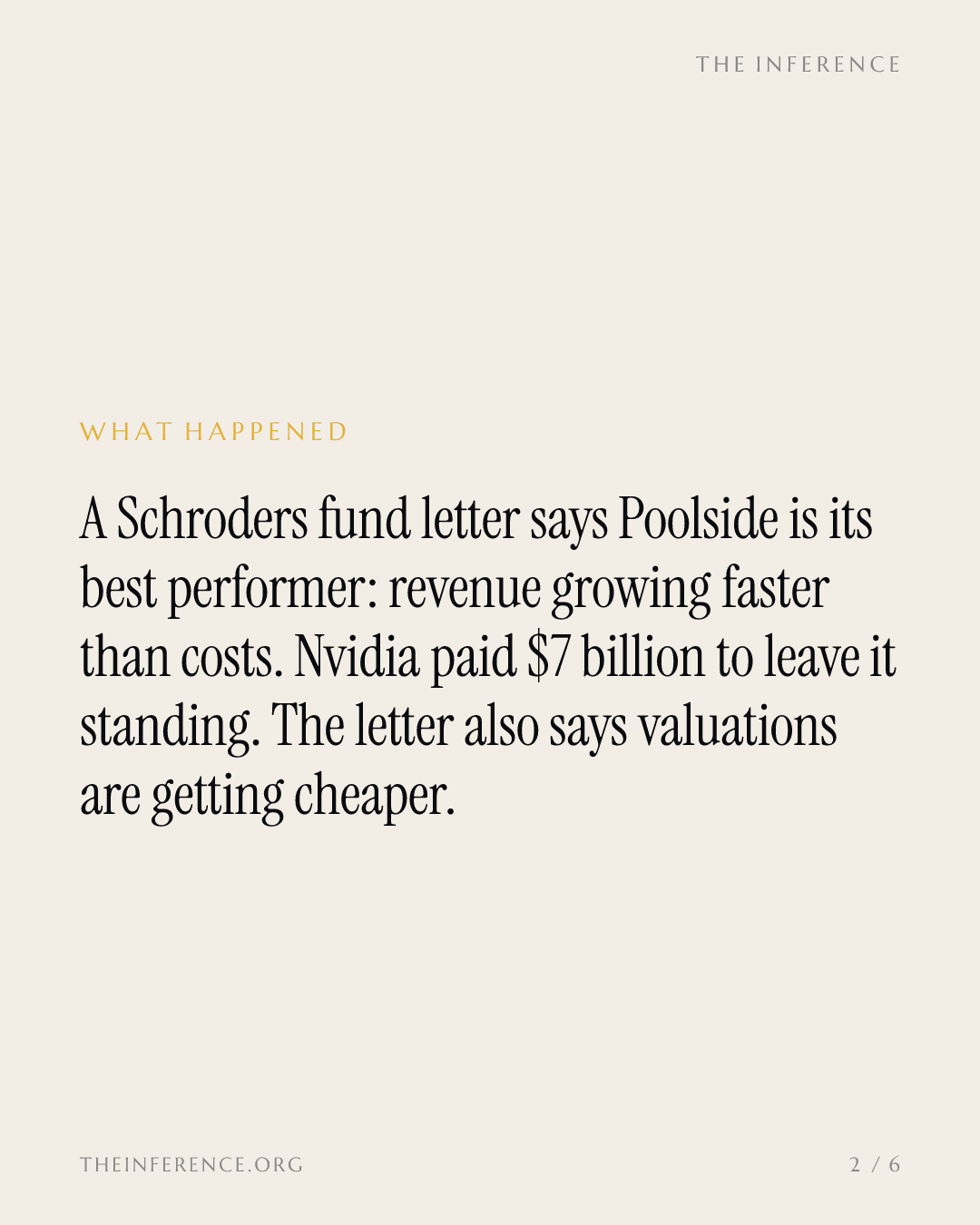
Schroders Capital's third-quarter letter to investors in its semi-liquid private equity fund names Poolside~$4.1B — Poolside, private, latest valuation ~$4.1B the largest contributor to performance, crediting revenue growth and operating leverage, revenue rising faster than the cost base, and adds that valuation assumptions have turned more conservative 1. Both halves matter. Together they are the first outside read on the question Nvidia's−1.70% — Nvidia, down 1.70 percent today August deal left open: whether the AI coding company Nvidia paid $7 billion to leave standing is a business or a husk 2. It is a business, and one whose price is coming down.
The license left the factory at home
The August letter to Poolside's investors was categorical that this "is not an acquisition and it is not an acquihire" 23. Nvidia paid $6 billion for a nonexclusive license to the Model Factory, the training system behind Poolside's Laguna coding models, and made offers to the engineers who built them 23. Its new equity went in at the $12 billion valuation the startup's failed funding round had been chasing 24. The fee cashes out backers including Bain Capital Ventures, eBay+5.16% — eBay, up 5.16 percent as of its last quote, Citi Ventures, Redpoint and Adams Street before the end of 2027 2. Chief executive Eiso Kant keeps a research bench under 115 people and, because the license is nonexclusive, the right to sell the same software again 2.
The business compounds; the price does not
What Schroders fund holders own is that residual, and the letter says it is compounding: a next-generation coding platform for enterprises, with revenue growing on a shrunken bench 1. The conservative half matters just as much, because it says the price of a coding lab is drifting down even as the business grows 1. The letter carries no revenue figure and no valuation, so the direction, not the level, is the signal 1. An October 11 post on X calling the deal an acqui-hire has the shape of the story wrong 5; the fund letter is the better witness that no company was absorbed 2.
Reflection is the next run of the template
Nvidia is already running the template again. The Financial Times and Bloomberg report early talks with Reflection AI$2.1B — Reflection AI, private, latest valuation $2.1B, an open-weight lab that shipped its Beam coding model on October 5 78. Nvidia holds $800 million of the lab 7. It was last valued at $25 billion, a license-and-hire is among the options, and an agreement is possible within weeks 67.
License-and-hire has carried Nvidia's biggest AI checks, and Reflection would top them
- Estimate
Data
| Value | |
|---|---|
| Enfabrica | $0.9B |
| Poolside | $7B |
| Hugging Face | $13B |
| Groq | $20B |
| Reflection AI (estimate) | $25B |
The first copy is already in court
Two former Groq$3.5B — Groq, private, latest valuation $3.5B engineers sued the chip designer's board on October 2 over the roughly $20 billion first run of this shape, and the Justice Department is asking whether it was built to dodge merger review 68. If Reflection closes as a license plus a wave of hires before any ruling, this letter becomes the first evidence that what Nvidia leaves behind is worth owning.
The labs that turn capability into revenue are the ones worth leaving standing. Nvidia took the machinery and the machinists; the mark says what stayed home still compounds.

More about NVIDIA
NVDA · Fiscal Q2 2027Revenue rose 106% to $96.2B, 92.5% of it from Data Center, “driven by the ramp of our Blackwell Ultra infrastructure”. Gains on equity stakes of $7.8B lifted net income to $59.7B.
Show as a table
| Line | Value |
|---|---|
| Revenue | $96.2B |
| Gross margin | 75.0% |
| Operating margin | 66.2% |
| Net income | $59.7B |
| Hyperscale | $48.7B |
| AI clouds & enterprise | $40.3B |
| Data Center | $89.0B |
| Edge Computing | $7.2B |
| Gross profit | $72.1B |
| Cost of revenue | $24.1B |
| Other income | $7.8B |
| Operating income | $63.7B |
| Operating expenses | $8.4B |
| Tax | $11.8B |
| R&D | $7.1B |
| SG&A | $1.4B |
Deepdive
AI-generated from this story and its cited sources. Not investment advice.