Spotify kept 50 million AI tracks off recommendations; they are 10 times likelier to earn no royalties
Spotify's purge of AI tracks is royalty-pool defense, not moderation, and it lands the same week the majors' subpoenas reach Suno's venture backers and Spotify signs its fourth remixing partner.
 Richard Tang · 3 min read

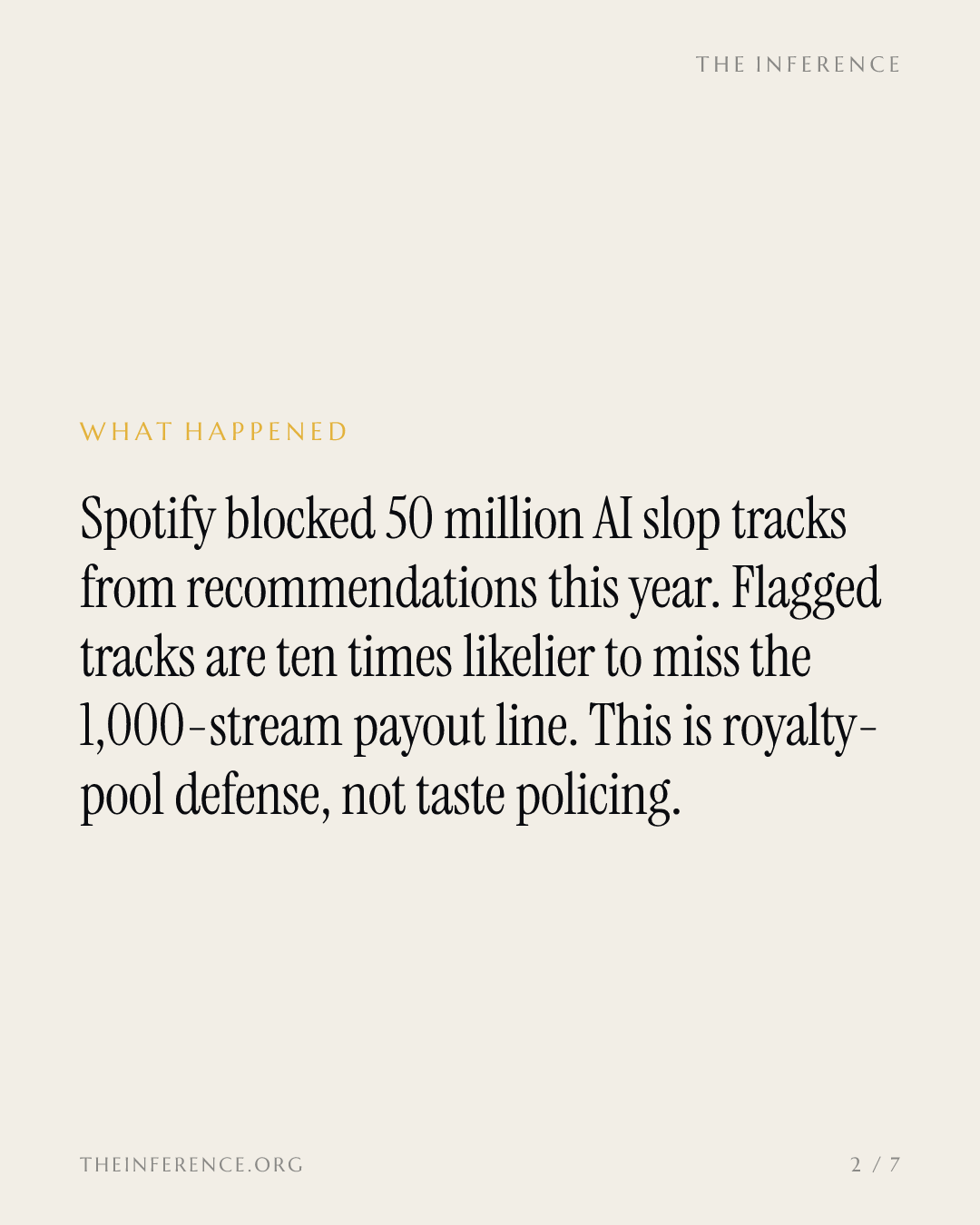
The slop war has entered its accounting phase. Spotify+1.85% — Spotify, up 1.85 percent today said on October 20 that it has blocked more than 50 million AI-generated "slop and spam" tracks from its recommendations this year, on top of 75 million spammy tracks deleted from the platform outright, and disclosed the money fact hiding inside the cleanup: tracks flagged as probably AI-generated are ten times more likely to fall below its 1,000-stream royalty threshold 1. That threshold decides who the royalty pool pays. Spotify is not moderating slop for taste; it is defending a payout pool that mass AI uploads dilute.
The threshold decides who the pool pays
The cleanup runs on multiple signals: listener feedback, upload patterns, metadata, third-party AI detection tools, and sweeps for mass uploads, duplicates and spammy playlist networks. Spotify has labeled both sides, giving more than 300,000 human artists a Verified badge while "AI Persona" artists are excluded from editorial and algorithmic recommendations unless a listener follows their profile 1. The same message frames the company as "a first line of defense for human artists," a position it can afford now that it has built the licensed lane.
Spotify opened the licensed lane
That lane is filling. Spotify signed Believe Music, the French independent company behind distributor TuneCore, as the latest participant in its AI remixing tool, following Universal Music, Merlin and Kobalt 34. The tool, a paid add-on for Premium subscribers, lets fans make licensed remixes and covers, with artists opting in through a two-step consent process and earning revenue on top of their existing streaming payouts 4. The service has no release date yet 3. The sequencing matters: hours before Believe signed, Spotify published the 50 million figure, and Believe's own statement ties its deal to Spotify's "safeguards against AI-generated spam" 3. Licensed partners capture the new revenue while unlicensed actors face discovery.
The subpoenas have reached the investors
The same counting logic has moved into court. Universal and Sony+1.49% — Sony, up 1.49 percent today are opposing a motion by Lightspeed Venture Partners, a Suno~$2.45B — Suno, private, latest valuation ~$2.45B backer, to quash a subpoena seeking documents on Suno's training-data risks and testimony on the investor's "understanding of SUNO's impact on the music industry"; Lightspeed says it has already produced 152 documents, and the majors call that insufficient 2. A magistrate has approved the same subpoena against a16z over Udio 2. AI music is being forced from an unmeasured externality into a counted, licensed, consented revenue line.
Two things to watch: whether Spotify's next earnings report prices the cleanup as a cost, which would be odd bookkeeping given that a pool paying real artists is the product, and whether Lightspeed's motion to quash fails as a16z's subpoena was approved. Either answer firms up who pays for slop and who profits from the count.
Deepdive
AI-generated from this story and its cited sources. Not investment advice.