NASA Held the Price on Its Moon Lander. It Lost the Calendar.
The contract SpaceX signed has grown 6% in cost and at least two years in schedule. The refuelling campaign behind it needs a tanker launch every six days.
 Vincent JiangSeptember 14, 2026 · 3 min read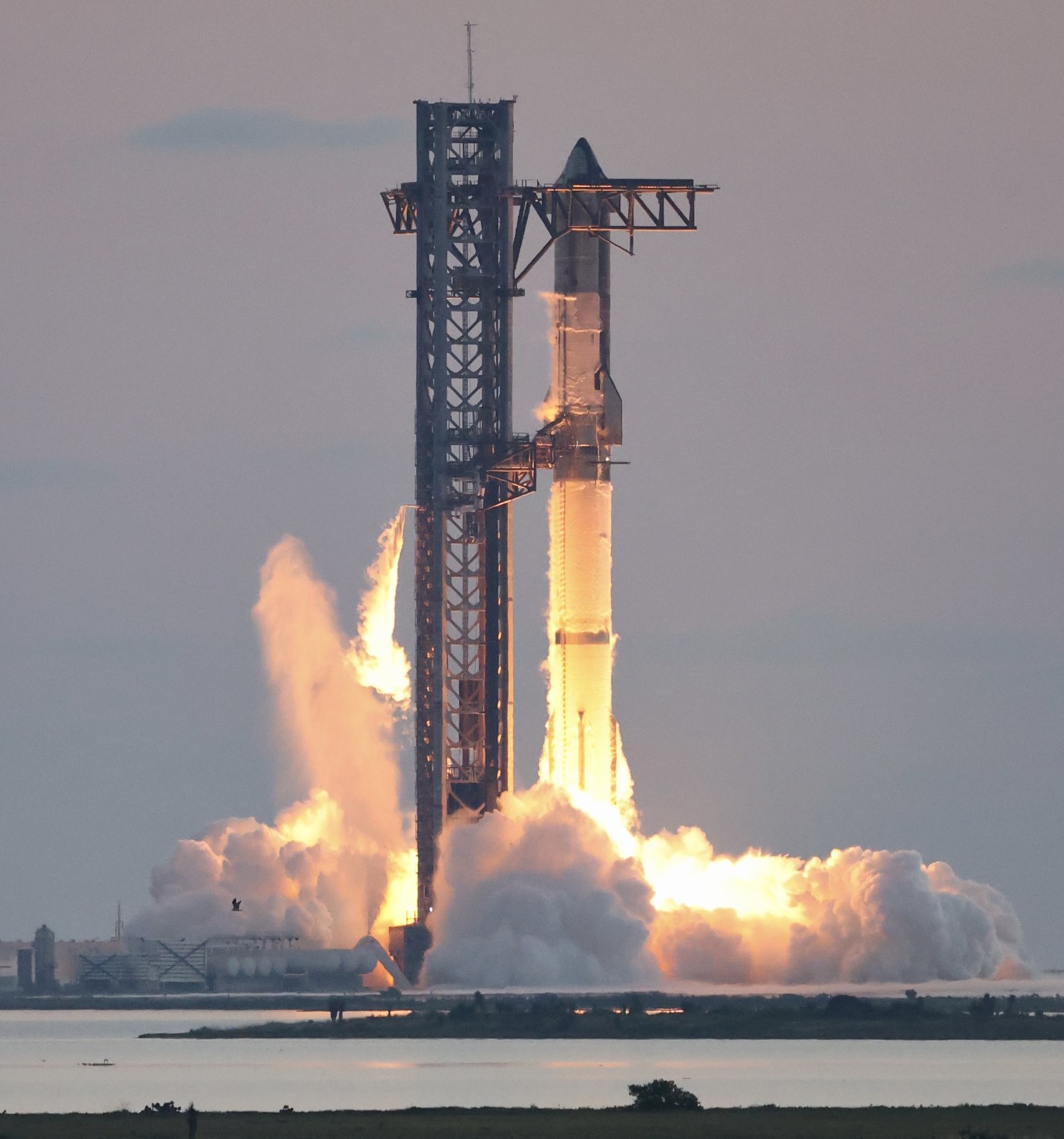
The mission that stopped being a landing
Artemis III was the flight that was going to put boots back on the Moon. In February NASA redesignated it a crewed demonstration in low Earth orbit, and moved the landing to Artemis IV in 2028.1 The astronauts still fly. They just do not land.
What the government actually bought
NASA awarded SpaceX a firm-fixed-price contract worth about $3 billion in July 2021 to develop and demonstrate the lander.2 Fixed price was the point: the provider carries the overrun, and payment comes only when milestones land. That provider is now a public company, listed in June at $135 a share.9
The discipline worked on money and nothing else
By the agency's own audit, that contract has grown 6% in cost. It has also slipped at least two years, and the inspector general expects more.2 The taxpayer was protected from the invoice and not from the calendar.
A fixed-price contract transfers the money risk. It does not transfer the physics.
The arithmetic behind the landing
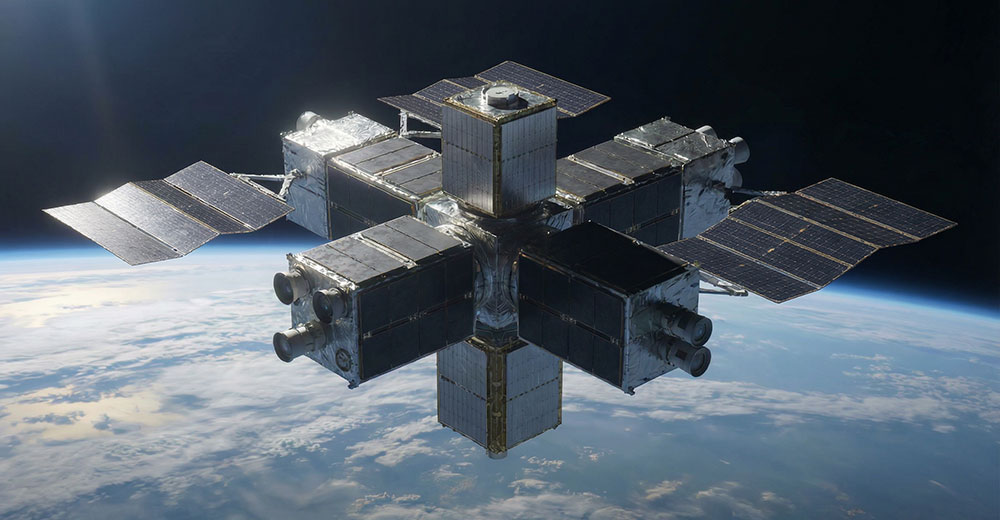
Starship cannot reach the Moon on one tank. NASA's report describes a depot in low Earth orbit filled by more than 10 tankers, with propellant gathering starting more than 200 days before the crew launches, and SpaceX targeting one tanker flight every six days until the depot is full.2
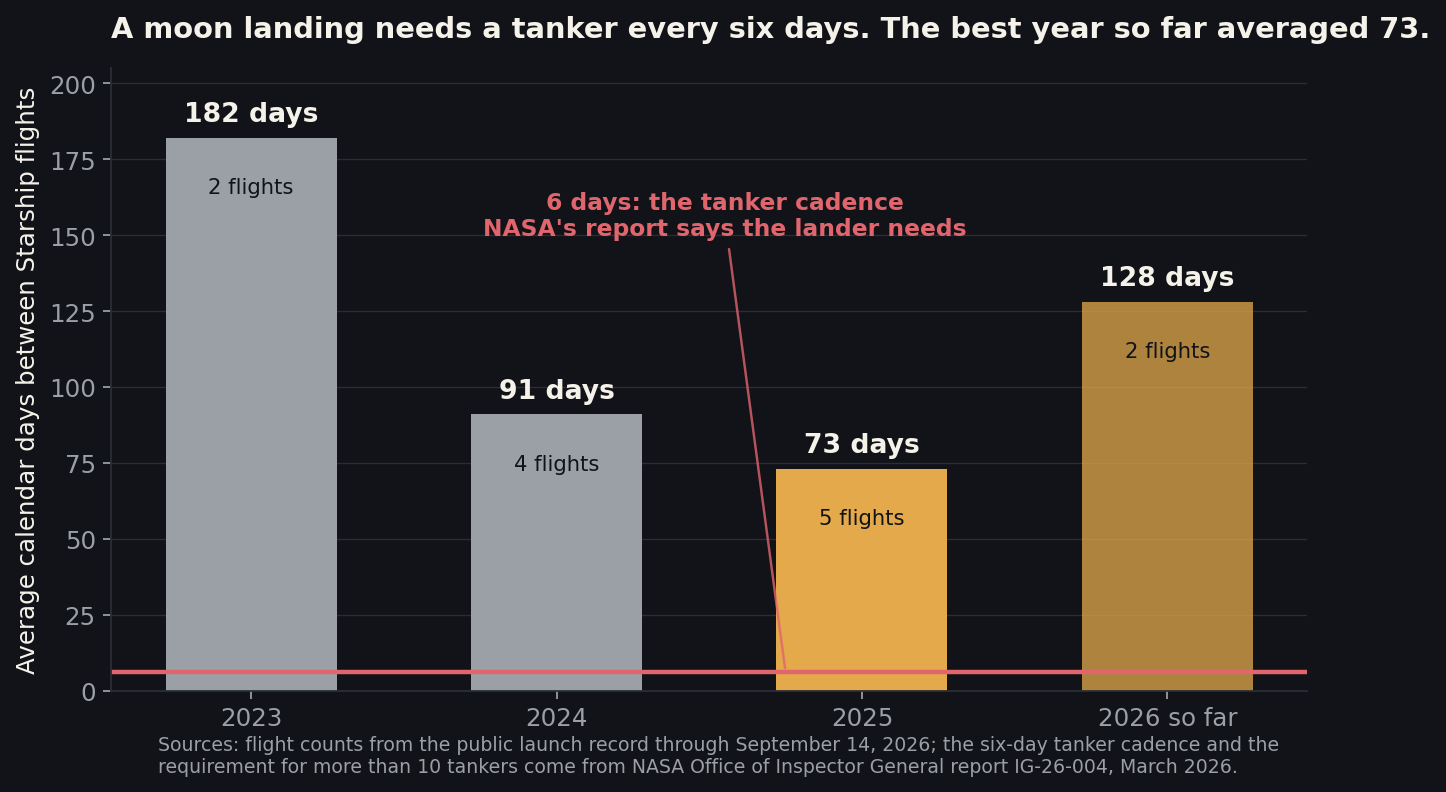
The milestone that unlocks any of it is a transfer of cryogenic propellant between two vehicles, which the program calls one of the hardest problems its provider faces. It was due in March 2025, was rescheduled to March 2026, and had still not been attempted after the thirteenth flight in July7, the first since the listing.2,3,8,10
The case that this is normal
Hard vehicles run late, and the same audit that records the slip credits the contracting approach with holding costs nearly flat across both providers.2 The alternative is not obviously faster: NASA reopened the competition, and the rocket meant to carry the rival lander exploded in May.4 Elon Musk has argued the refuelling estimates are too pessimistic, since a partly filled lander can still make the trip.5
That defence answers the cost question and leaves the cadence question where it was.
What to watch
Flight 14 is scheduled for September 22, carrying Starlink satellites to orbit.6 The number that matters is not whether it flies. It is whether two Starships ever dock and move propellant, and how many days pass before the next one leaves the pad.
The Moon is a cadence problem now, not a rocket problem.
How this brief was made
01Gathered & sourced258 channels · 1,813 articles▾
Agents swept 258 channels and ingested 1,813 articles, then de-duplicated and ranked them for signal.
02Verified & cross-validated10 claims · 20 data feeds▾
Every one of 10 load-bearing claims was checked against primary sources, with 20 live data feeds reconciling the figures and charts.
- 1NASA Artemis III mission profile, revised Feb 27 2026 (primary record: Artemis III redesignated a crewed low Earth orbit demonstration, landing moved to Artemis IV in 2028).
- 2NASA Office of Inspector General, ‘NASA’s Management of the Human Landing System Contracts’, IG-26-004, Mar 2026 (primary record: ~$3B firm-fixed-price award Jul 2021; 6% cost growth; delay of at least 2 years; more than 10 tankers; propellant aggregation beginning more than 200 days before crew launch; one tanker flight targeted every 6 days; the vehicle-to-vehicle cryogenic transfer test slipped from Mar 2025 to Mar 2026).
- 3Space Daily, 2026 (no large-scale orbital propellant transfer attempted as of the thirteenth flight in July 2026; single-source technical summary).
- 4Spaceflight Now, Jun 4 2026 (NASA urging an alternative launcher for Blue Origin's landers after the New Glenn failure; independent trade coverage).
- 5Wccftech, 2026 (Musk disputing the 16-launch refuelling figure, arguing a partly refuelled lander suffices; company-claimed, via trade coverage).
- 6Space Launch Schedule, accessed Sep 14 2026 (Flight 14 targeted for Sep 22 2026, third flight of Starship V3, first to deploy Starlink satellites into a stable orbit; a schedule, not a result).
- 7Public launch record of Starship integrated flight tests, accessed Sep 14 2026 (2 flights in 2023, 4 in 2024, 5 in 2025, 2 through September 2026; 13 flights with 8 successes and 5 failures).
- 8Spaceflight Now, Jul 25 2026 (Flight 13 mostly successful: booster lost on landing burn, ship survived splashdown intact; independent trade coverage).
- 9CNBC, Jun 12 2026 (SpaceX shares priced at $135 and closed the first day at $161; market report).
- 10CNBC, Jul 24 2026 (first Starship test flight after the listing; independent coverage).
03Reviewed & edited1 human editor▾
One editor read the draft against the evidence, tuned the framing, and signed off before it shipped.
Confidential tips
Know something about this story? We protect our sources. Reach the editor directly, or read our guide to sharing securely.
Deepdive
AI-generated from this story and its cited sources. Not investment advice.