SpaceX's $2 Trillion Valuation Runs Ahead of Its AI Contracts
Starlink gives SPCX a defensible business. The investment question is whether its profits and new AI revenue can finance everything Elon Musk wants to build.
 Vincent JiangSeptember 14, 2026 · 7 min read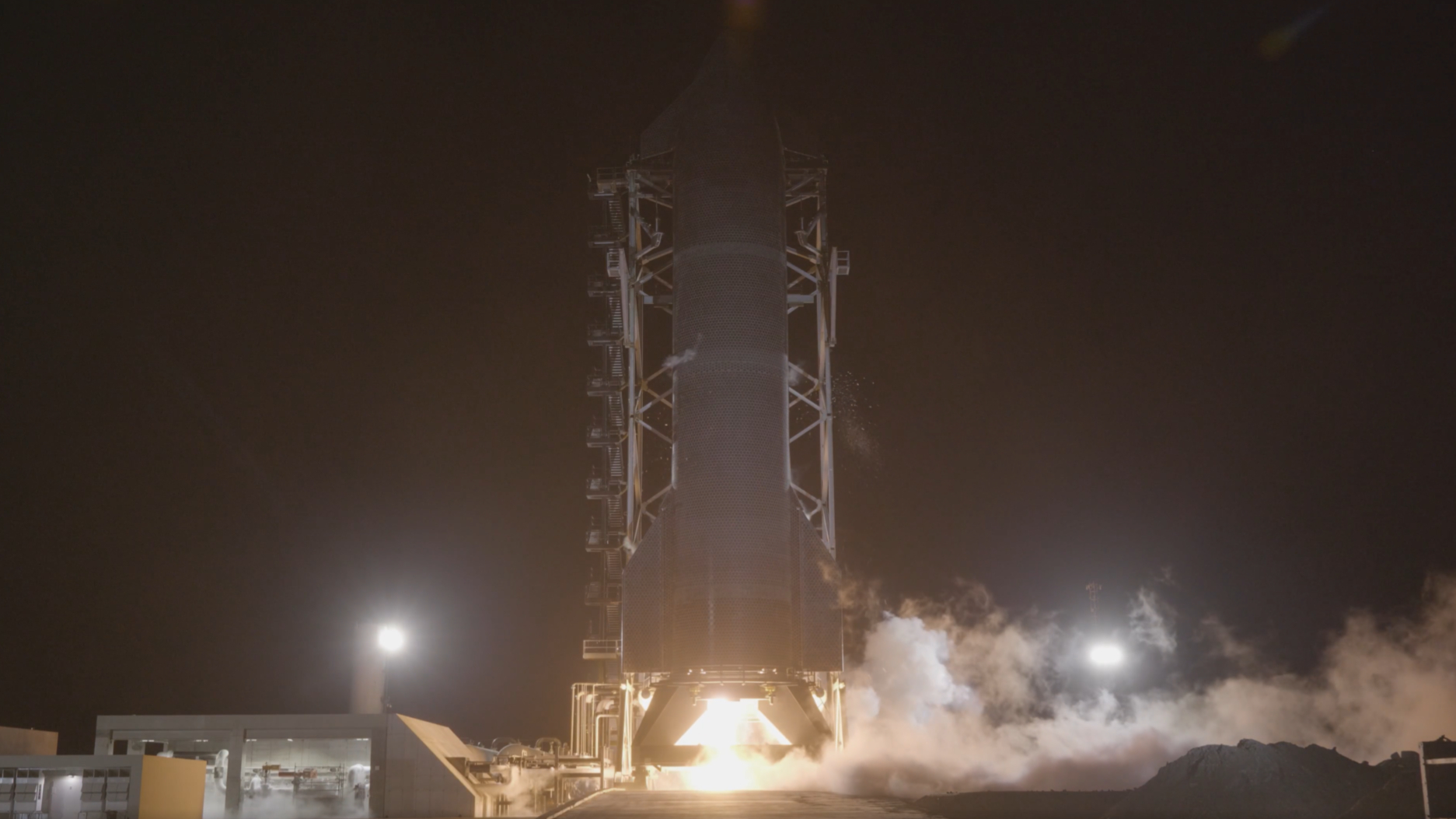
Six months behind the headline
Bret Johnsen, SpaceX's CFO, arrived at a September 10 investor conference with another enormous number: a new AI hosting deal worth $1.11 billion a month, starting December 1.1
That implies a $13.32 billion annual revenue pace. Johnsen described almost all, possibly all, compute agreements as 90 days with a 90-day exit, or roughly six-month commitments, including this one.1
That gap matters. SpaceX closed September 14 at $148.15 per share, implying roughly $2 trillion across both share classes using the latest disclosed share count and acquisition issuance.2,5,7 Investors need durable earnings from infrastructure whose next customer commitment can arrive much sooner than its replacement cycle.
Johnsen's $100 billion year-end revenue ambition annualizes December's expected sales. It is neither full-year 2026 revenue nor a guarantee that customers keep paying that rate.1
Annualizing a month of revenue does not annualize the customer's commitment.
Starlink has earned the benefit of the doubt
Starlink supplies internet where terrestrial connectivity is inadequate. Its advantage starts before the customer installs a dish: SpaceX controls the rockets that replenish and expand its network.
An August 4 investigation found Starlink occupied about 79% of Falcon 9's launch manifest so far in 2026, up from 54% in 2020. Other spacecraft companies were being told capacity was booked into 2028 or 2029.4
That is a concrete barrier to competition. A rival can design a better satellite and still wait behind the incumbent for a ride. Launch access gives SpaceX control over deployment timing, allowing customer demand and network capacity to develop together.
The August 4 earnings release reported 12 million Starlink subscriptions at June 30, twice the prior-year count. Monthly average revenue per subscription fell from $85 to $66.3,11 These are service lines, not individual people. Falling average revenue deserves attention, but can accompany expansion into less expensive markets rather than customer abandonment.
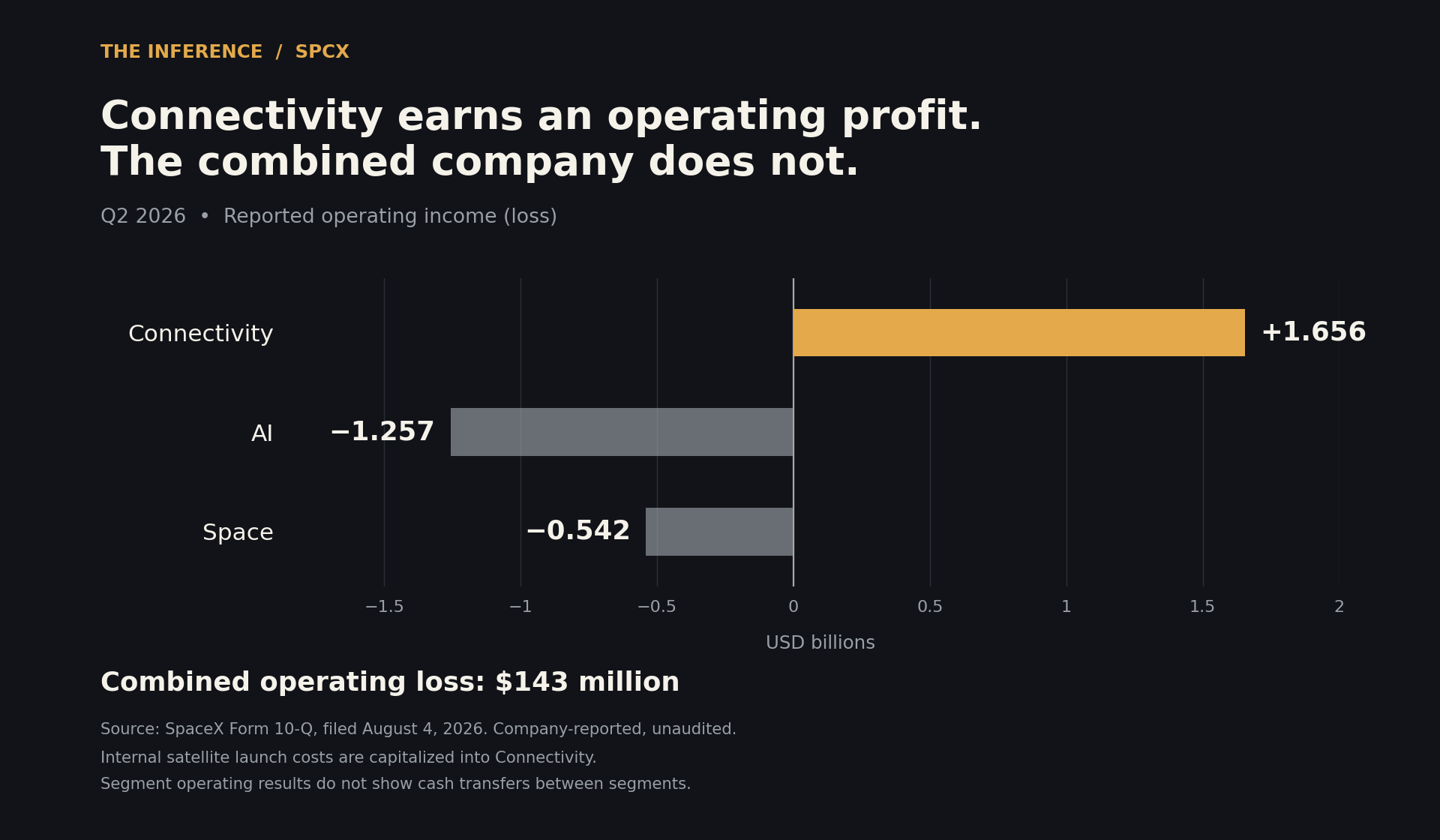
The wider Connectivity division, including Starshield, produced $4.291 billion of quarterly revenue and $1.656 billion of operating profit. Enterprise and government revenue grew 108%, versus 44% for consumer revenue.3 The business has more than household broadband supporting it.
However, launching satellites internally does not make launches free. SpaceX capitalizes those costs into satellites and depreciates them over time.5 The advantage is control and cost, not exemption from the replacement bill.
The cash engine does not cover the construction bill
Connectivity's profits sit inside a company making much larger bets. In Q2, the AI division lost $1.257 billion at the operating level and Space lost $542 million, leaving the combined company with a $143 million operating loss.3
AI's positive $1.146 billion adjusted EBITDA needs that context. The reconciliation adds back $1.885 billion of depreciation and amortization, among other expenses.3 Depreciation is noncash today, but equipment eventually needs replacing. Ignoring it permanently would overstate what shareholders can extract.
The spending is concentrated in AI: $15.83 billion of more than $18 billion in Q2 capital expenditure, according to the August results.11 Hosting has to justify repeated investment on that scale.
Cash flow makes the funding requirement clearer. During the first half, SpaceX generated $3.466 billion from operations and spent $28.476 billion purchasing property and equipment. After product rebates and capitalized interest, net cash capital investment was $27.301 billion, leaving a $23.835 billion gap.5
That calculation excludes acquisitions and spectrum purchases. It also includes expansion spending, so it cannot be treated as the recurring cost of maintaining today's business. Its narrower meaning is still useful: current operations have not financed the current construction pace.
The company held approximately $100 billion in cash and short-term securities at June 30.5 That provides time to execute. It does not establish that the investments will earn an adequate return.
The strongest defense has a denominator
The bullish answer is that these assets can repay their cost quickly. Johnsen said certain compute investments have less than a one-year payback, while short contracts preserve capacity for SpaceX's own AI products.1
If those economics survive at scale, six-month commitments become less troubling. Hardware that recovers its cost quickly needs fewer renewals to protect the original investment. Spare capacity can then support higher-margin software, assuming those products attract paying users.
But the conference discussion did not reconcile that payback claim to cash returns after all facility, power, financing and operating costs.1 Investors need to know which investment is being repaid and which expenses count against the repayment. GPU purchase recovery and a return on an entire operating campus are different calculations.
Execution adds another condition. September reporting describes revised construction practices emphasizing backup systems and testing after reliability problems.6 More dependable service can improve customer retention. It may also change construction timing and cost.
The next proof is therefore economic: revenue per unit of installed capacity, utilization, renewal prices and cash earned after delivery costs. The relevant comparison is what that capacity earns hosting outside customers versus serving SpaceX's own products. Moving it internally only improves shareholder returns if the second use earns more after its additional costs.
Shareholders own every allocation decision
Elon Musk can pursue this strategy across a broad company. Public investors receive exposure to that combined allocation of capital, including the AI business and X acquired earlier this year.5
The Cursor acquisition closed August 14. Its roughly 391 million gross shares of disclosed closing consideration and vested awards enlarge the ownership base; additional unvested awards and options were assumed.7 Stock consideration preserves cash, but existing shareholders own a smaller fraction afterward. The acquisition has to increase value per share, not merely company revenue.
The spending choices extend beyond AI. SpaceX announced a proposed $100 billion Louisiana spaceport in August.8,9 Construction is scheduled to begin by the end of 2027, with a first launch targeted as soon as 2029.8 That is a future investment program, not a bill already paid.
The distinction matters when assessing liquidity. Shareholders should neither subtract every announced project immediately nor treat the existing cash balance as permanently available for distribution. The timing and return of each new commitment determine how much value remains for them.
What two trillion dollars requires
A reverse valuation makes the burden concrete. Start with a rounded $2 trillion equity value, assume no dilution or interim distributions, and require a hypothetical 10% annual return over five years. The company would need a terminal equity value of roughly $3.22 trillion. The table converts that value into annual free cash flow available to equity after operating costs, taxes, interest and reinvestment.
| Year-five multiple | Required annual cash flow | Revenue at an assumed 25% cash-flow margin |
|---|---|---|
| 40 times | $81 billion | $322 billion |
| 30 times | $107 billion | $429 billion |
| 20 times | $161 billion | $644 billion |
Even the 40-times case requires enormous cash generation while retaining a demanding valuation. If future investors pay a lower multiple, the business must produce more cash to deliver the same return. Further dilution raises the company-level hurdle for today's shareholder.
SpaceX could meet that burden. Starlink has demonstrated demand, launch integration supports expansion, and AI hosting offers a path to monetizing capacity before internal software matures. However, today's valuation already asks those strengths to produce results far beyond current cash generation.
The immediate operational test is Starship Flight 14, expected later this month to deploy production V3 Starlink satellites.10 Successful deployment would support future connectivity revenue. Carrying the company's own satellites does not itself create external launch revenue.5
The more consequential investment test follows: whether AI customers renew at attractive prices while the gap between operating cash and investment narrows. SPCX merits a place on the watchlist. At this valuation, the case for buying needs cash-return evidence that a successful rocket launch cannot supply.
How this brief was made
01Gathered & sourced235 channels · 2,189 articles▾
Agents swept 235 channels and ingested 2,189 articles, then de-duplicated and ranked them for signal.
02Verified & cross-validated11 claims · 33 data feeds▾
Every one of 11 load-bearing claims was checked against primary sources, with 33 live data feeds reconciling the figures and charts.
- 1SpaceX management transcript, Goldman Sachs Communacopia + Technology Conference, Sep 10 2026, via Stock Analysis (primary management statements and forecasts, not audited contract performance).
- 2Stock Analysis / S&P Global Market Intelligence, SPCX historical prices, Sep 14 2026 close (market observation; the indicative capitalization is calculated with sources 5 and 7).
- 3SpaceX, Q2 2026 financial and operating results exhibit filed with the SEC, Aug 4 2026 (primary company-reported, unaudited results: segment operating income, Starlink subscriptions and ARPU, adjusted EBITDA reconciliation).
- 4Reuters investigation of launch access and Starlink's share of the Falcon 9 manifest, Aug 4 2026, syndicated by Investing.com (independent reporting and launch-data analysis).
- 5SpaceX, Form 10-Q for the quarter ended Jun 30 2026, filed Aug 4 2026 (primary filing, unaudited: first-half cash flows, capitalized launch costs, cash and short-term securities, acquired businesses).
- 6The Information, reporting on changes to data-center construction practices, Sep 10 2026 (independently reported, based partly on unnamed sources).
- 7SpaceX, Form 8-K reporting the Cursor acquisition closing, Aug 14 2026 (primary transaction disclosure; gross share counts are before tax withholding on vested awards).
- 8Louisiana Economic Development, SpaceX project schedule and details, announced Aug 25 2026, accessed Sep 14 (primary government description of the proposed investment and targets).
- 9Associated Press, reporting from the Louisiana spaceport announcement, Aug 25 2026 (independent event coverage; the planned expenditure remains a company and state claim).
- 10Aviation Week, reporting on the planned next Starship flight, Sep 11 2026 (independent reporting of management's prospective launch milestone).
- 11Reuters, SpaceX's first quarterly results after its listing, Aug 4 2026, via Investing.com (independent coverage of company-claimed results, subscriber growth and AI investment).
03Reviewed & edited2 human editors▾
2 editors read the draft against the evidence, tuned the framing, and signed off before it shipped.
Confidential tips
Know something about this story? We protect our sources. Reach the editor directly, or read our guide to sharing securely.
Deepdive
AI-generated from this story and its cited sources. Not investment advice.