Superhuman's Fathom prices its enterprise tier at $35 a seat, annual only
The first list price on the AI notetaker's top tier since the September buyout replaces "Talk to sales" with a number, handing buyers a benchmark and private-market investors a first public read on how the acquired asset is being monetized.
 Richard Tangtwo-minute read

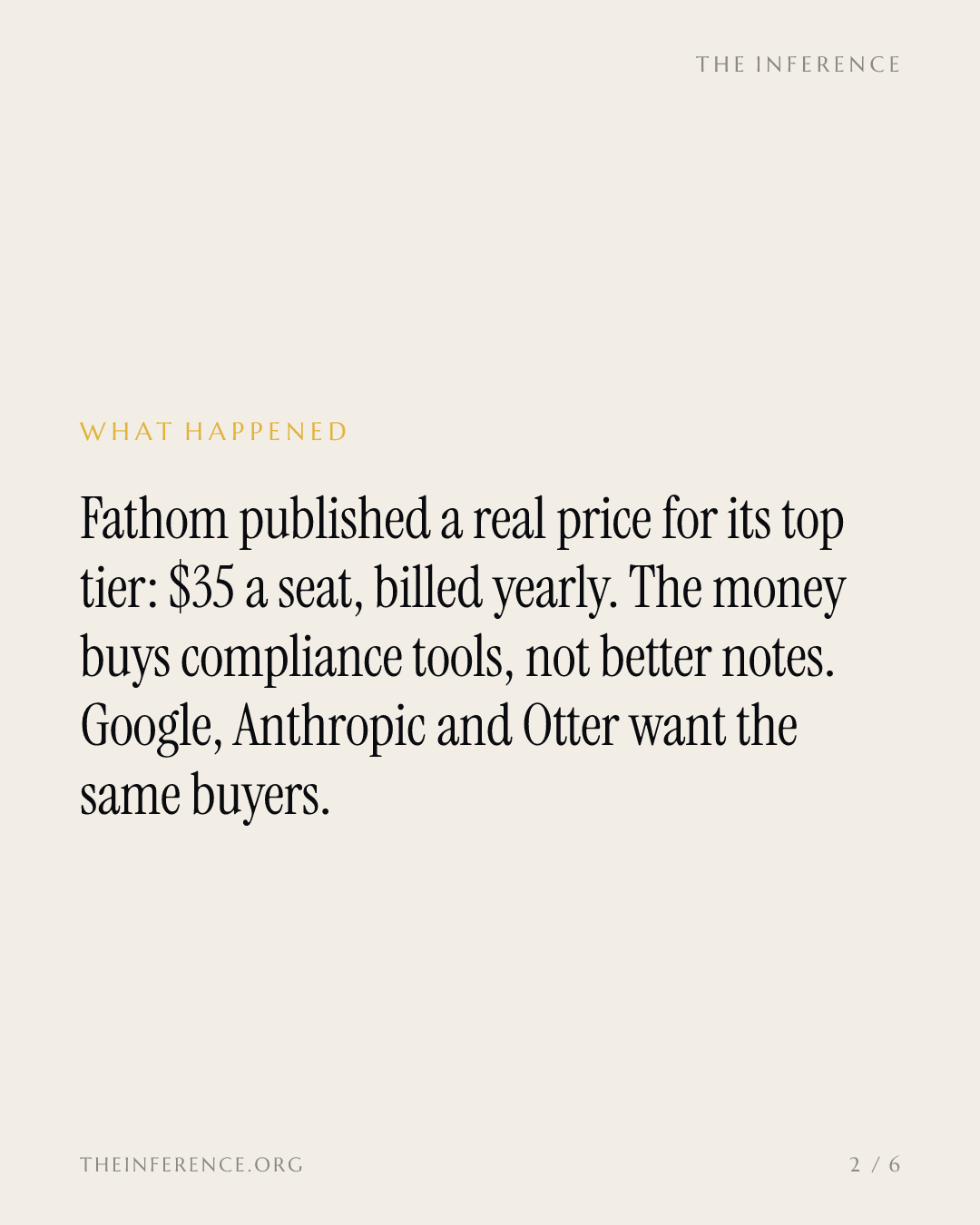
Fathom's Enterprise tier stopped saying "Talk to sales" and published a number instead: $35 per user per month, annual billing only, caught by a pricing tracker on November 4 1. It is the first list price on the notetaker's top tier since Superhuman, the company formerly known as Grammarly, bought it in September 23. The tell is what the tier charges for: not smarter summaries, but the governance that turns spoken meetings into a company record.
The premium buys compliance, not better AI
Everything Enterprise adds over Business is administrative: hands-on Launch Assist setup, single sign-on and SCIM provisioning, custom data retention, a custom health-data agreement, a dedicated success manager 14. None of it improves the transcript. It makes the record one a security review will approve, which is the layer platform owners do not sell separately.
Fathom's annual ladder tops out at a newly published $35 a seat
First list price on the top tier since the September buyout
Data
| Value | |
|---|---|
| Team | $15/user/mo, annual billing |
| Business | $25/user/mo, annual billing |
| Enterprise | $35/user/mo, annual billing |
The transcript is becoming free; the trust layer is what an enterprise now pays for.
Capture had to leave the meeting platform first
An enterprise tier is sellable because capture stopped depending on one. Fathom records calls without a bot joining, and its October iPhone app captures in-person rooms, attributing speakers through opt-in voiceprints, the hard case since a room has no speaker separation 5. Superhuman bought rather than built after internal testing showed, in chief executive Shishir Mehrotra's words, "how much you need to build" 2. The play is distribution: 500,000 companies 5 against Superhuman's 40 million users 2, with free Business on offer to anyone switching from Gong 4.
The same buyers, chased from three directions
Otter closed $320 million in October to expand enterprise sales, and told Reuters it plans an eventual listing 6. Google's Gemini-powered "Take notes for me", extended to in-person meetings in August, ships inside Workspace and AI subscriptions companies already pay 7. On November 10, Anthropic$350B — Anthropic, private, latest valuation $350B announced Claude Meetings, adding Claude to calls to take notes and update documents 8. Alphabet−1.54% — Alphabet, down 1.54 percent today is the listed company in the squeeze, bundling what Fathom charges for.
The money is moving to the governed record
Whether $35 holds is not yet visible to anyone outside Superhuman: Fathom was valued at $94 million as a standalone in 2024, and this tier is the first public read on what it earns inside a suite 2. The direction is clear. The value in meeting AI is shifting from transcription to the governed record, and it belongs to whoever closes that gap. Teams that learn to work from the record will collect the return; the rest will have bought transcripts nobody reads.
Get Applications by email, free
How AI is changing the software people and companies use. In our daily email, every weekday.





Reader comments
0 comments