Tether and Tron move their crypto crime unit from TRM Labs to Chainalysis; TRM launches a rival desk
TRM Labs built the Tron-Tether crime-fighting unit, then watched the job go to rival Chainalysis; its same-day answer, Beacon Concierge, hands police a license-free path to freeze crypto at any issuer. The enforcement gap now reaches Circle (CRCL), whose USDC pitch rests on regulated reserves rather than seizure reach.
 Vincent Jiangthree-minute read

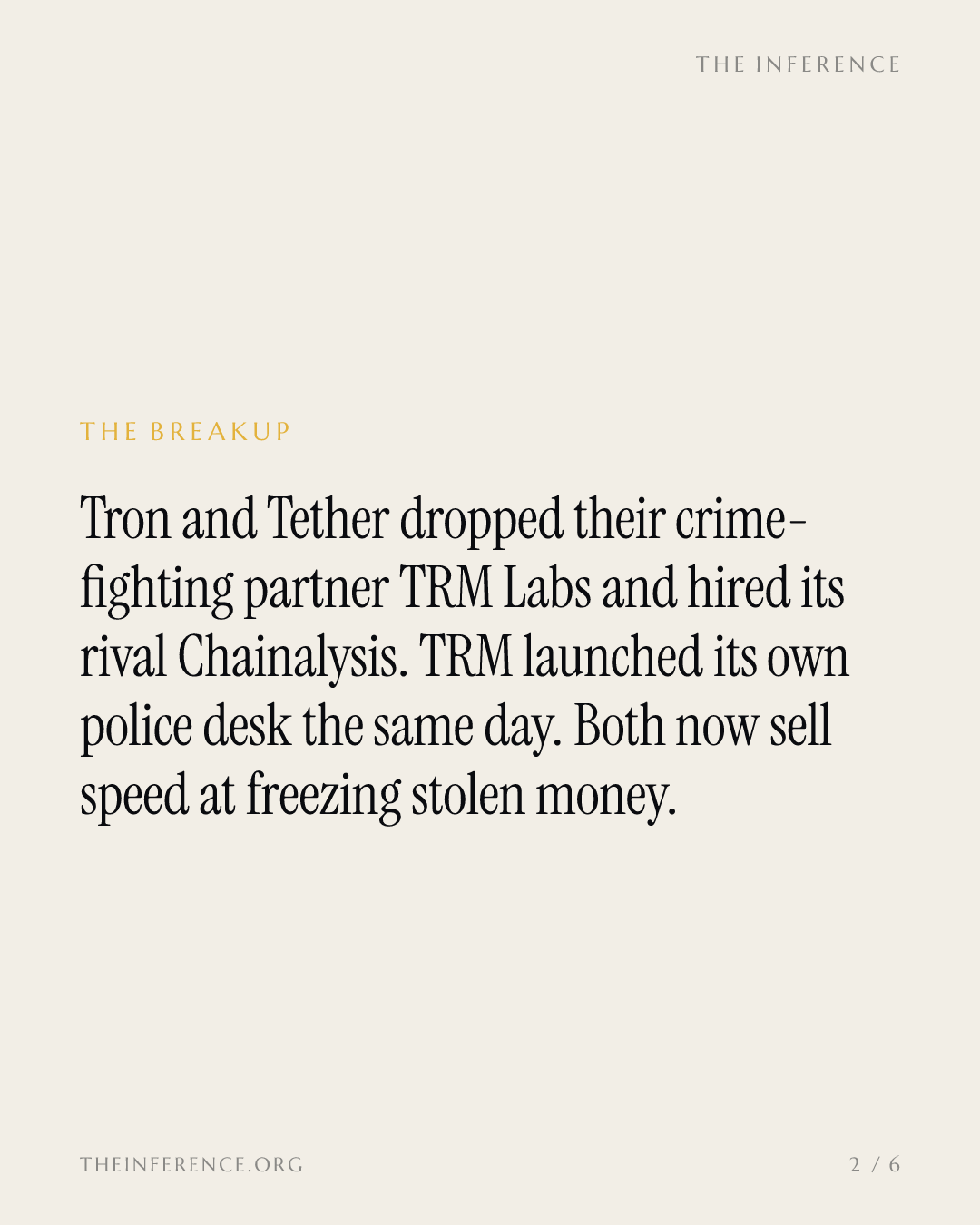
On November 12, Tron, Tether (the issuer of the USDT stablecoin) and Chainalysis, a blockchain-analytics firm, launched the Digital Crime Task Force to trace illicit USDT on the Tron blockchain and coordinate freezes before the funds move 1. The seat was open because its last holder lost it.
T3, the crime unit Tron and Tether built with analytics firm TRM Labs in 2024, froze more than $450 million across 23 jurisdictions before winding down in late August 12. Bloomberg broke the breakup on November 4, blaming slow responses and poor coordination and citing people familiar with the operation 13. "Criminals are using AI to move faster than ever, and waiting for a victim to report a crime is no longer good enough," Tether chief executive Paolo Ardoino said at the launch 1.
Tron carries the money, and one casino city moves a billion
More than $94 billion of USDT circulates on Tron, and Ardoino puts Tether's own cumulative illicit-linked freezes above $7 billion, across 360-plus law-enforcement agencies in 73 countries 1. TRM's research sizes the workload: 34 casinos in Sihanoukville, Cambodia received $1.07 billion in crypto between January 1 and September 7, 99.9% of it USDT on Tron, with $687 million traced to US-sanctioned networks 1.
The October 29 theft from the Binance exchange, $6.34 billion and the largest in crypto history, showed the lag the new alliance exists to close 2. Attackers swapped roughly $234 million of stolen USDT into TRX, Tron's native token, before Tether froze the rest in two linked wallets 1. Tether alone froze more than $1.567 billion of USDT after the attack 2.
TRM now sells the coordination T3 lacked
TRM answered the same day with Beacon Concierge. A verified agency files one request, no TRM license required, and TRM's investigators trace the funds, build the evidence package, flag the addresses and route the freeze to the right issuer or exchange 45. Across the Beacon Network of more than 200 members covering 80% of crypto trading volume, action once flagged funds reach a member is measured in minutes 46.
The tally so far, all TRM's own numbers: 15 cases for 14 agencies in 10 countries, more than $35 million frozen, more than $200 million interdicted across Beacon 4. The rivalry has a paper trail: Chainalysis has sued the U.S. government over an immigration-enforcement contract awarded to TRM without competitive bidding 7. Bloomberg's unnamed sources blamed slow coordination for T3's death; the service TRM launched the same day is, at core, a coordination desk 13.
Tether's own freeze record dwarfs both analytics alliances
TRM's $35M concierge start is a rounding error next to Tether's own machine
Data
| Value | |
|---|---|
| Tether (all illicit freezes) | $7,000M |
| T3 (Tron-Tether-TRM, closed) | $450M |
| TRM Beacon Network | $200M |
| TRM Beacon Concierge | $35M |
The issuers still hold every key
The divorce is not clean. A Tether spokesperson says the company will keep working with TRM and has been taking part in Beacon 23. Freeze power sits with issuers, not analytics firms: Concierge gives TRM no direct control over coins, and issuers such as Tether and Circle−3.79% — Circle, down 3.79 percent today can freeze tokens even in personal wallets, while self-custodied Bitcoin cannot be frozen on-chain at all 8.
Circle's regulated pitch meets Tether's enforcement stack
Circle (CRCL) sells USDC as the regulated option: $67.9 billion in circulation against $68.1 billion of attested reserves, as of November 12 9. Tether's USDT on Tron alone tops that entire balance 1, and the enforcement behind it now runs three deep: Tether's own $7 billion freeze record, the Chainalysis task force, and a seat on its rival's network 124.
USDT on Tron alone is bigger than all of Circle's USDC
Data
| Dollars, billions | |
|---|---|
| USDC in circulation | $67.9B |
| USDC attested reserves | $68.1B |
| USDT on Tron | $94B |
For a CRCL holder the stake is plain: Tether's enforcement stack is what Circle's regulated-reserves pitch lacks, and the thing to watch is Circle answering with comparable proactive monitoring. TRM, which raised a $70 million Series C in February 2, keeps the police doorway either way. The next hack will show whether any alliance buys an hour of speed over an issuer acting alone 2.
Get Security by email, free
The breaches, flaws and security vendors AI is putting to the test. In our daily email, every weekday.




Reader comments
0 comments