The stock Palo Alto Networks paid CyberArk with nearly doubled, $165 at closing to $326 now
The annual report shows the real accounting price was $21.1 billion, paid in shares valued at $165.07 that now trade at $326.36. That lifts former CyberArk holders and dilutes Palo Alto shareholders straight into a Nov. 18 print that must justify $14.8 billion of goodwill.
 Richard Tangtwo-minute read
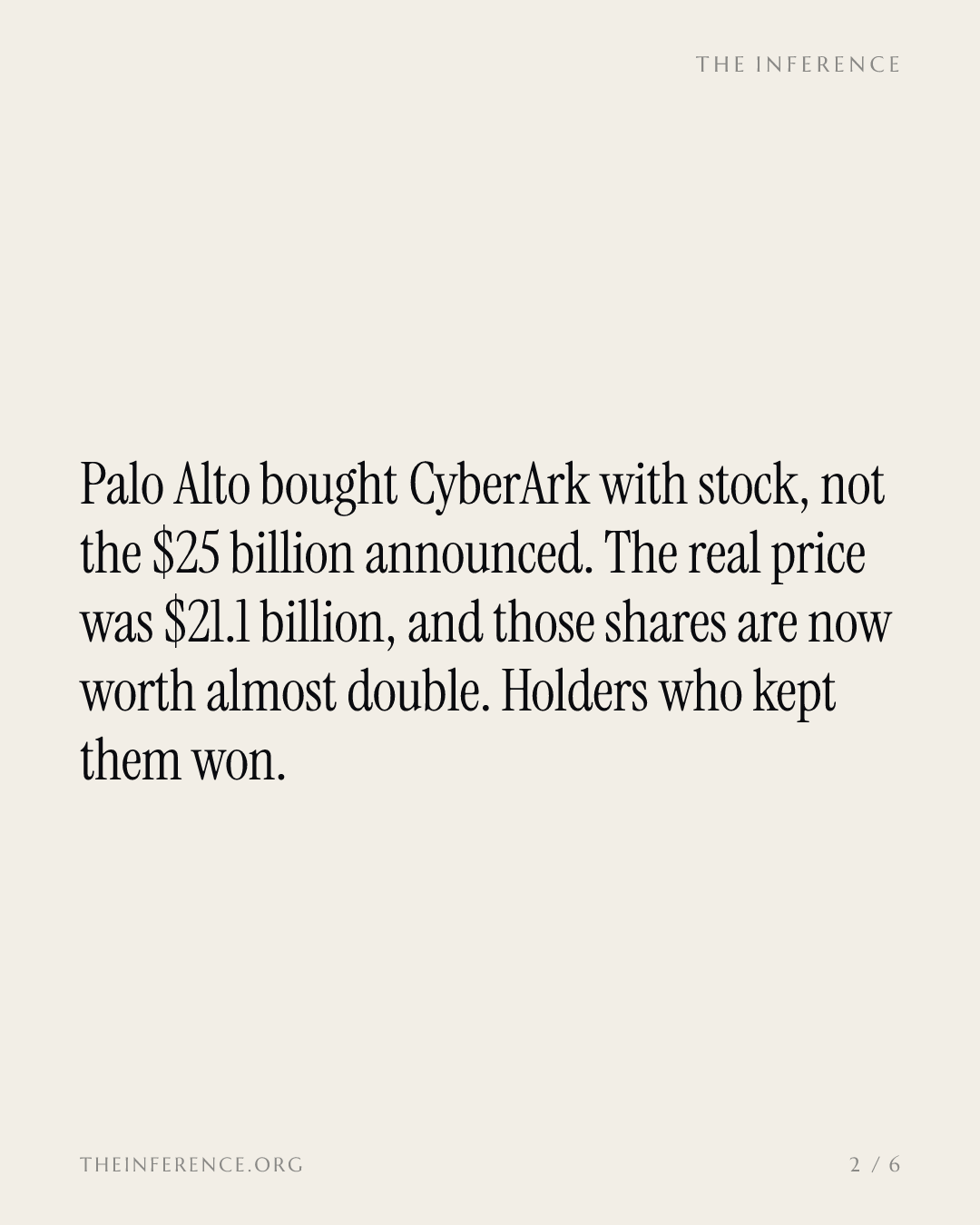
Palo Alto Networks'+2.31% — Palo Alto Networks, up 2.31 percent today CyberArk deal closed at $21.1 billion, not the $25 billion announced, and the stock it paid with has since nearly doubled, making former CyberArk holders the biggest winners of the deal 1. Identity security is the business of managing digital identities and permissions, and that is the platform Palo Alto paid for. The real price sits in Palo Alto's own annual report, and only Israel's CTech has written the numbers up 1. They matter this week because Palo Alto reports its first full CyberArk quarter on Nov. 18 2.
The mechanics are simple. Each CyberArk shareholder got $45 in cash plus 2.2005 Palo Alto shares 1. Palo Alto issued about 112 million shares, which its accounts valued at $165.07 each when the deal closed on Feb 1. 11, 2026 1.
At Tuesday's close of $326.36, the same block is worth about $36.6 billion, and the stock portion alone is worth about $718 per former CyberArk share, against roughly $408 at closing 1. Holders who sold in February left most of that on the table; holders who kept it doubled it in nine months. That is the payoff of being paid in shares near the buyer's own valuation low.
The stock CyberArk holders took has nearly doubled the deal's value
Data
| Deal value | |
|---|---|
| Announced | $25B |
| Closing (Feb 11, 2026) | $21.1B |
| Nov 10, 2026 | $36.6B |
The cost lands on Palo Alto shareholders
The acquisitions lifted the share count by about 19%, and most of the recent revenue acceleration is the acquired revenue, not the base business growing faster 3. CyberArk and Chronosphere, an observability company Palo Alto acquired in January, together brought in $930 million of revenue and a $797 million operating loss in their first partial period, while adding $14.8 billion of goodwill 1. The assumed CyberArk convertible notes alone produced a $620 million accounting loss last fiscal year 1.
Nov. 18 is the test
The Next-Generation Security ARR guide of $9.54 to $9.56 billion is where the identity platform either earns its goodwill or starts costing it 2. Palo Alto reports Nov. 18, and Zscaler−0.99% — Zscaler, down 0.99 percent today, a rival in cloud security, reports Dec 2. 2 as a second read on the same spending line 2. The stock is down about 22% in a month, so each week of drift moves this paper value by billions 1. Watch the ARR line, not the headline beat: it is the only number that prices what Palo Alto actually bought.
What you can do with this: when a deal is paid in stock, read the buyer's annual report, not the announcement. The announced price is a marketing figure; the filed consideration, the share count and the goodwill are the real ones, and they are what the next quarter has to justify.
Get Security by email, free
The breaches, flaws and security vendors AI is putting to the test. In our daily email, every weekday.