Intuitive Surgical is 35% off its high as a court, J&J and Medtronic test its robot monopoly
A revived antitrust case, two newly cleared rivals and a return to the cardiac market it walked away from in 1998 all converge on the October 20 report. Hospitals pay the instrument-and-service lock-in; ISRG shareholders are carrying the de-rate.
 Vincent Jiang · 3 min read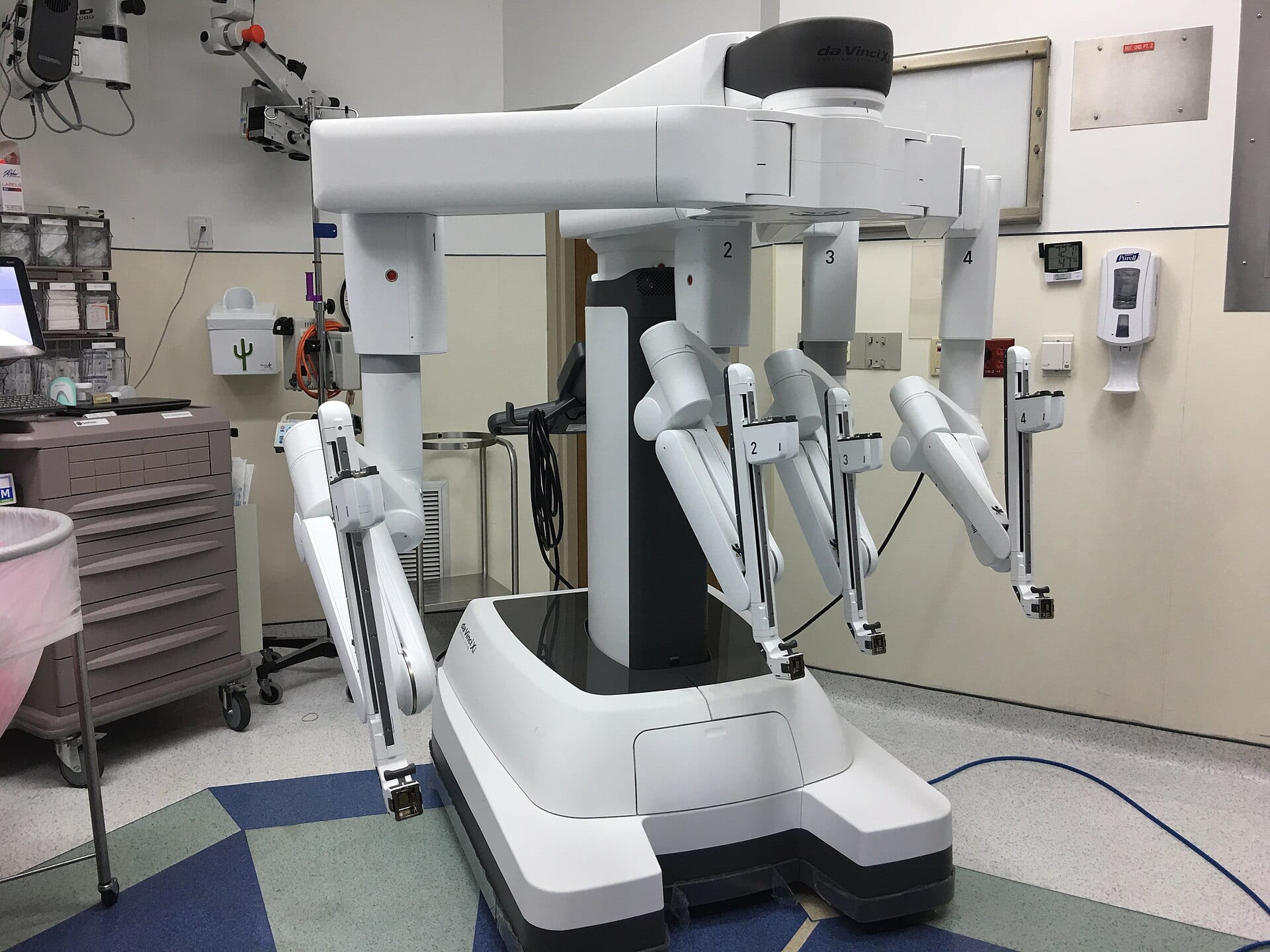
A 35% de-rate on a 19% grower
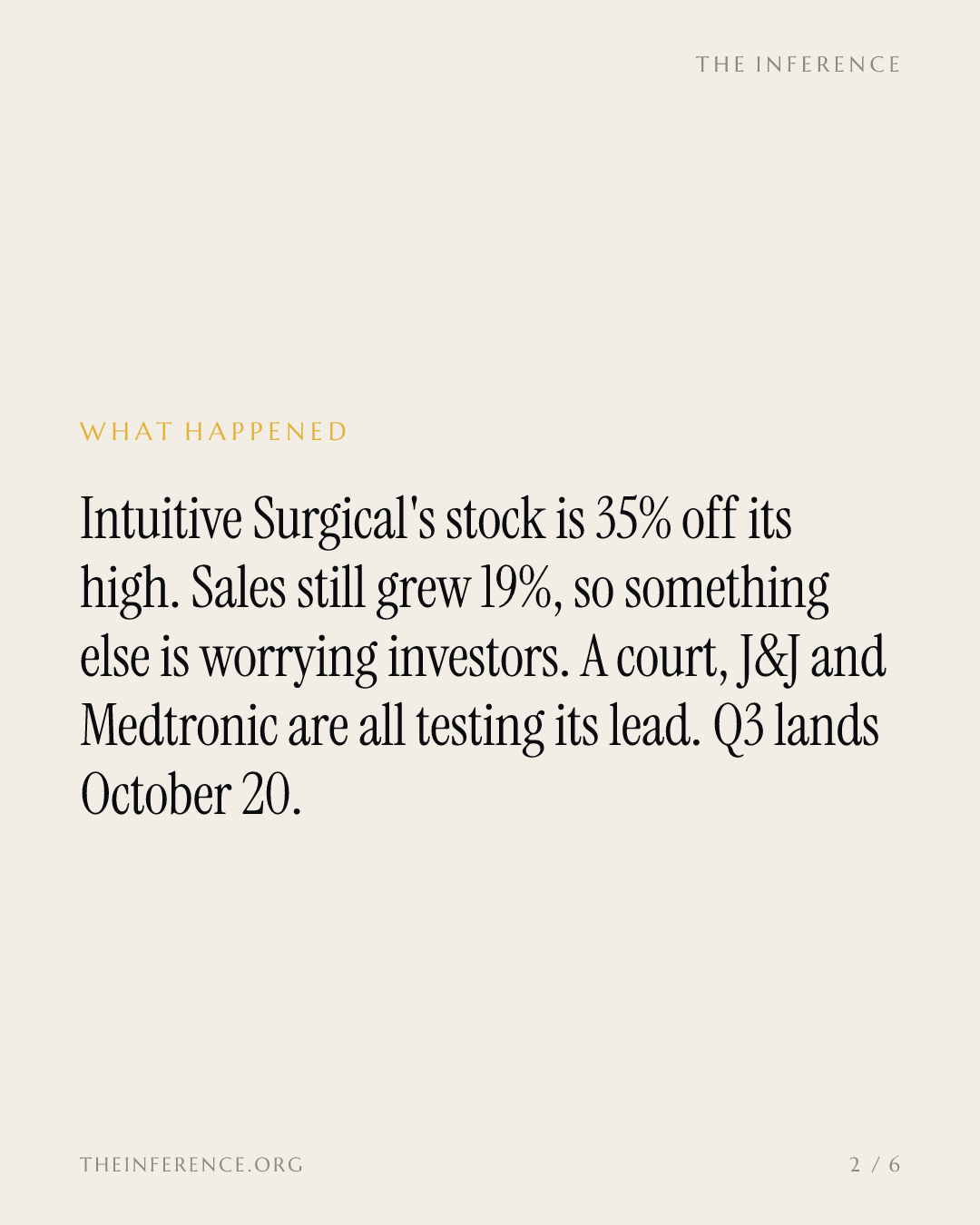
Intuitive closed at $391.95 on October 2, down 2.32% on the day and about 35% below its 52-week high of $603.88, valuing the company at $138.5 billion 1. The business underneath is not shrinking: second-quarter revenue rose 19% to $2.89 billion and net income reached $818 million 2. What the tape is repricing is the durability of an annuity that has gone essentially unchallenged for nearly 25 years 3.
The court reopened the blades aftermarket
On August 17 the Ninth Circuit revived Surgical Instrument Service's claims that Intuitive blocked third parties from refurbishing da Vinci instruments, refusing to apply the usual Kodak standard because near-100% market power changes how the aftermarket is judged 4. Intuitive petitioned the full court on September 29; the case, 25-1372, dates to March 2025 5. If refurbishing opens, hospitals get a cheaper second source for the highest-margin line, and the refurbisher gets the business.
The installed base is contestable for the first time
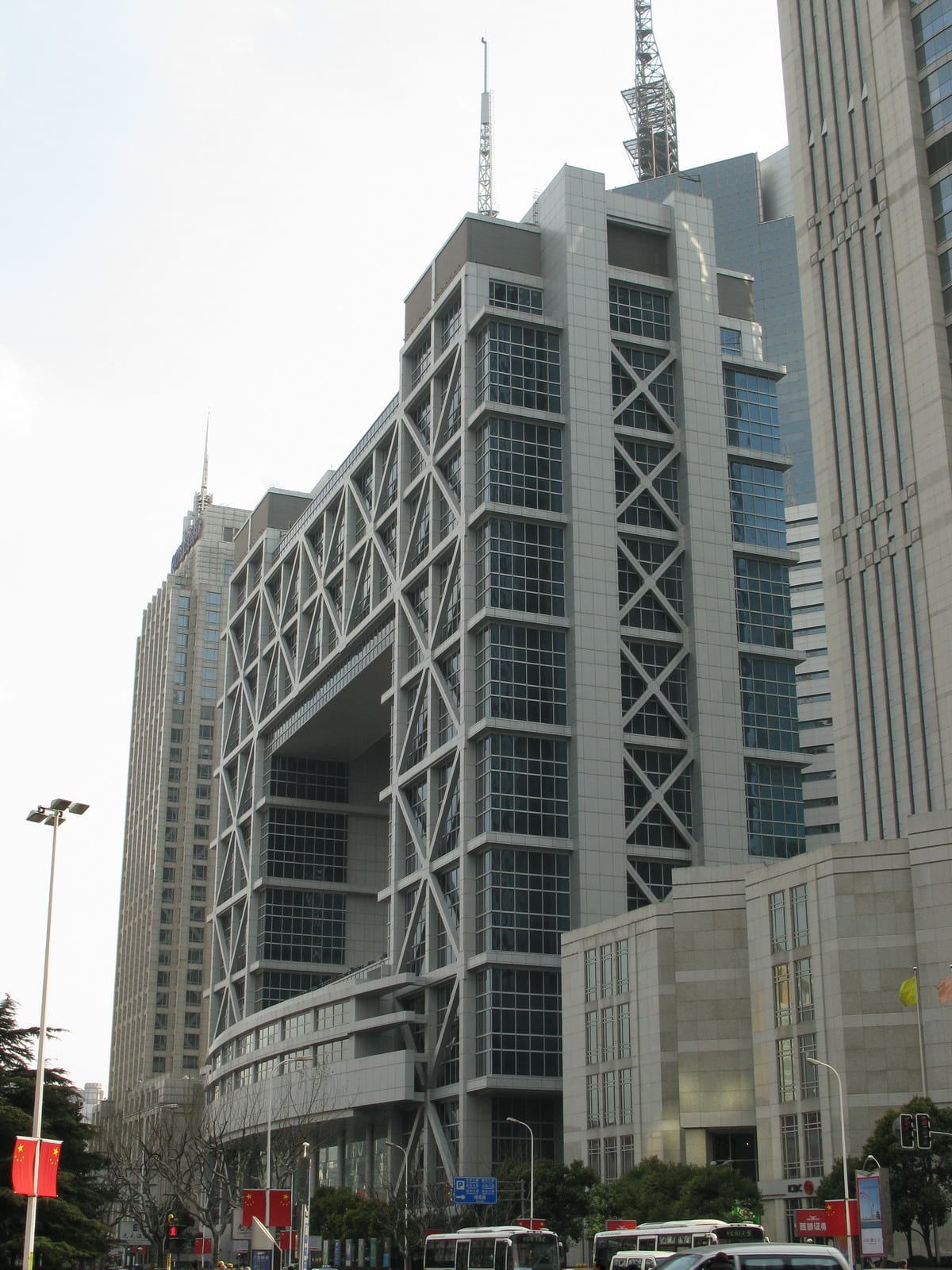
Johnson & Johnson's Ottava won De Novo authorization in July covering 10 general-surgery procedures, on a footprint 30-50% smaller than cart- and boom-mounted systems 3. Medtronic's Hugo cleared the FDA for urology on December 3, 2025, with gynecology submissions advancing 6. Da Vinci still holds clearances across urology, gynecology and general surgery 6.
Cardiac is the offense as US growth slows
Intuitive was founded to chase robotic heart surgery and ran its first cardiac procedures in France and Germany in 1998, then spent decades on prostate and hernia volume instead 78. It is going back: a US cardiac clearance in January and a September 29 CE mark covering coronary bypass on da Vinci 5 78. The need is showing; US procedure growth slowed to 12% in the second quarter from 14% in the first, while international grew 20% 1.
US procedure growth slowed to 12% as international ran at 20%
Data
| Da Vinci procedure growth, y/y | |
|---|---|
| US, Q1 2026 | 14% |
| US, Q2 2026 | 12% |
| International, Q2 2026 | 20% |
76 cents of every revenue dollar arrives after install
The installed base reached 11,710 systems, up 12%, on 468 placements 2. Instruments and accessories brought in $1.73 billion and services $472 million: 76 cents of every revenue dollar arrives after the robot is already installed 2. Non-GAAP gross margin ran at 70.0% 2.
Instruments and services are 76% of Intuitive's quarterly revenue
- Instruments and accessories$1,730M59.9%
- Services$472M16.3%
- Systems and other$688M23.8%
Data
| Slice | Value | Share |
|---|---|---|
| Instruments and accessories | $1,730M | 59.9% |
| Services | $472M | 16.3% |
| Systems and other | $688M | 23.8% |
Guidance held, and every broker target sits above the tape
Guidance held at 13.5% to 15.5%, toward the midpoint 2. A beat without a raise forecasts a slower second half, and targets were cut 9. A fourth pressure is demand-side: GLP-1 drugs are absorbing the bariatric patient pool 4. RBC set $575 on October 1, $183 above the tape 1; Piper Sandler called the decline unjustified at $470, UBS holds $500 and Bernstein trimmed to $685 4.
Every listed broker target sits $78 to $293 above the October 2 close
- Estimate
Data
| Value | |
|---|---|
| Bernstein (estimate) | $685 |
| RBC (estimate) | $575 |
| UBS (estimate) | $500 |
| Piper Sandler (estimate) | $470 |
Nothing filed yet shows erosion
The appeals court revived the claims without deciding them, and no filed number yet shows margin loss or lost placements 45. Even J&J's own bull case calls Ottava "still early" 10; the pessimist case assumes it scales slowly enough to lag MedTech margins 10. Hugo starts from a single specialty 6.
Three numbers settle it on October 20
Placements, US procedure growth, and instruments revenue per procedure 12. The en banc answer arrives more slowly, and nothing filed yet prices what an open refurbishing market would cost the blades.
Deepdive
AI-generated from this story and its cited sources. Not investment advice.