Tower Semiconductor sued Intel over $450 million in walk-away costs ahead of its Nov. 2 print
The Israeli foundry put more than $450 million of Intel walk-away costs on the public record on October 15, while its stock trades 41.9% below the June high at 134 times forward earnings and Japan pledges $1 billion toward the next build. The November 2 print decides whether the capacity anyone left behind is worth what the market pays for it.
 Vincent Jiang · 2 min read
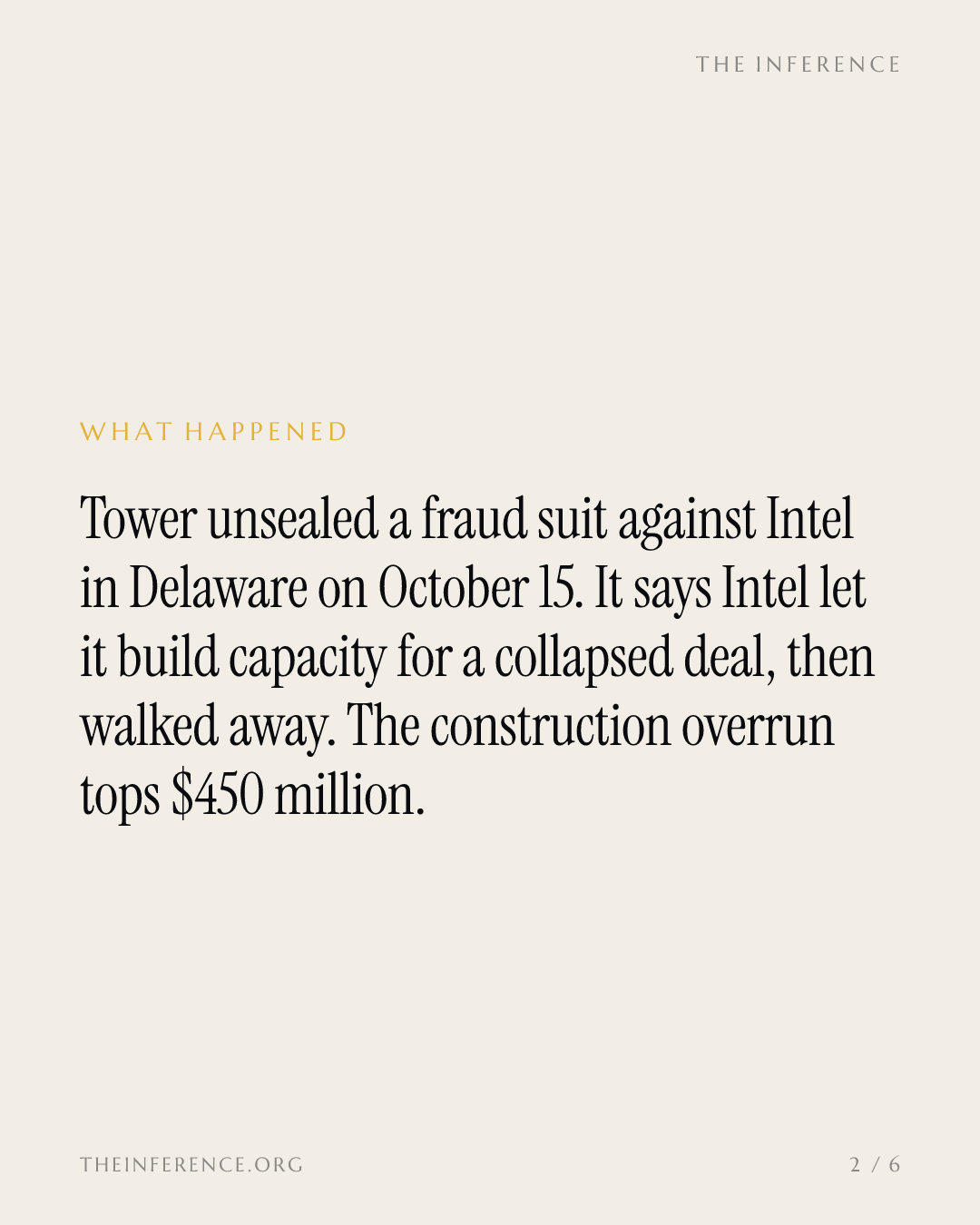
Tower Semiconductor+2.50% — Tower Semiconductor, up 2.50 percent today unsealed a fraud suit against Intel in Delaware's Chancery Court on October 15, alleging that after their $5.4 billion merger collapsed, Intel+1.27% — Intel, up 1.27 percent today signed a manufacturing services agreement, let Tower build capacity to serve it, then walked away without justification 1. The filing puts more than $450 million in increased construction costs on the public record, with the total damages request blacked out 1.
The claim is unproven until a judge says otherwise. But it names the wound in a company the market has been repricing all autumn: a stock 41.9% below its June high of $319.94, at roughly 134 times forward earnings, that fell 7.1% on October 20 while the Philadelphia Semiconductor Index rose 1.6% 4.
The suit prices the capacity Intel left behind
Tower, the Israeli specialty foundry led by Russell Ellwanger, says the repudiated deal caused it hundreds of millions in harm, the construction overrun alone topping $450 million 1. Law360's Chancery roundup corroborates the filing is live 6. The redacted total matters for sizing: Bloomberg Law is so far the only outlet carrying the numbers, so the market has not yet priced the claim at all.
The optics ramp is the bull case, and it is real money
The revenue engine is silicon photonics, the chips that move AI data between processors as light. Its annualized run rate went from $180 million a year ago to $680 million in Q2 2026, with management targeting more than $1 billion by Q4 3.
On the August call, Ellwanger cited customer contracts of about $1.3 billion in silicon photonics revenue for 2027, backed by $290 million of customer prepayments, and raised the 2028 model to $3.6 billion in revenue and $1.2 billion in net profit 5. Japan has pledged $1 billion in grants toward a $3 billion expansion of the same photonics and SiGe lines 2. Customers and a government are both paying for this capacity in advance.
Tower's silicon photonics run rate has nearly quadrupled in a year
- SiPho run rate
- Estimate
Data
| SiPho run rate | |
|---|---|
| Q2 2025 | $180M |
| Q2 2026 | $680M |
| Q4 2026 target (estimate) | $1,000M |
The counterpoint: a guide this good cannot miss
The short case answers with arithmetic. Q3 is guided to a record $520 million, plus or minus 5%, with the Q4 outlook attached to the November 2 report 45. Guidance that aggressive at a triple-digit forward multiple leaves no room for error, and pre-earnings selling is already visible in the tape 4.
Revenue has accelerated through 2026, and the $520 million guide is the test
- Revenue
- Estimate
Data
| Revenue | |
|---|---|
| Q3 '24 | $370.51M |
| Q4 '24 | $387.19M |
| Q1 '25 | $358.17M |
| Q2 '25 | $372.06M |
| Q3 '25 | $395.67M |
| Q4 '25 | $440.21M |
| Q1 '26 | $413.63M |
| Q2 '26 | $460.08M |
| Q3 '26E (estimate) | $520M |
The verdict arrives twice: damages from Delaware on a claim Tower must still prove, and the November 2 print, when the $520 million midpoint and the Q4 guide either fund the $3.6 billion 2028 model or crack it 145.
The daily newsletter