Workday cuts 500 staff, mostly product, and holds every profit guide except GAAP
The 29 September 8-K reiterates all fiscal 2027 guidance except GAAP operating margin, which absorbs $65m to $80m of charges from the company's second restructuring of the year, cut mostly from the teams building its AI.
 Richard Tang · 3 min read
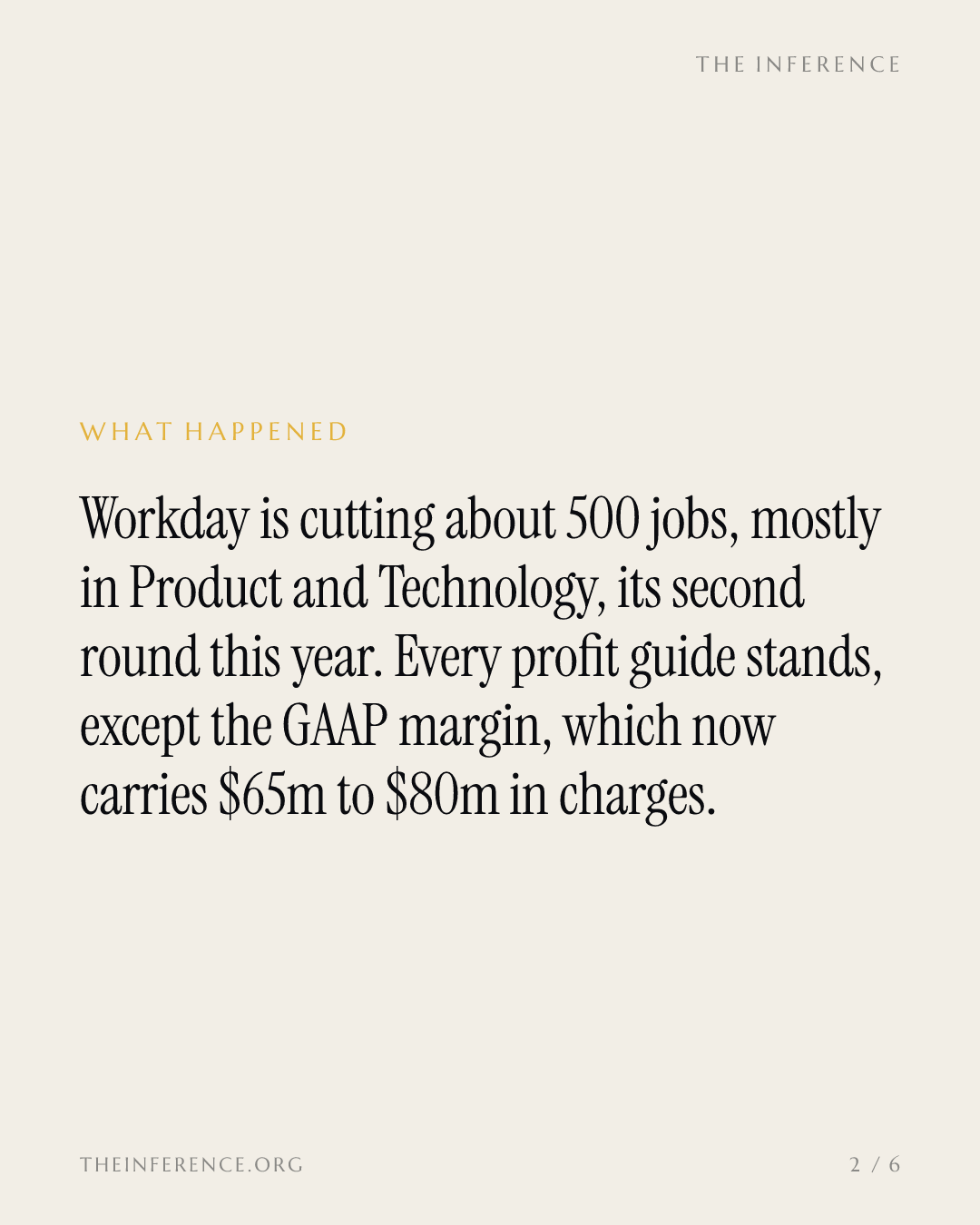
Workday (NASDAQ: WDAY) filed an 8-K on 29 September 2026 cutting about 2.5% of its workforce, roughly 500 people, primarily in Product and Technology, its second reorganization of the year 12. About $40m to $55m of the $65m to $80m in charges is cash severance for the people going; the rest is non-cash, stock compensation and leased-office impairments 1. In February about 400 roles went, and a week later chief executive Carl Eschenbach left, with co-founder Aneel Bhusri returning to the job 2. The company says it is still hiring in key strategic areas through fiscal 2027 1.
The filing moves only the ledger that absorbs the cost
Every guide from the 27 August earnings call stands except GAAP operating margin. Workday reiterated its 30.0% non-GAAP margin guide for the fiscal third quarter and 31.0% for the full year, and now guides GAAP margin about 20 to 21 points under the first and 19 points under the second, because the filing excludes restructuring charges from non-GAAP measures 13. The gap is not new: in the quarter just reported, stock compensation alone accounted for most of the distance between the two ledgers 3. A frame in which only the accounting number moves tells investors which ledger management wants priced.
GAAP margin hit its best level of the last ten quarters just before the cuts
Data
| GAAP operating margin | |
|---|---|
| Q1 '24 | 3.2% |
| Q2 '24 | 5.3% |
| Q3 '24 | 7.6% |
| Q4 '24 | 3.4% |
| Q1 '25 | 1.7% |
| Q2 '25 | 10.6% |
| Q3 '25 | 10.6% |
| Q4 '25 | 6.9% |
| Q1 '26 | 13.3% |
| Q2 '26 | 11.8% |
Guided GAAP margin sits about 20 points under the non-GAAP guide Workday holds
- GAAP operating margin
- Estimate
Data
| GAAP operating margin | |
|---|---|
| Q1 FY27 | 13.3% |
| Q2 FY27 | 11.8% |
| Q3 FY27 guide (estimate) | 9.5% (9–10%) |
| FY27 guide (estimate) | 12% |
Bhusri's denial meets its first cost line
On the August call Bhusri said he had "not met a single customer looking to replace Workday with an internally built product or a startup offering," and the company cited no AI motive in either round of cuts 2. The same quarter's release credits AI with more than a quarter of new annual contract value and more than 5,500 customers using at least one Workday agent 3. Two rounds of cuts inside the team building that product do not prove the build-it-yourself threat real; they show where management will spend cash to reshape first. Shares are down about 12% year to date amid broader investor pressure on enterprise software stocks over concerns about AI-driven competition 2; if that fear is right, the beneficiaries sit outside Workday, with the vendors of the agent tooling its customers would use to build software rather than buy it.
The court is asked to bill the vendor for its AI
In September, job seekers asked a federal judge in San Francisco to certify a discrimination case against Workday itself as a class action, four subclasses covering Black, female, older and disabled applicants screened by its hiring tools; the court hears the motion on 9 March 2027 5. Workday denies wrongdoing and says its tools look only at job qualifications, not protected traits 5. If the vendor, not its customers, ends up paying for what the AI does, the bill lands on the GAAP line the filing just moved.
Watch the number the filing moved
The 8-K and the docket point one way: the transition to agentic AI gets paid for somewhere, and management has shown which ledger it wants the bill to bypass. If Bhusri is right, the charge is the price of tuning the machine. If the fear is right, it is the sound of a moat rebuilt with fewer hands. Two dates carry the answer: the fiscal third-quarter print, where the 20-to-21-point gap lands, and 9 March 2027, when the court takes up whether the job seekers become a class. Price the ledger the filing moved.
Deepdive
AI-generated from this story and its cited sources. Not investment advice.