Salesforce Opens the Door to Claude. Who Keeps the Software Budget?
OpenAI and Anthropic can help Salesforce, ServiceNow and Palantir sell more automation while competing for the same customers. The durable advantage is control over work that customers will keep paying to complete.
 Vincent JiangSeptember 16, 2026 · 5 min read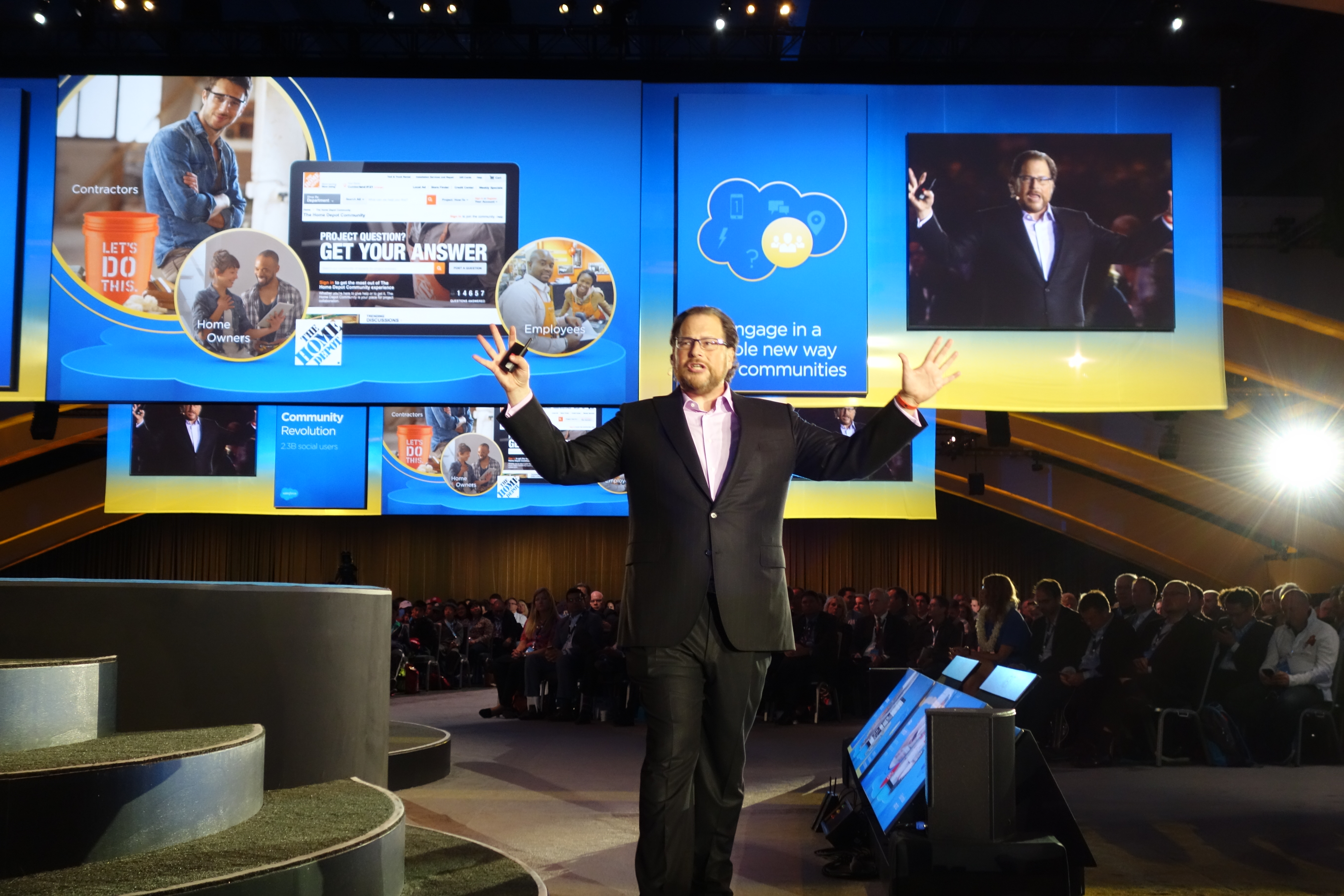
Marc Benioff spent Tuesday explaining how customers could use his company's software from somebody else's AI assistant. At Dreamforce, Salesforce introduced AIforce, which makes its data, workflows and business rules accessible through outside interfaces, including the Salesforce in Claude beta 1,17.
The stakes are a business that reported $11.35 billion in quarterly revenue on August 26. Salesforce (CRM) wants an employee starting work in Claude to remain a paying Salesforce customer underneath 2.
That is a sensible defense. It also exposes the central problem facing enterprise software: customers can keep the database while changing which company they depend on to get work done. Partnerships with model providers preserve access to better AI. They do not automatically preserve the incumbent's share of the software budget.
The partners also want the work
An AI assistant that drafts a customer email needs information. An assistant that changes a contract needs authority: the correct account, approved terms, permissions and a record of what happened. Salesforce's pitch is that those controls remain in its platform even when the request begins elsewhere 1,3.
But OpenAI and Anthropic are pursuing that operational layer themselves. In February, OpenAI paired its engineers with Accenture, Capgemini, McKinsey and BCG to help companies move agents into core business processes. The competition reaches implementation and customer relationships, beyond access to a model 4.
Anthropic moved further into finance in May with ten agents for work including credit memos and financial-statement audits. Those products can be adapted to a firm's policies. They demonstrate an ambition to sell completed professional work, although an announcement does not establish reliable performance at scale 5.
The strategic inference is uncomfortable: today's model supplier can become tomorrow's application vendor without terminating the partnership.
Three businesses, three defenses
Salesforce's defense is its customer data and the business rules attached to it. Its August agreement with Anthropic combines product integration with reciprocal adoption, including Anthropic choosing Salesforce as its preferred CRM. That creates a distribution opportunity, but the announcement does not disclose a revenue-sharing formula that establishes who captures the incremental spending 6.
ServiceNow (NOW) has a more explicit answer to the charging question. It announced expanded relationships with both OpenAI and Anthropic in January. Its Action Fabric strategy allows outside agents to execute work through ServiceNow. Calls through its agent connector consume Assist units, although usage already included in a customer's contract does not immediately produce additional revenue 7,8,9,16.
The implication is that ServiceNow can earn money even when an employee starts in another vendor's assistant. Its defense depends on the approval, fulfillment or other paid action continuing to run through ServiceNow. If customers move that execution elsewhere, connecting to more assistants provides less protection.
Palantir (PLTR) sells a different kind of dependency. Its Artificial Intelligence Platform, AIP, connects models to an operational representation of a business: data, logic, actions and security. Its documentation supports multiple model families, including OpenAI and Anthropic. The intended asset is the machinery that turns a model's answer into a controlled business action 10.
That can be expensive to replace because the customer must recreate how decisions connect to operations. Yet this advantage is conditional. OpenAI's deployment engineers and consulting partners are competing to build those connections too. Palantir has to make deployment and ongoing operations sufficiently valuable that customers keep buying the platform 4,10.
The earnings reject a single software story
The latest reported quarters show three growing businesses at very different speeds: Salesforce's total revenue rose 11%, ServiceNow's 24% and Palantir's 93% from a year earlier. These company-reported figures are corroborated by independent earnings coverage 2,11,12,13,14,15.
The chart defeats a blanket claim that enterprise software is already collapsing. It cannot identify which partnership creates lasting pricing power. Palantir's figure includes government revenue; Salesforce's includes an acquired business. Different starting sizes and customer mixes also matter.
The AI-specific numbers require more care. Salesforce expanded its Agentforce annual recurring revenue definition this quarter to include additional AI offerings, Slackbot and Headless 360. Comparing that measure with ServiceNow's AI annual contract value would mix different definitions and mistake sales metrics for recognized revenue 11,12.
Keeping the database is not the same as keeping the customer's budget.
More automation can weaken pricing power
The strongest case for incumbents is practical. Their customers have already configured permissions, approvals and operating processes. Better models make those investments more useful. An employee who previously needed a specialist to navigate the software might now initiate valuable work through a familiar assistant.
This could expand the market: more people requesting more actions, with the existing platform collecting usage revenue. The expensive work of cleaning data and establishing governance still has to happen, a limitation highlighted by analysts examining Salesforce's launch 3.
The problem is how the gains are divided. If automation reduces the number of employees needing paid seats, new usage revenue must compensate. If the AI provider owns the daily customer interaction, it can influence which applications get invoked. An incumbent may process more work while losing negotiating power at renewal. These are economic risks, not outcomes established by this quarter's results.
Costs create another constraint. ServiceNow said its 2026 subscription gross-margin outlook reflected increased hyperscaler usage and faster AI adoption. More AI activity can increase both sales and the bill for delivering them 12.
The useful measure is therefore gross profit from reliably completed workflows after model and delivery costs. Agent counts and demonstrations cannot establish that profitability.
Watch the contract after the demo
The likely dividing line is between software that remains necessary to execute a business process and software whose contribution an assistant can reproduce. Salesforce, ServiceNow and Palantir each have a credible claim to the former. Their partnerships strengthen distribution while testing how much of the customer relationship they can surrender without surrendering economics.
The next results and renewals should answer three questions. Does outside-agent activity generate incremental paid usage? Does that revenue offset any pressure on human-user subscriptions? Do customers and vendors retain enough savings after model costs, integration and exception handling?
For Benioff, opening Salesforce to Claude is a bet that customers will pay for the business controls behind the conversation. The next useful evidence is whether those customers expand their contracts once the work moves into Claude.
How this brief was made
01Gathered & sourced344 channels · 1,478 articles▾
Agents swept 344 channels and ingested 1,478 articles, then de-duplicated and ranked them for signal.
02Verified & cross-validated17 claims · 12 data feeds▾
Every one of 17 load-bearing claims was checked against primary sources, with 12 live data feeds reconciling the figures and charts.
- 1CIO, "Salesforce seeks to rewrite enterprise software with AIforce", 15 September 2026
- 2Reuters, "Salesforce raises annual forecasts, expands AI partnership with Anthropic", 26 August 2026
- 3CIO Dive, "Salesforce launches AIforce as interface layer in agentic architecture", 15 September 2026
- 4Reuters, "OpenAI deepens partnerships with consulting giants to push enterprise AI beyond pilot", 23 February 2026
- 5Reuters, "Anthropic deepens finance push with 10 new AI agents for banks, insurers", 5 May 2026
- 6Salesforce investor relations, "Salesforce and Anthropic announce Claudeforce", 26 August 2026
- 7ServiceNow investor relations, "ServiceNow and OpenAI collaborate to deepen and accelerate enterprise AI outcomes", 20 January 2026
- 8ServiceNow investor relations, "ServiceNow and Anthropic partner to help customers build AI-powered applications", 28 January 2026
- 9ServiceNow, Financial Analyst Day presentation, page 28, 4 May 2026
- 10Palantir, AIP architecture overview documentation, accessed 16 September 2026
- 11Salesforce, second-quarter fiscal 2027 results, Exhibit 99.1, 26 August 2026
- 12ServiceNow, second-quarter 2026 financial results, 22 July 2026
- 13Constellation Research, "ServiceNow delivers solid Q2, touts AI Control Tower strength", 22 July 2026
- 14Palantir, second-quarter 2026 Form 10-Q, filed 4 August 2026
- 15Reuters, "Palantir raises annual revenue forecast on demand from government and commercial customers", 3 August 2026
- 16ServiceNow, Now Assist Overview, pages 3 and 11, effective 24 August 2026
- 17Anthropic, Claude release notes, 15 September 2026 entry
03Reviewed & edited1 human editor▾
One editor read the draft against the evidence, tuned the framing, and signed off before it shipped.
Confidential tips
Know something about this story? We protect our sources. Reach the editor directly, or read our guide to sharing securely.
Deepdive
AI-generated from this story and its cited sources. Not investment advice.