A class action tests whether AppLovin's AI improved itself on the schedule it sold
A securities suit in San Francisco federal court alleges AppLovin overstated how consistently its ad models improve and hid delays in the AI video tool built to feed them. The first hard test lands on November 4, 2026, AppLovin's first report since the class period closed and two weeks before the lead-plaintiff deadline.
 Richard Tang · 3 min read
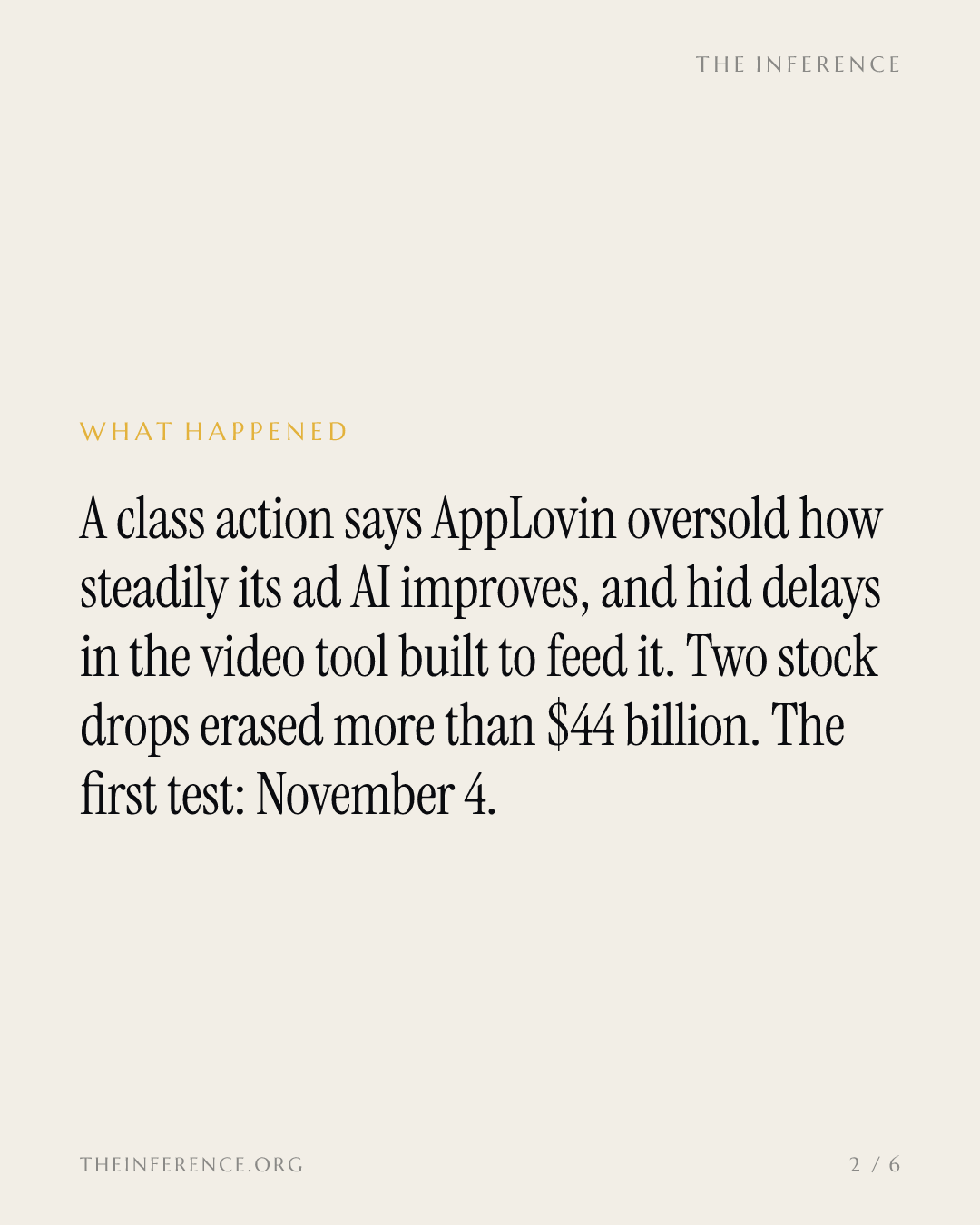
The class action filed against AppLovin+0.49% — AppLovin, up 0.49 percent today this month does not ask whether its AI works. It asks whether the AI improved on the schedule the shares were priced on. In *Talbot v. AppLovin*, No. 26-cv-10584, in the Northern District of California, buyers between February 12 and August 5, 2026, allege the ad-technology company overstated how consistently its AI models improve, oversold the "virtuous cycle" that improvement was meant to compound, and hid delays in the generative AI video tool built to feed them 123.
The pitch was a schedule of improvement
AppLovin's software decides which ads appear inside mobile-phone games and, more and more, for online shops 4. Its AXON models pair the ad with the user, and the outcome of each placement trains the next decision 5. The resulting gain in advertisers' return on spend, what the industry calls uplift, is what pulls budget in 5.
When the stock slid in February, management called it "a real disconnect between market sentiment and the reality of our business," and the class period opened that morning 1. On May 6, chief executive Adam Foroughi called a recent model update "quite substantial," with April "bigger than any quarter that we had" 5.
The bottleneck moved from the model to the ads themselves
The loop has two feeds, and only one is automatic. Outcomes collect themselves; the creative the model places had to scale beyond human hands, which is what the generative video tool was for. Management has called creative "the biggest hurdle" for e-commerce 4, and on August 5 the tool was "still [a] work in progress" 1.
The stall went public across two days
On July 13 a Bank of America note called the June 22 opening of AppLovin Ads to all advertisers a "muted GA start"; the stock fell 12.6% 2. On August 5, revenue of $1.92 billion missed the $1.94 billion consensus, and management said its "pace of meaningful model improvement was lighter than normal during the quarter" 12. The shares fell a further 19.66% the next day 12. Between the two drops the company lost more than $44 billion of market value 5. Growth is still running above 50% a year, and it has slowed every quarter since mid-2025 6.
Still growing more than 50% a year, and slowing every quarter since mid-2025
Data
| Revenue growth, % year over year | |
|---|---|
| Q2 2025 | 77 |
| Q3 2025 | 68.2 |
| Q4 2025 | 65.9 |
| Q1 2026 | 59 |
| Q2 2026 | 52.8 |
Advertisers stayed; the story did not
Jefferies' October advertiser survey expects AppLovin's share of e-commerce advertising budgets to reach 8.1% this quarter 7. Respondents also expect to give it 8.3% of budgets in 2027, up from 7.8% this year, the largest expected gain of any platform polled 7. The same survey found generative AI used for video creative by only 37% of advertisers, down from half 7. Jefferies still cut its 2027 e-commerce revenue forecast to $1.7 billion from $2.8 billion 7.
Citi reads the same adoption data as acceleration, with United States store growth quickening to 2.7% a week, and kept a $600 target on October 12 8. Bank of America, whose July note the suit counts as its first corrective disclosure, cut its target to $325 on October 9 129.
One dataset, targets from $325 to $600 around a $271 stock
Data
| Value | |
|---|---|
| Close, 12 Oct 2026 | $270.87 |
| BofA | $325 |
| Jefferies | $375 |
| Mean of 33 analysts | $485.4 |
| Evercore | $510 |
| Citi | $600 |
The next hard fact arrives on November 4
The complaint identifies more than $109.1 million of insider share-sale proceeds during the class period 1. The question underneath is timing: when during the spring did management know the uplift had thinned? No public figure measures model uplift, so the answer has to come from reported results. The next set arrives on November 4, guided to just over $2 billion of revenue 10, with the November 16 deadline to seek lead-plaintiff status two weeks behind it 2.
Management says the next step up in model performance "landed just after quarter end," and the business is "back on the trajectory we expect" 4. If the step-up is real, that report is where it shows. Advertisers' budgets already show the capability is real 7; the improvement schedule is the part only reported numbers can settle.
Deepdive
AI-generated from this story and its cited sources. Not investment advice.