a16z priced TypeSafe at $7.5 billion; Workday put the four-week-old model on every user's home screen
Workday has made Sana, the assistant it bought for $1.1 billion, the default home screen of its HR, finance and IT software, with TypeSafe's four-week-old Jev model choosing which parts of each screen appear. Days earlier the venture firm Andreessen Horowitz (a16z) valued TypeSafe at $7.5 billion, the same week Microsoft shipped a rival decision model at the identical price.
 Richard Tang · 4 min read
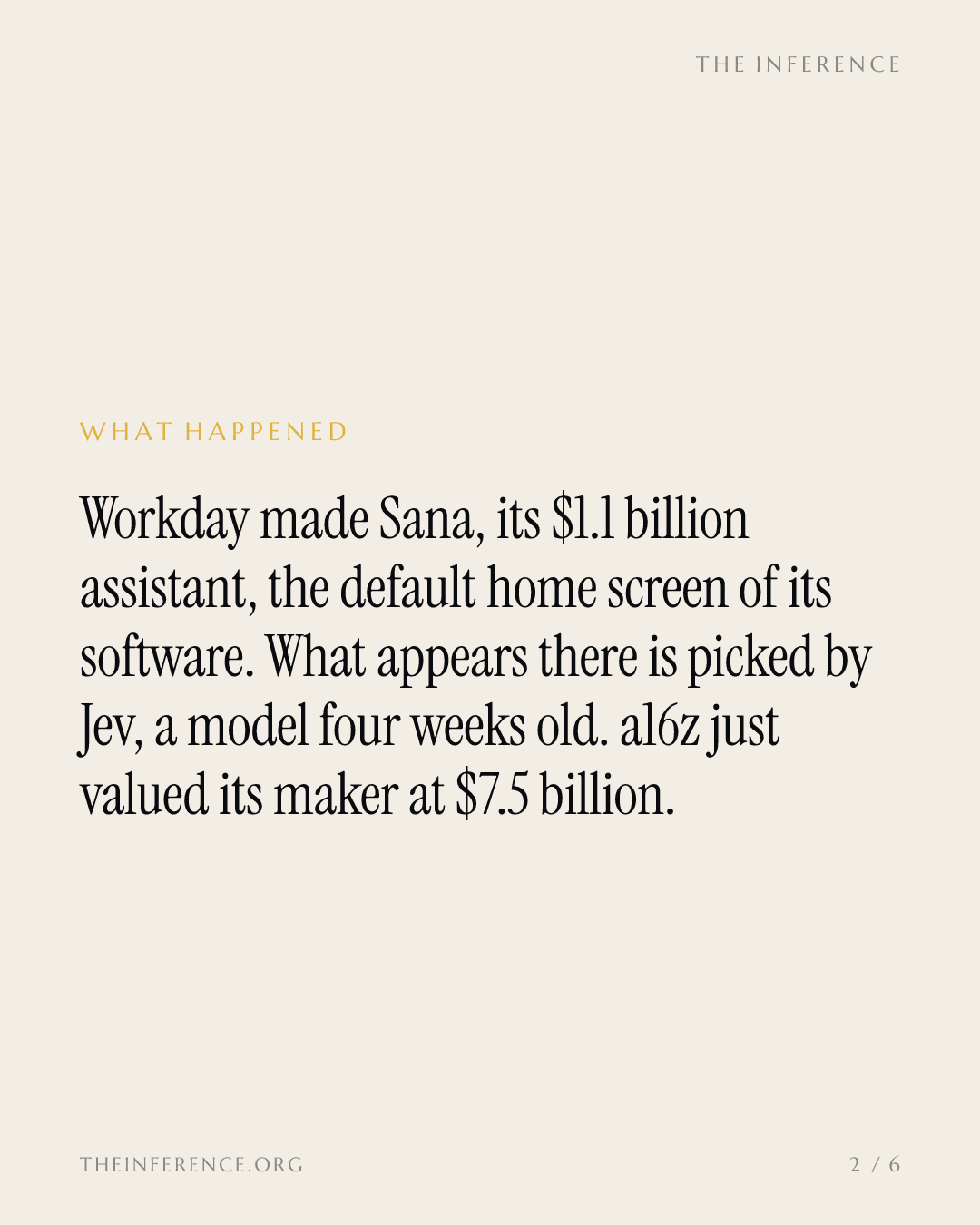
Workday+1.51% — Workday, up 1.51 percent today made a four-week-old model the picker behind its default home screen on October 13, and the question worth money is who holds the risk in that 12. Sana, the assistant Workday bought for $1.1 billion last year, is now the first screen of its HR, finance and IT software, and the piece deciding which card, form or calendar appears as you type is Jev, from the startup TypeSafe 12.
Days earlier, Andreessen Horowitz (a16z) had led an $870 million round valuing TypeSafe at $7.5 billion 3. The deployment is the best evidence yet for this class of model; the valuation needs separating from it.
Picking beats generating when the options are fixed
Jev does not write. An application sends it context and typed questions, and it returns probabilities over a fixed list of up to 255 options 1. On Banking77, a public intent-classification test, it answered in a median 175 milliseconds at 81 percent accuracy; Claude Opus 5 scored 84.4 percent but needed 2.3 seconds and cost about 22 times as much 1.
Workday handed Jev every atomic component in its design system, hard-coded none of the selection logic, and in the launch demo a paycheck card appeared before the question was fully typed 1. An outside developer cut a generative dashboard's median render time from 29 seconds to under four the same way, sending only the uncertain cases to a language model 1.
The valuation rests on adoption claims that disagree
Jev launched on September 15 with a $40 million seed led by the venture firm DCVC 4. Twenty-four days later came the Series A, with Sequoia participating and Wilson Sonsini as deal counsel confirming the terms 356.
TypeSafe was founded in 2024 by Diogo Almeida, Erik Gafni and Sasha Sheng; Almeida, now chief executive, worked on ChatGPT and GPT-4 at OpenAI$1.18T — OpenAI, private, latest valuation $1.18T 4. The rest of the round prices adoption numbers that do not agree: the company says a third of the Fortune 500 already use Jev, a16z's own announcement says a quarter, and the only published case study is Jack & Jill, a recruiting marketplace 1. No Fortune 500 customer is named in TypeSafe's materials or the round's coverage 13.
The same day, at the same price
OpenAI, Amazon−1.92% — Amazon, down 1.92 percent today, Cloudflare−7.05% — Cloudflare, down 7.05 percent today and Perplexity$20B — Perplexity, private, latest valuation $20B had already shipped decision models when Microsoft−1.98% — Microsoft, down 1.98 percent today followed on October 9 with Decision-1, built from Alibaba's−0.11% — Alibaba, down 0.11 percent today Qwen3.5-9B, an open-weights base that anyone can download 17. Jev charges $0.042 per million input tokens with output free, and runs only on TypeSafe's hosted API 18. Microsoft lists the identical figure; OpenAI's decisions endpoint charges $0.10 7.
Microsoft matched Jev's $0.042 price the day the round was announced; OpenAI charges 2.4 times as much
Data
| Value | |
|---|---|
| Jev (TypeSafe) | $0.04 |
| Microsoft Decision-1 | $0.04 |
| OpenAI decisions endpoint | $0.1 |
The round paid for a lead Microsoft had matched on price the day it was announced.
The dependency lands on Workday
TypeSafe now sits on Workday's subprocessor list, the register of outside companies permitted to process customer data, and the entry covers every product line, not only Sana, for intent classification and confidence scoring 1. Jev's own documentation says it does not count reliably, reads dates as text rather than ordered quantities, leans toward whichever option is listed first, and does not treat injected content as hostile by default 9.
None of that dooms the deployment, because Workday's engineers did the work that makes the capability usable: enumerating the design system, tuning data preloading, keeping the arithmetic in code 129. Workday's latest quarter brought in about $2.6 billion, roughly a $10.6 billion annual pace, and that pace is now fronted by a model four weeks old 10.
The business now fronted by a four-week-old model
Data
| Revenue | |
|---|---|
| Q3 '24 | $2.16B |
| Q4 '24 | $2.21B |
| Q1 '25 | $2.24B |
| Q2 '25 | $2.35B |
| Q3 '25 | $2.43B |
| Q4 '25 | $2.53B |
| Q1 '26 | $2.54B |
| Q2 '26 | $2.65B |
The same portability caps TypeSafe's pricing power
Because no selection logic is hard-coded, Workday can swap the picker, which bounds its risk and caps TypeSafe's pricing power in the same move. The pattern is the part worth learning today: a fast picker for closed questions, a language model only as the fallback.
The stake to watch is Workday's, and two things decide it
Workday trades as WDAY, and its exposure mirrors TypeSafe's opportunity: the portability that protects Workday caps what TypeSafe can charge. Two things decide it. One is whether Decision-1 or OpenAI's model matches Jev's 81 percent on Banking77 at the same $0.042 178. The other is what Workday's next quarterly filing shows for subscription growth, now that Sana is the default way in 10.
The screens were built at Workday; the $7.5 billion went to the model maker; the dependency sits on WDAY.
Deepdive
AI-generated from this story and its cited sources. Not investment advice.